

Uzbekistan's total external debt grew by 16.5% over the year — to $84.1 billion
Uzbekistan's total external debt reached $84.1 billion as of July 1 — nearly $12 billion, or 16.5%, more than a year earlier. Public debt rose to $41.7 billion, while corporate debt increased to $42.4 billion. However, GDP growth and the strengthening of the sum contributed to a decrease in the debt-to-GDP ratio.
Uzbekistan's total external debt increased by 16.5% over the year, reaching $84.1 billion
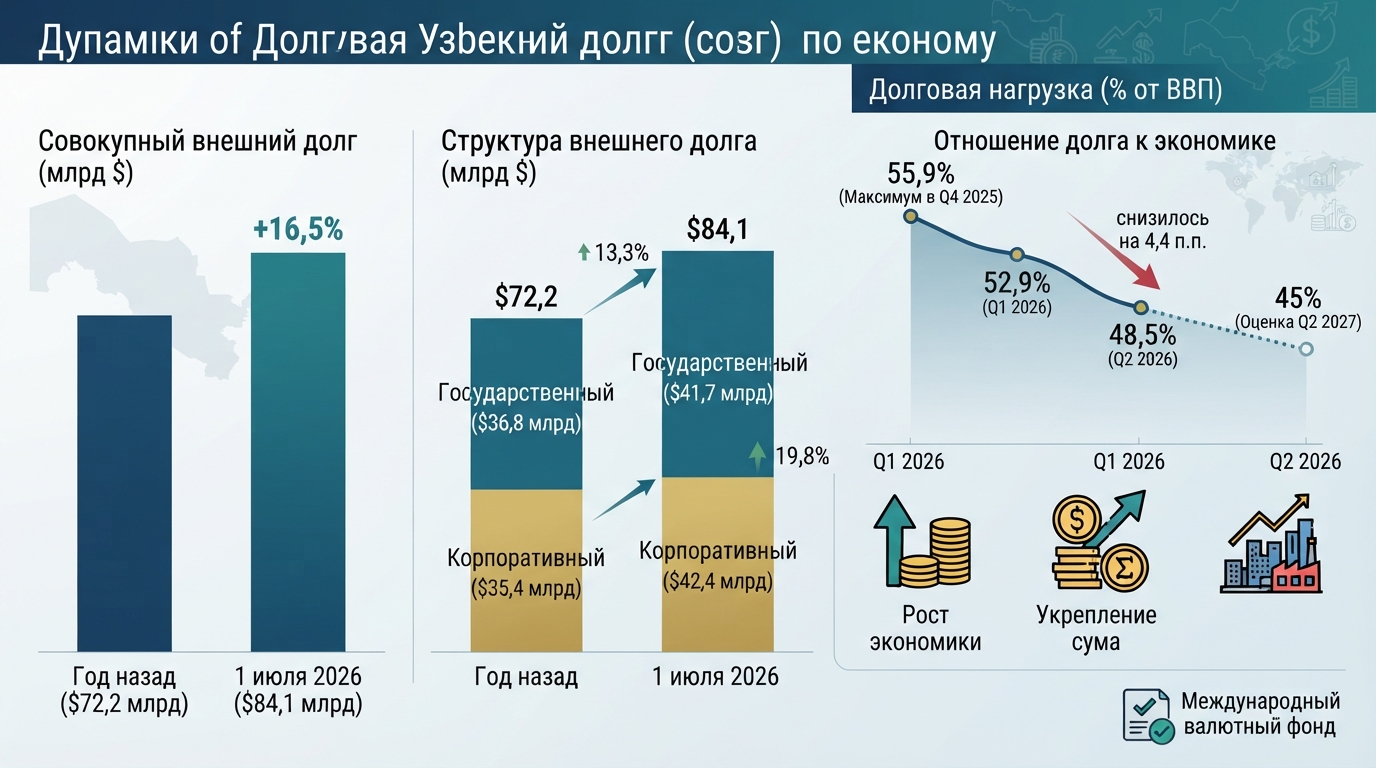
As of July 1, 2026, Uzbekistan's total external debt amounted to 84.1 billion dollars, which is 11.9 billion dollars, or 16.5%, more than a year earlier, according to a review by the Central Bank. A year ago, this figure stood at 72.2 billion dollars.
The main contribution to the growth occurred in the second half of 2025. Since the beginning of this year, the external debt has added about 1.9 billion dollars, or 2.3%, increasing from 82.2 billion dollars as of January 1.
State external debt over the year grew from 36.8 billion to 41.7 billion dollars, which is a 13.3% increase. Corporate external debt rose from 35.4 billion to 42.4 billion dollars, or by 19.8%. Since the beginning of the year, the growth amounted to approximately 1.2 billion and 700 million dollars, respectively.
The Central Bank explains that corporate external debt includes borrowings of the private sector, including enterprises and banks, raised without a state guarantee. The state bears no obligations for them, and payments are made from the borrowers' own funds.
When calculating the state external debt, accrued but not yet paid interest is taken into account, and the value of sovereign international bonds is recalculated at the market price on the reporting date.
Economist Mirkomil Kholboyev points out that the growth of debt in nominal terms is accompanied by a decrease in its share relative to the size of the economy.
According to his calculations, at the end of the second quarter, the ratio of total external debt to the economy was 48.5%, down by 4.4 percentage points compared to the first quarter.
The indicator reached its peak in the fourth quarter of 2025 at 55.9%. Since then, it has been declining for the second consecutive quarter, decreasing by a total of 7.4 percentage points by the end of June.
Kholboyev attributes this dynamic to the fact that the economy in dollar terms is growing faster than the external debt. At the end of the first half of the year, real economic growth accelerated to 8.5% compared to 7.2% a year earlier.
An additional factor was the strengthening of the soum. According to the economist's calculations, the average exchange rate used to convert the economy into dollars in the second quarter of 2026 was about 5% stronger than a year earlier. This, in turn, increases the dollar valuation of the size of the economy.
For the calculation, Kholboyev used the volume of the economy over the last four quarters and the average exchange rate for the corresponding period.
According to his estimate, if the current rates of economic growth and borrowing continue, and the average exchange rate does not change significantly, by the end of the second quarter of 2027, the ratio of total external debt to the economy could decrease to about 45%.
"Despite the fairly rapid growth of nominal debt, the country's income is currently growing faster than the debt. As a result, the debt burden is decreasing," the economist noted.
In its review, the Central Bank also cites an assessment by the International Monetary Fund, according to which Uzbekistan's debt burden remains low, and a significant portion of the external debt has been raised on concessional terms.