

How child abuse damages the economy
**How Violence Against Children Hits the Economy**
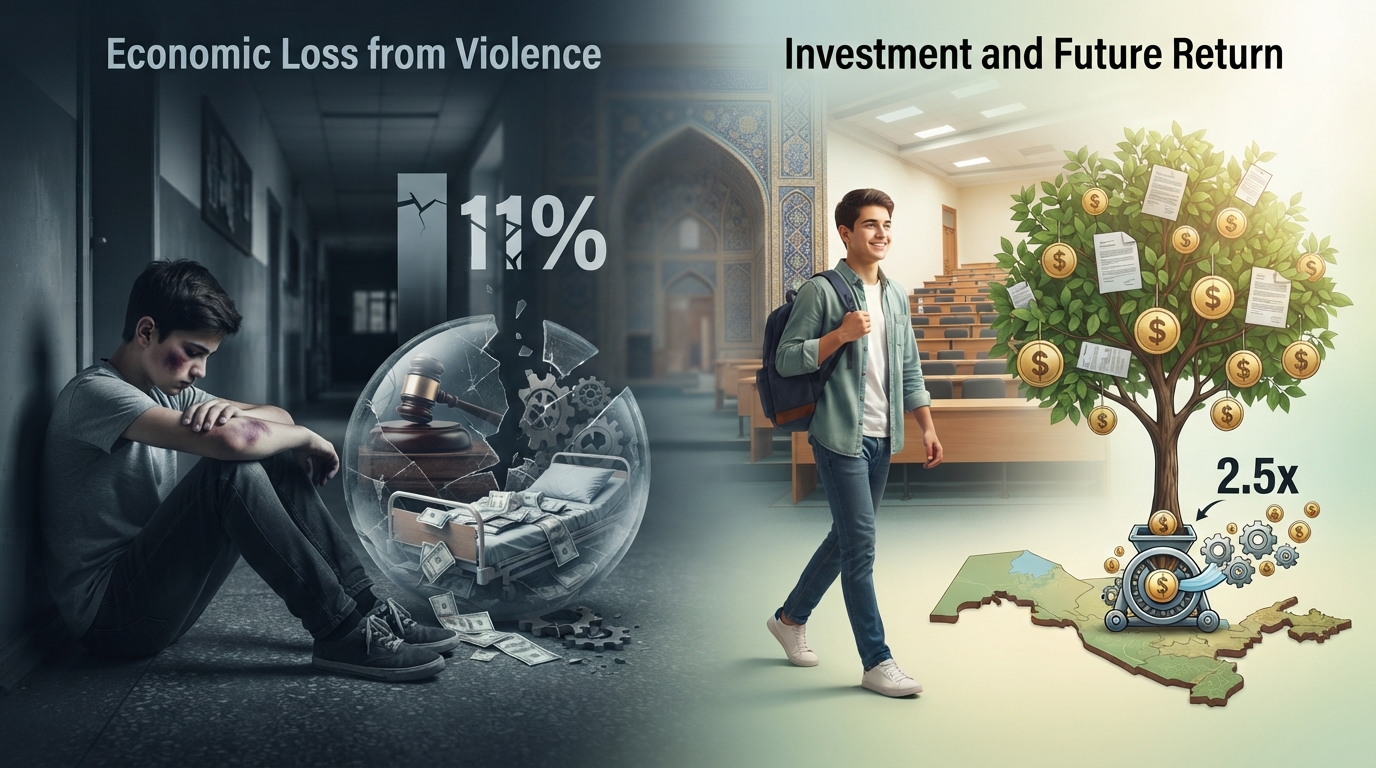
Violence against children can cost individual countries' economies an amount comparable to 11% of GDP, and its consequences affect the health, education, and income of victims for many years to come. At the same time, spending on support for children and families can generate long-term economic returns. A Podrobno.uz correspondent learned how to assess the scale of these losses and the effectiveness of investments in children's well-being on the sidelines of the World Summit on Child Well-being held in Samarkand.
### What Makes Up the Economic Losses from Violence
The scale of the economic consequences of violence against children can be assessed through several parameters. According to the report by the UN Secretary-General’s Special Representative on Violence against Children, *Building the Investment Case for Ending Violence Against Children*, published in January 2025, total direct and indirect losses in individual countries can reach up to 11% of GDP.
In a number of states, the annual cost of the consequences of violence exceeds public spending on healthcare — in some cases sixfold.
At the World Summit on Child Well-being, Tamara Tutnjevic, Global Director of Public Policy and External Engagement at World Vision International, cited a different estimate: economic losses from violence against children can amount to 7% of GDP.
The difference between these figures is linked, among other things, to calculation methodologies and which specific consequences researchers take into account. Economic damage is not limited solely to the cost of treating children affected by physical or psychological violence. Calculations may include the costs of social services and the justice system, expenses for subsequent assistance to victims, losses due to absenteeism and lower educational attainment, as well as a reduction in a person's future earnings. In the long term, the consequences of violence can impact health and labor productivity well into adulthood.
However, there is no universal figure applicable to all countries. The final estimate depends on which types of violence are considered, how fully the scale of the problem is known, and which consequences researchers translate into monetary terms. Some calculations primarily take into account lost income and health outcomes, while others include public system costs and a broader range of indirect losses. A lack of data on instances of violence can also lead to an underestimation of the damage.
Therefore, a figure expressed as a percentage of GDP does not mean that a state literally pays out such an amount in a year. Nor does it allow for a direct calculation of the savings that a single specific violence prevention program would yield. This indicator shows the scale of cumulative losses and helps compare them with other government expenditures.
However, assessing damage is only one side of the coin. It is equally important to understand the impact of investments in children's well-being and to determine whether funds directed toward these goals genuinely change their lives.
### How to Measure the Return on Investment in Child Well-being
In the *State of Social Protection Report 2025*, World Bank Country Director for Central Asia Najy Benhassine provides an estimate according to which every dollar transferred to low-income families creates a multiplier effect of approximately $2.50 in the local economy.
This figure does not mean that the state receives $2.50 in revenue for every dollar spent. It refers to how payments stimulate economic activity: families spend money on food, medicine, transportation, and school supplies, supporting local merchants and service providers.
The magnitude of such an effect depends on the conditions of the specific economy and the structure of the social protection program. But the impact of payments on the local market is only one possible form of return on investment in children and families.
Supporting families can help children stay in school, receive necessary medical care, and maintain their usual diet during times of financial hardship. Access to childcare, benefits, and other forms of support can also facilitate the participation of parents, especially women, in paid work. In the long term, the quality of education and health affects a person's opportunities and future earnings.
At the same time, an increase in spending in itself does not guarantee that children will receive the necessary help. During a panel discussion, World Vision International representative Tamara Tutnjevic pointed to the gap between budget allocations and actual service delivery.
"If the money doesn't reach the children, then we are not where we should be," she said, speaking of the need to track what proportion of budget funds actually reaches the service delivery level.
According to her, in a study of 23 governments presented in the *Safeguarding Children* report, only two were able to state the amount they invest in children. This demonstrates why, when evaluating public spending, it is important to consider not only how much money is allocated for education, healthcare, or child protection, but also whether it reached specific beneficiaries, what services were provided, and whether the situation of children improved as a result.
To achieve this, the entire spending chain needs to be tracked — from budget approval to the operations of a specific service. For example, the volume of allocated funds alone does not show whether children gained access to needed assistance, were able to continue their education, or received timely support after experiencing violence. Drawing such conclusions requires data on the services provided and their outcomes, as well as an assessment of the extent to which changes are directly linked to the funded measures.
Such an evaluation is especially important in the context of tight budgets. It allows for the comparison of programs, the identification of those that truly work, and the adjustment of resource allocation. Among possible directions, the World Bank report highlights a more efficient use of existing resources and the improvement of social assistance delivery systems.
Thus, the economic consequences of violence against children are not limited to direct expenditure on assistance to victims, but can impact people's health, education, and income throughout their lives. Investments in violence prevention and family support, in turn, can reduce these losses and create conditions for children's development. To evaluate the effectiveness of such measures, it is not enough to consider only the amount of allocated funds: it is necessary to understand what services children received and how this affected their lives. This makes it possible to determine how effectively state resources are being used and which areas of support require additional investment.