

Hague court rules in favor of Pakistan on Indian waters
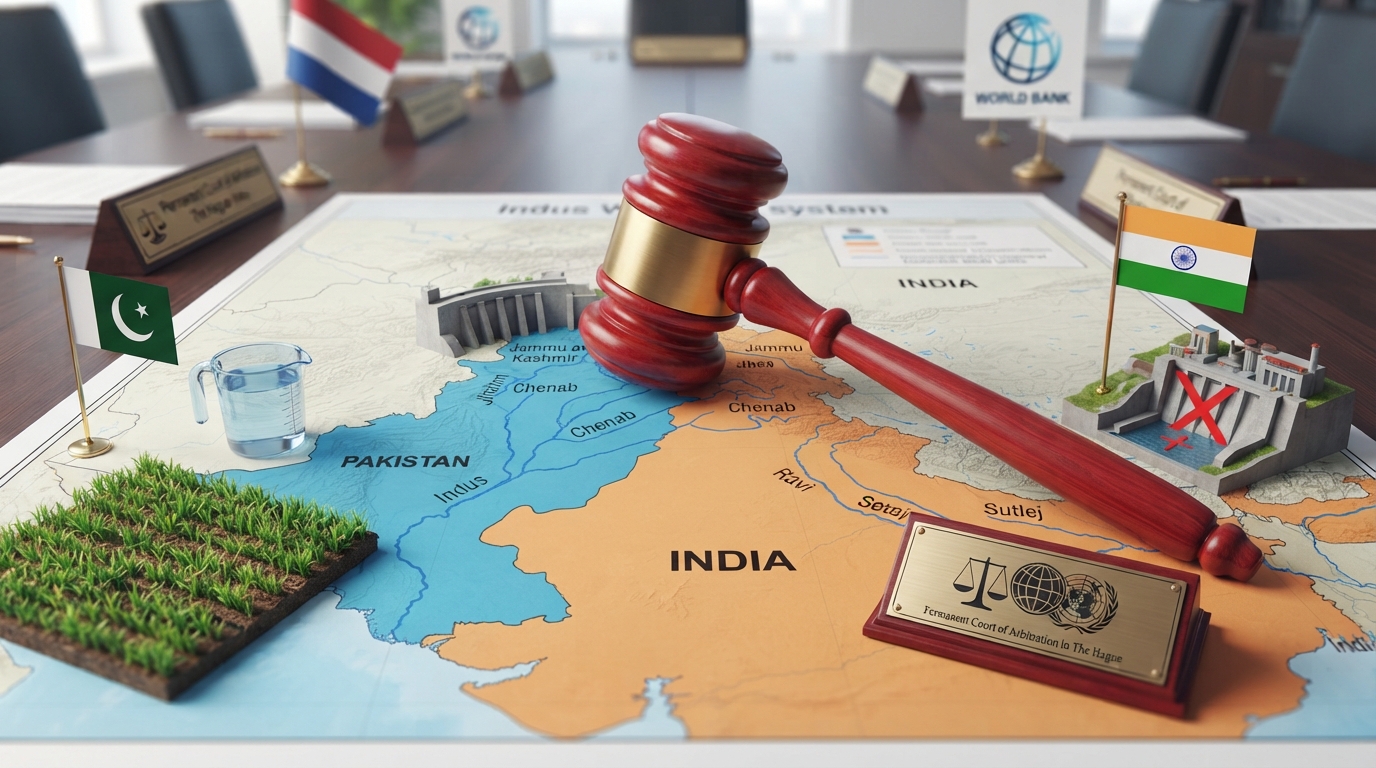
Hague court blocks India’s unilateral termination of Indus Waters Treaty
The Hague arbitration court has ruled that India does not have the right to unilaterally terminate the 1960 Indus Waters Treaty with Pakistan.
The ruling, issued on August 31, considered India’s decision to “suspend” the treaty in April 2025. The arbitral tribunal, having examined the grounds that India could have put forward for terminating or terminating the treaty, concluded that none of them justified such a decision.
Accordingly, the Indus Waters Treaty remains in full force and India must comply with its obligations, including those relating to hydropower projects on the western rivers. The ruling was unanimous.
The court also partially granted Pakistan’s request for the Ratle Dam. India has been banned from concreting the dam wall and some parts of the intake structure above the specified level. This restriction will be in effect for another 90 days after the final decision of a neutral expert appointed by the World Bank. The expert's opinion is expected to be issued around July 2027.
"India has been banned from concreting the dam wall and some parts of the intake structure above the specified level until the independent expert has issued a decision. In addition, India is obliged to inform about changes in the construction schedule of the facility," the statement said.
India must also provide information about changes in the construction schedule of the Ratle HPP. Two other interim measures requested by Pakistan were rejected by the court.
The Ratle HPP is being built on the Chenab River. Pakistan has been claiming that some technical solutions of this facility and the Kishenganga HPP violate the requirements of the Indus Waters Treaty. India, on the other hand, insists that it has the right to build hydropower plants on the western rivers under the conditions stipulated in the treaty.
India has not recognized the arbitration award. New Delhi considers the court to be formed in violation of the treaty and has said that it does not have jurisdiction over India's sovereign decisions. The country said that its decision to suspend the Indus Waters Treaty is still in force.
The Indus Waters Treaty was signed between India and Pakistan in 1960 under the mediation of the World Bank. According to it, the waters of the western rivers - Indus, Jhelum and Chenab - are mainly used by Pakistan, and the eastern rivers - Ravi, Beas and Sutlej - by India.
India unilaterally suspended the treaty after an attack in the Pahalgam region of Jammu and Kashmir in April 2025 that killed 26 people. In June, the country's Home Minister Amit Shah said that the treaty "will never be restored" and said that there is a plan to redirect some of the water flowing to Pakistan to Rajasthan.
Pakistan has strongly opposed such moves. In August 2025, Prime Minister Shahbaz Sharif said that India would not be able to take away "even a drop of water" from Pakistan. Islamabad later accused New Delhi of using water as a "weapon".