

Greenhouses in the capital and adjacent areas are allowed to use only gas, electricity, and other safe energy sources
The government of Uzbekistan has introduced a special ecological regime for greenhouses in the city of Tashkent and five adjacent districts. They are permitted to operate using only gas, electricity, geothermal, solar, and secondary heat energy. Coal-fired greenhouses must be modernized by December.
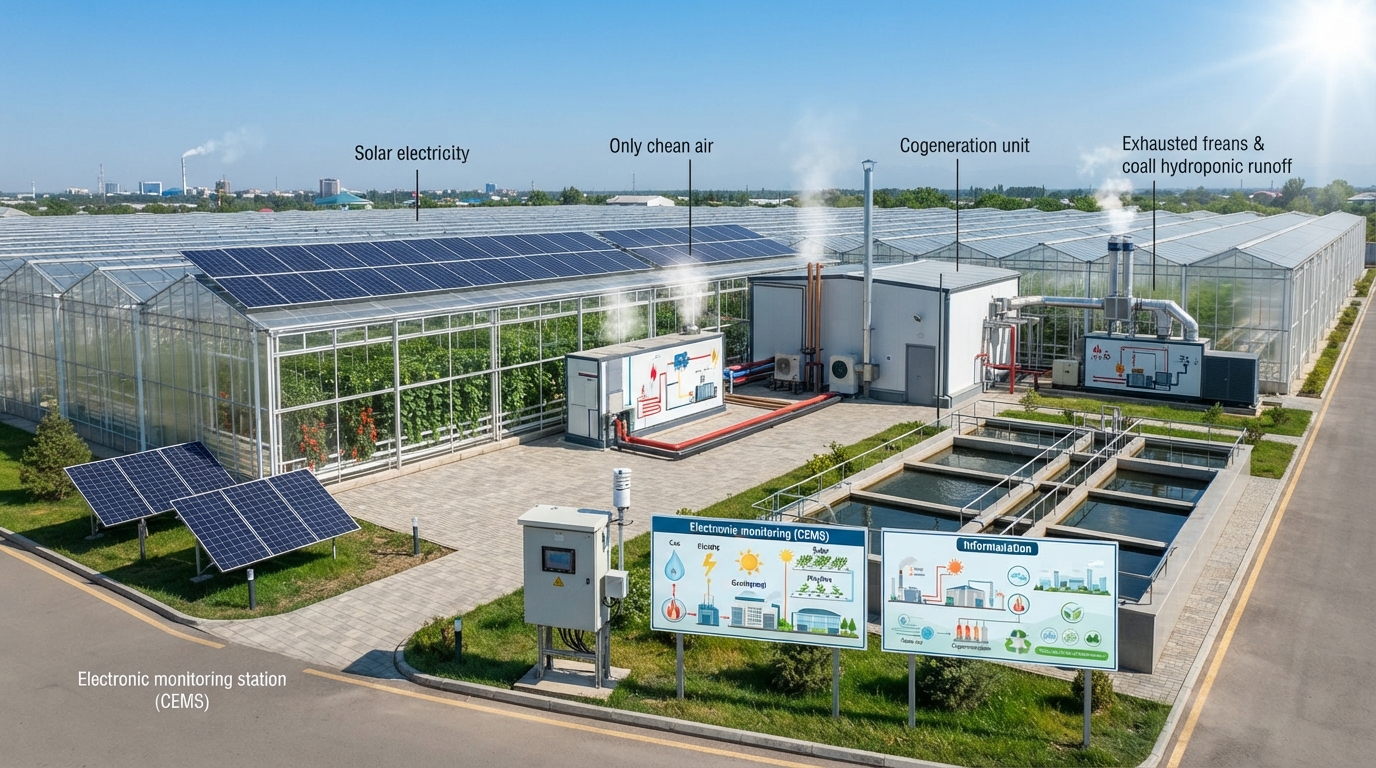
Greenhouses in the capital and nearby areas are permitted to use only gas, electricity, and other safe energy sources
By Resolution No. 586, the government approved additional measures aimed at ensuring the environmentally safe operation of greenhouse farms in Tashkent city and adjacent areas.
According to the document, a special ecological regime has been introduced for greenhouse farms in the territory of the capital, as well as in the Yukori Chirchik, Kibray, Yangiyul, Zangiata, and Tashkent districts of the Tashkent region (special area).
Greenhouse farms equipped with heating systems in the special area may operate exclusively on natural gas (including liquefied gas), electricity, geothermal and solar energy, as well as secondary thermal energy generated at thermal power plants. In this case, a positive conclusion of the state environmental expertise is mandatory.
Greenhouse farms using solid fuel (coal, briquettes and pellets made from biomass) must transition their heating systems to the above-mentioned energy types by December 1 and continue their operations.
Greenhouse farms are permitted to use solid fuel only when all of the following requirements are met simultaneously:
Burning tires, bitumen, fuel oil, plastic and polymer films, synthetic cardboard, rubber, wool fiber, used oils, household and industrial waste, and materials of similar composition as fuel is strictly prohibited in greenhouse farms operating in the special area.
According to the resolution, financial assistance will be provided for the ecological modernization of greenhouse farms in the special area.
In particular, until January 1, 2028, a subsidy of 50 percent of the cost of purchasing dust and gas cleaning equipment, boiler house units, energy-saving screens, energy-efficient technologies, as well as heating equipment operating on electricity, geothermal and solar energy, and cogeneration is provided. The subsidy amount must not exceed 50 million UZS per hectare of greenhouse farm.
To finance projects for transitioning to heating systems using electricity, geothermal and solar energy, as well as cogeneration, in 2026–2027, loans will be allocated through commercial banks in the national currency at an annual rate of 14 percent (including a 4 percent bank margin) for a term of 7 years, including a 3-year grace period. The loan amount will be up to 50 percent of the project value, but not exceeding 3 billion UZS per hectare.
In addition, up to 350 million UZS per station will be allocated to greenhouse farms wishing to purchase continuous emission monitoring systems (CEMS).
Financing will be carried out under a tripartite agreement with an interest-free 5-year installment plan, subject to compliance with the technical requirements approved by the State Center for Environmental Certification and Standardization under the Ecology Committee. In this case, the recipients of funds undertake to install the stations, integrate them into the committee's information system, and ensure the continuous transmission of data.
If contractual obligations regarding the installation of stations, their integration with the information system of the Ecology Committee, ensuring continuous transmission of monitoring data, or making timely payments are not fulfilled, measures will be taken after a written warning to dismantle the stations and repossess them in accordance with the procedure specified in the contract. Overdue debts will be collected in an unaccepted procedure.
Environmental standards will also be established for boiler house units in other sectors generating heat using fuel that negatively impacts atmospheric air. Enterprises impacting the environment will be divided into "red", "yellow", and "green" categories depending on the level of ecological safety of their operations. Relevant requirements will be enshrined in legislation.
At the same time, until January 1, 2030, an exemption from customs duties will be granted for the import of equipment intended for the establishment and modernization of greenhouse farms that is not manufactured in Uzbekistan. The privilege applies to dust and gas cleaning equipment, energy-efficient boilers, cogeneration units, equipment intended for the use of geothermal and solar energy, automatic emission monitoring systems, as well as their components.
According to the decision, hazardous liquid waste generated in the filters of greenhouse heating systems, as well as hydroponic wastewater (filtrates), will be treated and redirected for reuse as industrial water. For this purpose, a reservoir for temporary storage of filtrates will be constructed and put into operation in the eco-industrial zone of the Akhangaran district by January 1, 2027.
By June 1, 2027, an enterprise engaged in filtrate processing will be selected on a competitive basis. The Tashkent Region Khokimiyat must allocate a land plot from the eco-industrial zone by November 1 of this year.
Construction of the temporary storage reservoir for filtrates is allowed to be carried out in stages based on project documentation, subject to urban planning norms and rules. Greenhouse farms, regardless of their form of ownership, are obliged to hand over the filtrates generated on their premises to this operator according to established tariffs.
"Ecological modernization of greenhouse farms is an important stage of comprehensive measures aimed at improving ambient air quality in the city of Tashkent and adjacent areas. The introduction of modern purification systems, automatic monitoring tools, and energy-efficient technologies creates conditions for reducing environmental load and forming a more sustainable model for the development of greenhouse farming," noted the Ecology Committee.
"The main task is to ensure a balance between business development, efficient use of resources, and the right of citizens to a favorable environment," the agency emphasized.
Earlier this month, the Ecology Committee reported that greenhouse representatives had proposed maintaining their operations subject to the installation of special filters for air purification. A sample of such a filter was presented to the committee, but it failed the inspection.
In November 2025, against the backdrop of deteriorating air quality in Tashkent, a decision was made to immediately transfer all greenhouses in the capital and adjacent areas to a gas heating system. In March, it was announced that restrictions on establishing new greenhouses in the capital and surrounding districts would be introduced from October 1 of this year.
In June 2026, a special commission on air quality improvement began dismantling greenhouses in the Tashkent region and disconnecting them from artificial heating systems. Entrepreneurs were offered to relocate their farms to the "Surkhon-Agro" free economic zone in the Surkhandarya region.
At the end of summer, Tashkent Khokim Shavkat Umurzokov stated in an interview with Gazeta that the possibility of using permitted fuel types with emission purification and installing filters was being considered for greenhouse farms wishing to continue their work in the capital region. He also informed about financial support instruments.