

Gosaktiv explained the sale of Paynet without bidding. But questions remain regarding the privatization mechanism
The state's stake in Paynet was sold using the preemptive right of other members of the LLC, the head of the State Assets Management Agency reported. However, prior to the privatization, the state was the sole owner of the company, and seven applications had been submitted for the previously announced tender. He also spoke about the sale of the Dehkanabad Potash Plant.
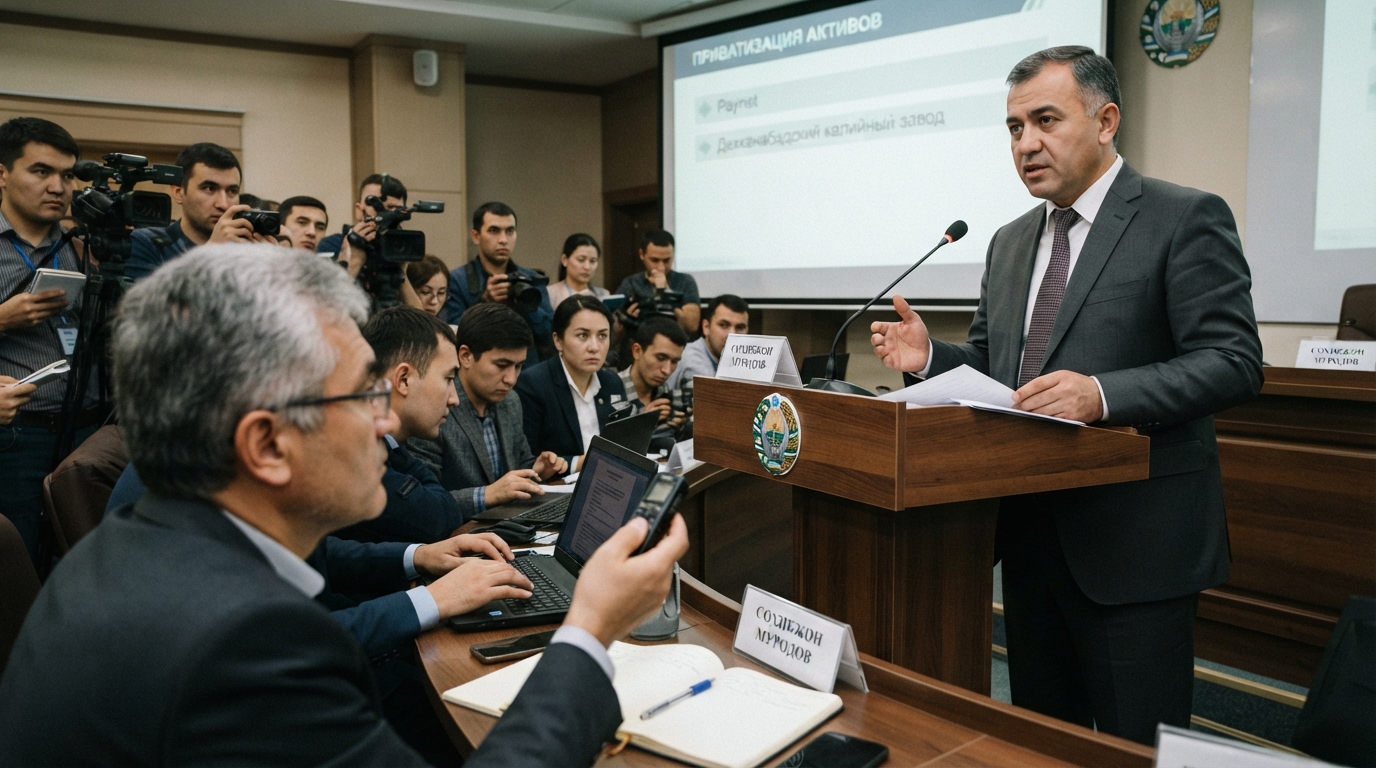
State Asset Agency explains no-bid sale of Paynet, but questions remain over privatization mechanism
Sokhibjon Murodov, Director of the State Assets Management Agency (SAMA), for the first time publicly spoke at an October 8 press conference about the mechanism used to privatize the Paynet payment organization, the change of ownership of which became known in April 2024.
Transactions involving state assets became known not through official sales announcements, but rather from corporate documents and registries. Paynet and the Dehkanabad Potash Plant were cited as examples.
According to Murodov, the privatization of the state stake in Paynet utilized a mechanism provided for by legislation on limited liability companies.
"If one of the participants in a limited liability company wishes to sell their stake, they must first offer it to the other participants in that company or to the company itself. This is a pre-emptive right established by law. The stake was sold using this right," the agency head stated.
He added that a similar practice is applied to other LLCs in which state shares are put up for sale.
At the same time, the head of SAMA did not clarify who exactly exercised the pre-emptive right to purchase Paynet, how the value of the stake was determined, or the amount for which it was sold.
Following the press conference, economist Otabek Bakirov drew attention to the circumstances surrounding the privatization of Paynet, which, in his view, do not align with the explanation provided by the head of the agency.
As Gazeta previously reported, in August 2022, SAMA announced an open tender for the sale of a 100% state stake in Uzpaynet LLC. At that time, the sole founder of the company was the state, represented by SAMA.
Within a month, seven applications were received from potential buyers to participate in the privatization. However, the acceptance of bids was subsequently postponed under the pretext of "additional clarification."
In April 2024, it became known that the entire 100% stake in Uzpaynet had been transferred to New Industrial Technologies. Meanwhile, information regarding the change of ownership had appeared on social media as early as November 2023. There was no official statement from SAMA regarding the completion of the privatization or its results.
Bakirov questioned how the pre-emptive right of other LLC participants could have been exercised if, prior to privatization, the state was the sole owner of the company.
The economist also pointed out that neither the former Law "On Denationalization and Privatization" nor the Law "On Privatization of State Property" passed in February 2024 provides for the sale of a state stake to other LLC participants by way of pre-emptive right as an independent method of privatization.
Article 19 of the new law lists eight methods of privatization, including auctions, competitive bidding, public invitations to negotiate, competitive dialogue, and exchange trading. At the same time, the law allows for exceptions provided for by the law itself and other legislative acts.
The pre-emptive right of company participants is enshrined in Article 20 of the Law "On Limited and Additional Liability Companies." It stipulates that when a stake is sold by one participant, the other participants have priority over third parties.
Thus, it remains unclear how this mechanism was applied to the sale of a 100% state stake in Uzpaynet, given that the company had no other participants.
Separately, Bakirov called attention to amendments to the Law on LLCs adopted on October 22, 2024. These established an exception to the pre-emptive right of participants in cases where the company's charter provides for the sale of the state stake through public auctions.
However, these changes were enacted after the change of owner at Paynet. Their significance applies primarily to subsequent transactions, with the application of the exception depending on the provisions of a specific company's charter.
Bakirov believes SAMA must explain the legal basis on which the previously announced sales procedure for Paynet was altered, why the tender with seven potential buyers was not completed, and what amount the state received from the company's privatization.
Responding to remarks by a journalist regarding so-called hidden privatization, Murodov disagreed with the assertion that a regulatory gap existed in former legislation regarding the methods of selling state assets.
According to him, specific mechanisms were previously defined by subordinate regulatory legal acts and were later explicitly codified in law.
At the same time, the head of the agency acknowledged the problem of insufficient public information.
"That is true, we admit it. If we do not convey information to the public in a timely manner, various suspicions will naturally arise. You know this better than I do," Murodov stated.
He explained that corporate decisions were published on the Unified Portal of Corporate Information Openinfo.uz, and details about privatization were also posted on the agency's official website. However, information about these sources did not always reach a broad audience.
"But there is another source — the official website of the State Assets Management Agency. There is a 'News' section there where information about this was also posted. We have now arranged to publish all updates from the website on the Telegram channel as well. But information about this Dehkanabad Potash Plant was also posted," the head of SAMA said.
Murodov reported that the agency intends to change its approach to transaction transparency.
"We have made changes to our working style. Now, even when using such privatization methods, we will disclose information to the general public," he emphasized.
After the press conference, Otabek Bakirov also asked SAMA to provide links to previously published information regarding the privatization of the Dehkanabad Potash Plant.
Murodov maintained that information about such transactions had been published on the official website of the agency and its information resources.
The economist suggested publishing specific announcements that would state the method of the plant's privatization, the buyer, the cost, and the terms of the sale. He recalled that journalists had previously attempted to obtain details about the sale of several state assets, including UNG Petro and the Chinaz Oil Refinery.
As Gazeta previously reported, the privatization of the Dehkanabad Potash Plant became known in August 2025 from a shareholder decision posted on the Openinfo.uz portal.
According to the document, 100% of the enterprise's shares were transferred to Asian Chemical Group. At the same time, a presidential decree dated April 26, 2024, provided for the privatization of the plant through public bidding on the international market.
The sale price and detailed terms of the transaction were not disclosed in the published corporate decision.
Asian Chemical Group was registered in November 2024. Its founders remain OV Industrial Investments L.L.C-FZ from the UAE with a 51% stake and New Industrial Technologies with a 49% stake.
The latter previously acquired the state stake in Paynet. Thus, the buyers of the two enterprises are linked through New Industrial Technologies. This company was registered in April 2019. To date, its authorized capital stands at 3.35 trillion sum. At the time of acquiring the stake in Paynet, a foreign citizen, Alex Lee, was listed as the founder of 60% of the firm (in June 2024, he was the sole founder), while 40% was held by Mustafa Abdurakhmanov, who also owns 77.6% of Asia Alliance Group — the majority shareholder of Asia Alliance Bank.
As of October 13, Mustafa Abdurakhmanov owns a 5% stake, while 95% belongs to First Management — FZCO (a free zone private company registered in the UAE).
The Dehkanabad Potash Plant itself, built for 128.2 million dollars, is one of the largest chemical industry enterprises in Uzbekistan. As of July 1, 2025, its equity capital stood at 2.9 trillion sum.
At the press conference, Murodov provided no separate detailed explanation of the mechanism for the plant's privatization, nor did he name the transaction price.
Bakirov called on the agency to provide documents and details regarding the method, terms, and sum for which the enterprise was transferred to its new owner.
Unlike Uzpaynet, the Dehkanabad Potash Plant was a joint-stock company.
Gazeta has repeatedly written about instances of non-transparent privatization in Uzbekistan, where major assets pass to new owners without public discussion or open bidding. Previously, transparency concerns were raised by transactions involving Qizilqumsegment, the UNG Petro gas station network, the Chinaz Oil Refinery, the Angren Tire Plant, the Fergana Oil Refinery, the mobile operator Perfectum, Uzagroexportbank, Uzcard, Humo, the Dehkanabad Potash Plant, and others.