

Global demand for air cargo rose by 7.7% in September
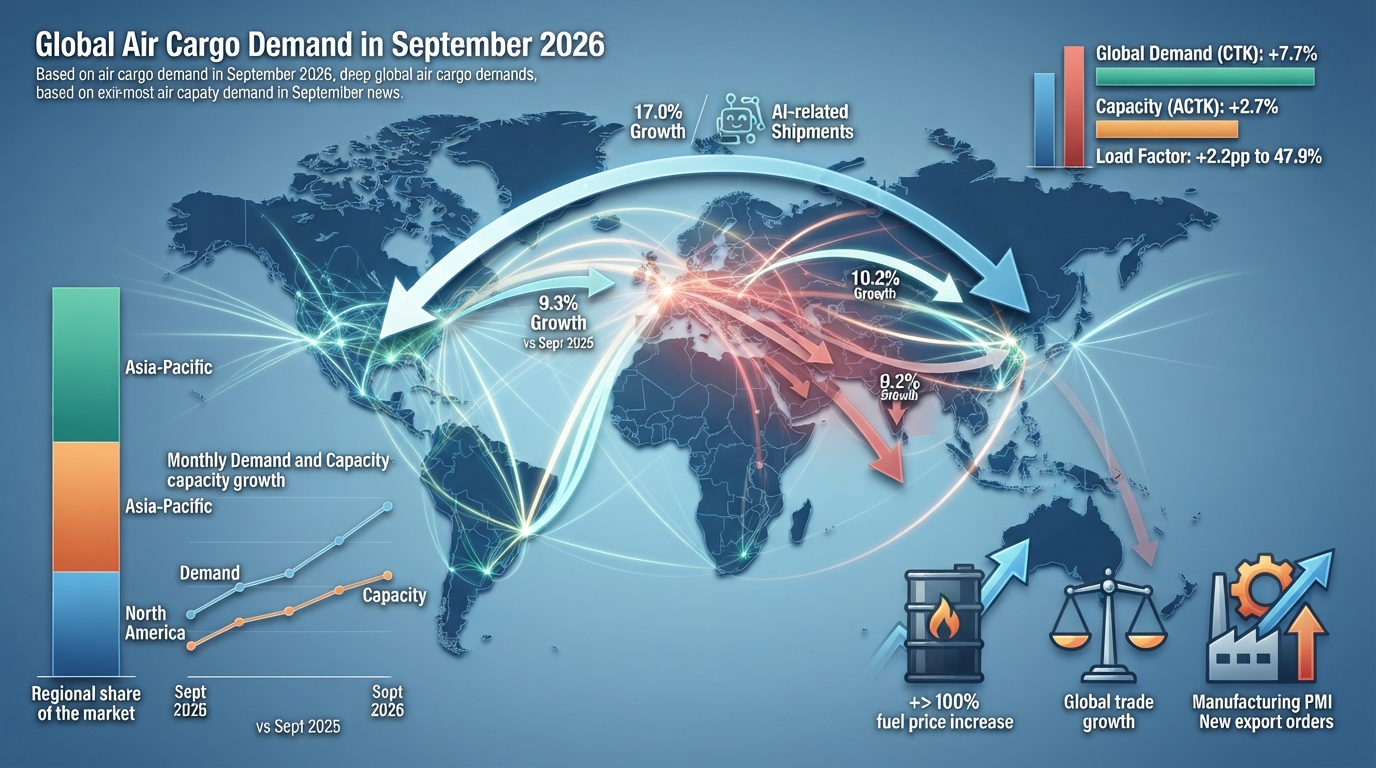
Global demand for air cargo grew by 7.7% in September 2026, but a more than twofold increase in jet fuel prices complicates operations for carriers, IATA reports.
**Global air cargo demand increased by 7.7% in September**
In September 2026, global demand for air cargo services grew by 7.7% compared to September 2025. On international routes, the increase was 8.6%. This was reported by the International Air Transport Association (IATA), which published data on the global air cargo market on October 29.
**Demand grew in all regions, but costs are rising faster than revenues**
Demand is measured in cargo tonne-kilometers (CTKs). Capacity, measured in available cargo tonne-kilometers (ACTKs), increased by 2.7% over the same period, and by 3.3% on international flights. Since demand grew faster than capacity, the cargo load factor rose by 2.2 percentage points to 47.9%.
Marie Owens Thomsen, IATA’s Senior Vice President of Sustainability and Chief Economist, stated that growth was recorded in all regions. According to her, it was supported by the strengthening of global trade and industry, while shipments related to artificial intelligence provided another month of double-digit growth on Pacific routes.
According to the economist's assessment, costs remain the main challenge for the industry. Aviation fuel has more than doubled in price over the year, while transport yields are failing to keep pace with price increases. Thomsen emphasized that there are enough goods to transport, but carrying them at a profit with consistently high fuel prices has become more difficult.
**Fuel, trade, and industry**
According to IATA, aviation fuel prices in September rose by 17.5% month-on-month and by 103.4% compared to September 2025.
Global trade in August grew by 3.6% year-on-year. Growth has continued for 42 consecutive months. Global industrial activity in August also increased. The global manufacturing Purchasing Managers' Index (PMI) rose by 0.7 points to 53.8, while the new export orders index rose by 0.5 points to 51.9. Both indicators reached five-year highs. IATA considers them to remain favorable for air cargo demand.
**Regional results**
North American carriers showed the most notable demand growth, rising by 11.8%. Capacity in the region increased by only 0.8%, which caused the load factor to rise by 4.3 percentage points to 43.9%. The region accounts for 24.6% of the global market based on 2025 results.
Airlines in the Asia-Pacific region, which account for 35.8% of the market, increased demand by 8.6% and capacity by 4.9%. The load factor rose by 1.7 points to 50.7%.
European carriers, whose market share stands at 21.4%, saw demand rise by 4.5%, while capacity contracted by 1.6%. The load factor increased by 3.2 points to 54.6%.
In Latin America and the Caribbean, which accounts for 2.9% of the market, demand grew by 6.7% and capacity by 7.6%. The load factor fell by 0.3 points to 34.3%.
African airlines, accounting for 2.1% of the market, increased demand by 4.7% despite a 1.2% capacity reduction. The load factor rose by 2.7 points to 47.0%.
The Middle East, which accounts for 13.2% of the market, performed weaker than the rest. Demand there grew by 3.8% and capacity by 7.0%, causing the load factor to decline by 1.4 points to 44.0%.
**Key trade corridors**
The situation on major trade corridors in September was mixed. Transportation between Asia and North America led the growth rate: up 17.0% compared to September last year, with growth continuing for eight consecutive months. This corridor accounts for 23.5% of the industry market.
Within Asia, volumes grew by 10.2%, with growth continuing for 35 consecutive months. The corridor's share is 7.3%. Cargo traffic between Europe and North America increased by 9.3%, marking the fifth consecutive month of growth, with the corridor accounting for a 13.5% share.
On the route between Europe and Asia, which represents 21.5% of the market, growth reached 6.0%, continuing for 43 consecutive months. Between Africa and Asia, accounting for 1.3% of the market, volumes rose by 2.6%, marking the first month of growth.
Corridors connected to the Middle East remained under pressure. Volumes between Europe and the Middle East, which account for 5.2% of the market, fell by 18.0%, while those between the Middle East and Asia, representing 7.4% of the market, dropped by 10.2%. On both routes, the decline has continued for seven consecutive months.
IATA brings together more than 370 airlines, accounting for approximately 85% of global air traffic.