

Global Air Cargo Demand Expands 3.9% in July
Global air cargo demand grew 3.9% year-on-year in July 2026, driven by North America and Europe, according to IATA.
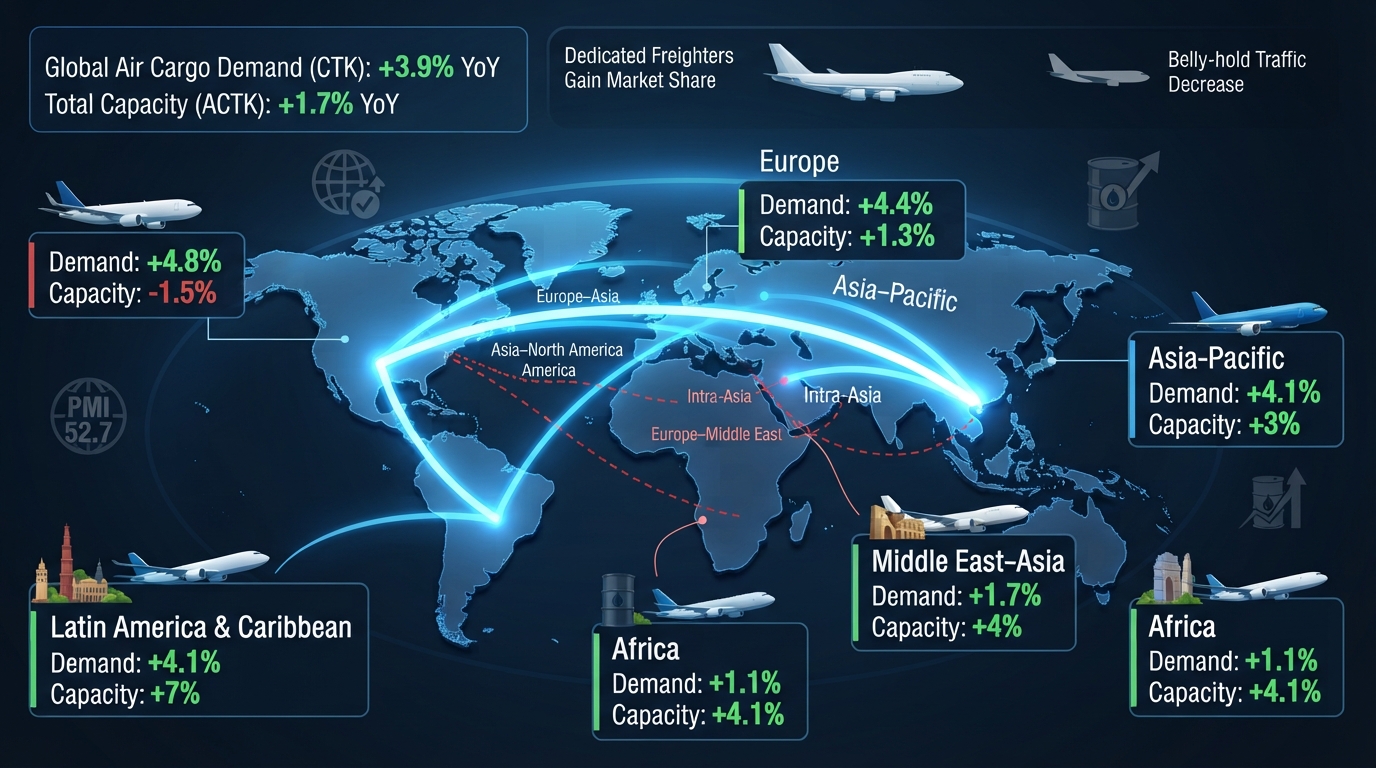
Global air cargo demand experienced a 3.9% increase in July 2026 compared to the previous year, with international demand seeing a 4.7% rise, according to data released by the International Air Transport Association (IATA).
This measurement is based on cargo tonne-kilometers (CTK). Total capacity, measured in available cargo tonne-kilometers (ACTK), expanded by 1.7% year-on-year, while international capacity grew by 1.8%.
Marie Owens Thomsen, IATA's Senior Vice President of Sustainability and Chief Economist, observed that although all regions reported growth, carriers in the Asia-Pacific, Europe, and North America were responsible for over 90% of the total gain. Dedicated freighters gained additional market share as belly-hold cargo traffic decreased, which she suggested might indicate a demand for larger or specialized shipments, in addition to the operational flexibility offered by cargo aircraft. She also noted that while manufacturing activity, export orders, and global trade maintain a positive broader outlook, rising fuel prices, geopolitical tensions, and tariff uncertainties require close monitoring.
IATA highlighted several operational factors, including a 7.5% year-on-year increase in global trade. Jet fuel prices climbed 12.2% month-on-month in July and were 56.9% higher than a year prior. Global manufacturing activity eased slightly in June but remained supportive; the Global Manufacturing Output Purchasing Managers' Index (PMI) decreased by 0.3 points to 52.7, while the New Export Orders Index rose to 50, reaching a three-month high.
Regionally, Asia-Pacific carriers saw demand increase by 4.1% year-on-year against a 3% capacity rise. North American airlines recorded the strongest demand growth at 4.8%, despite a 1.5% reduction in capacity. European carriers reported a 4.4% increase in demand alongside a 1.3% expansion in capacity.
Middle Eastern airlines experienced a 1.7% demand increase against a 4% capacity growth. Latin American and Caribbean carriers registered a 4.1% demand gain while capacity grew by 7%. African airlines recorded the lowest regional demand growth at 1.1%, alongside a 4.1% capacity expansion.
Major trade routes showed varied outcomes. The Asia–North America corridor expanded by 9.2%, marking its sixth consecutive month of growth. The Europe–Asia route grew by 3.1% for a 41st consecutive month, while Europe–North America increased by 2.1% for a third straight month. Intra-Asia traffic grew by 6.1%, extending its growth streak to 33 months. Conversely, Middle Eastern trade lanes continued to face disruptions; Middle East–Asia traffic contracted by 14.1% and Europe–Middle East traffic fell by 16.1%, both marking a fifth consecutive month of decline. The Africa–Asia route dropped by 14.7%, shrinking for a second month.