

IATA: Air travel demand rose by 0.2% in July
The International Air Transport Association (IATA) reported that global passenger demand in July 2026 grew by 0.2%, with the Middle East and North American markets showing declines.
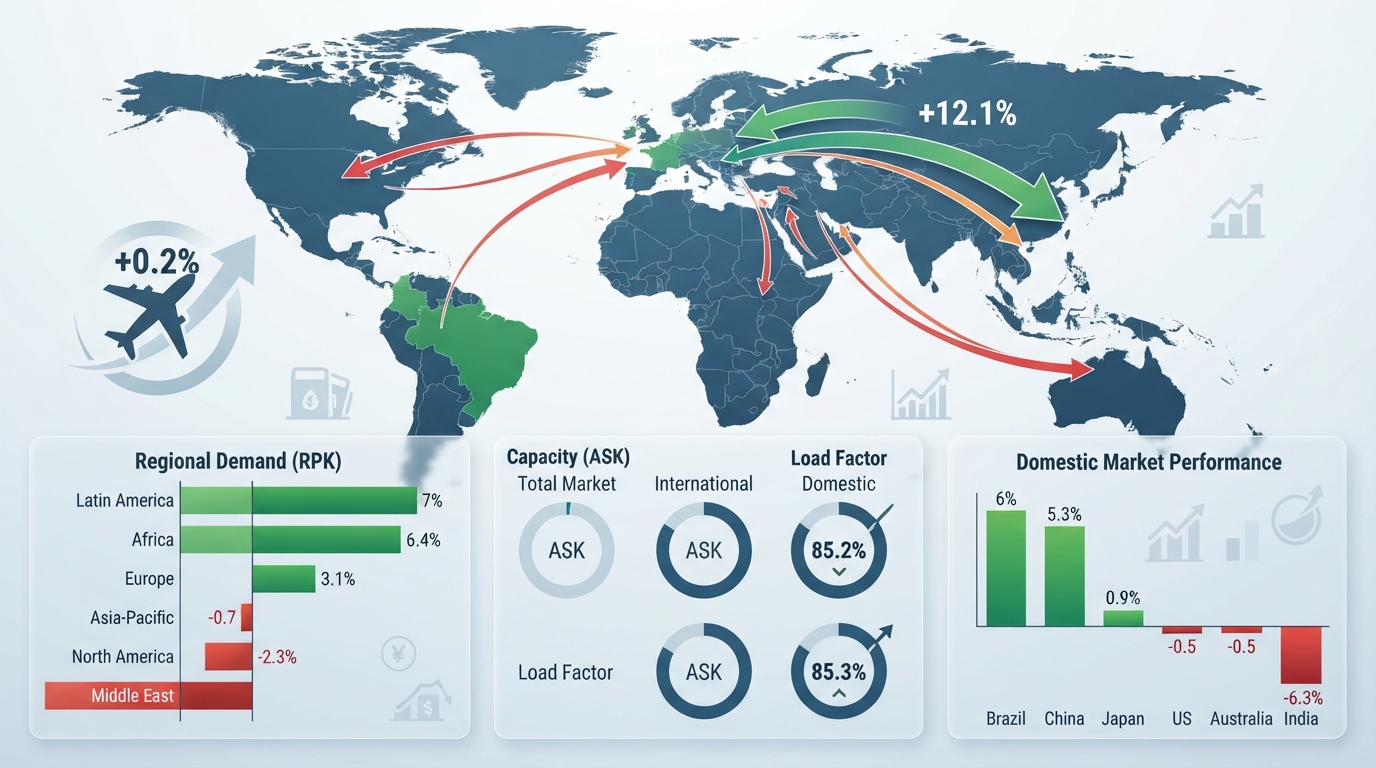
July 2026 saw a slight increase in global air travel demand, which, according to the International Air Transport Association (IATA), increased by 0.2% compared to the same period the previous year.
According to the IATA report, this indicator, measured in passenger passenger kilometers (RPKs), shows a more significant growth of 1.2% when excluding data from Middle Eastern airlines. Total capacity, measured in seat kilometers (ASKs), increased by 0.3% year-on-year, with the seat load factor reaching 85.2%, down 0.1 percentage point from July 2025.
International demand decreased by 0.1%, but excluding the Middle East, it grew by 1.5%. International capacity increased by 0.3%, with load factor reaching 85.2%, down 0.3 percentage points. Meanwhile, domestic demand grew by 0.6%, with capacity increasing by 0.2%, and load factor reaching 85.3%, up 0.3 percentage points.
Mari Owens Thomsen, Senior Vice President, Sustainability and Chief Economist, IATA, noted: "The peak summer travel season in the Northern Hemisphere is generally positive for air travel. Overall growth of 0.2% in July was achieved despite a combined decline for North American and Middle Eastern airlines. Notably, traffic through the Gulf hubs continues to recover. While high fuel prices, economic uncertainty, and geopolitical tensions persist, airlines are confident in demand for the remainder of the year, with capacity expected to grow nearly 3% in September."
Across international markets, demand from Asia-Pacific airlines declined by 0.7% year-on-year, with capacity down 1.7%; load factor was 84.5%, up 0.9 percentage points. European airlines saw demand grow by 3.1%, with capacity increasing by 3.2% and load factor reaching 87.1%. Passenger traffic between Europe and Asia grew by 12.1%, the strongest growth among all major international destinations.
Demand from North American airlines declined by 2.3%, with capacity also declining; load factor was 88.2%, unchanged from last year. The key transatlantic route declined by 2.2%, with significant declines in traffic from the UK, France, and Spain.
Demand from Middle Eastern airlines declined by 9.5%, with capacity declining by 5.8%. Load factor was 80.9%, down 3.3 percentage points. The decline in traffic continues to slow after a double-digit decline earlier in the year. Latin American airlines saw demand growth of 7.1%, with capacity increasing by 7.2% and load factor of 85.7%. African airlines saw demand growth of 6.4%, with capacity increasing by 9% and load factor of 74.1%.
In domestic markets, RPK growth in July 2026 was 0.6% compared to the same month last year. Strong growth was recorded in China (5.3%) and Brazil (6%), while declines were recorded in the US (0.5%), Australia (0.5%), and India (6.3%). Japan's domestic market grew by 0.9%.