

**Gender Gap**
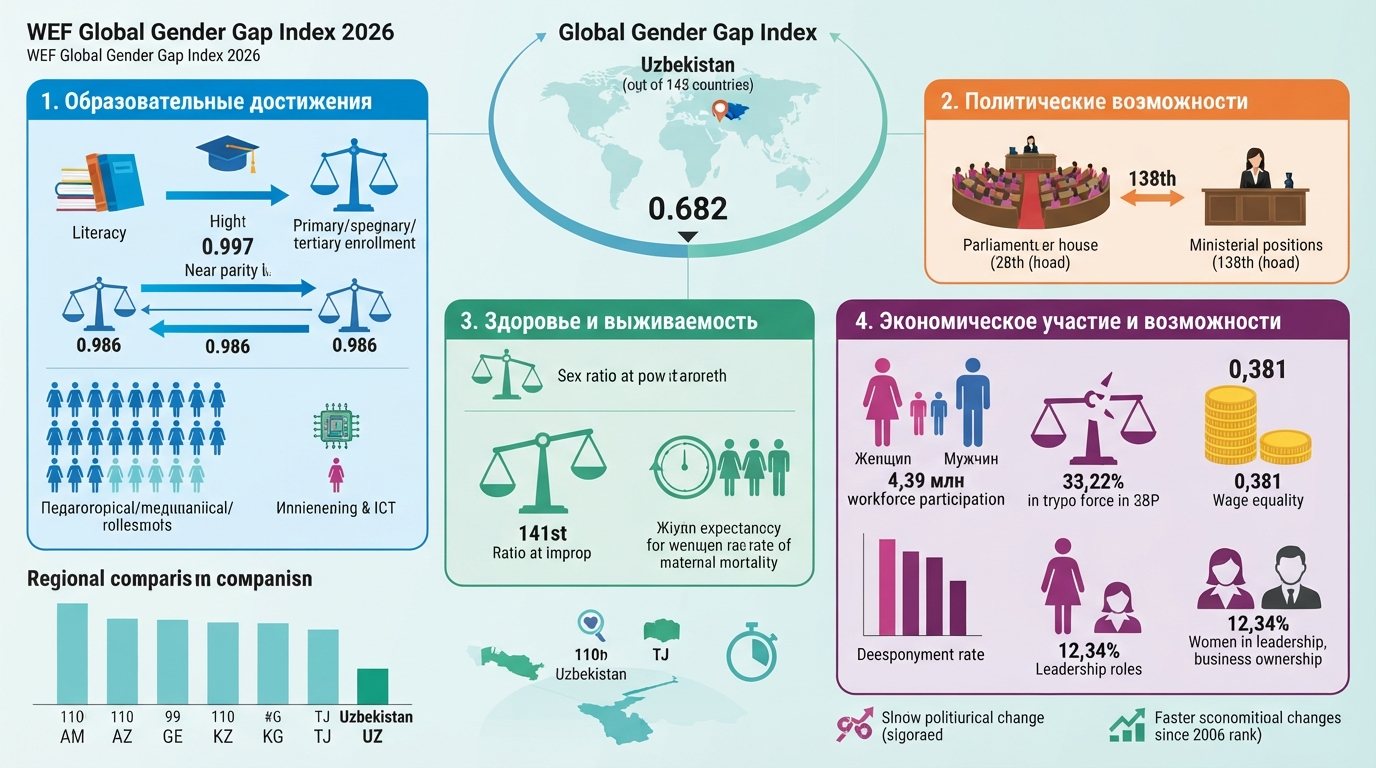
Uzbekistan ranked 110th among 145 countries in the Global Gender Gap Index 2026, prepared by the World Economic Forum (WEF). The country scored 0.682 points, compared to 0.678 a year earlier. In the field of education, men and women have almost achieved equality, but a noticeable gap still persists in the labor market and the economy.
The WEF Global Gender Gap Index reflects how close the positions of women and men are. For each indicator, the ratio of the value for women to the value for men is calculated. The result is expressed as a share of full gender parity, which ranges from one, meaning full equality, to zero.
A country's composite index is determined as the weighted average of four sub-indexes:
- **Economic Participation and Opportunity** — labor force participation, equal pay for similar work, income, and other economic opportunities;
- **Educational Attainment** — literacy and enrollment in primary, secondary, and tertiary education;
- **Health and Survival** — sex ratio at birth and healthy life expectancy;
- **Political Empowerment** — representation of women in parliament and ministerial positions, as well as the number of years a woman has led the country.
Uzbekistan's strongest area in the ranking is education.
The educational equality index stands at 0.997, which corresponds to 54th place in the world. Women and men have identical indicators in literacy and enrollment in primary and tertiary education. For secondary education, the ratio is slightly lower at 0.986. Thus, the main gender gap in the country, according to WEF data, is no longer related to access to basic or higher education.
At the same time, differences in the choice of specialties persist. Among STEM graduates, the share of women is 15.95% compared to 38.87% among men. In information and communication technologies, the ratio is 1.11% versus 7.85%, and in engineering, manufacturing, and construction, it is 5.61% versus 25.80%.
Women are significantly better represented among graduates of pedagogical and medical specialties.
Economic participation remains Uzbekistan's main weakness. In this component, the country ranks 124th with a score of 0.562.
Women's labor force participation is estimated at 0.546, with a gender gap of 33.22 percentage points. In this indicator, Uzbekistan ranks 126th.
According to the country profile, among the economically active population — that is, people who are working or looking for work — there are 4.39 million women and 7.8 million men. At the same time, the unemployment rate among women aged 15–64 is 7.68% compared to 3.96% among men.
Another indicator highlighted in the report is the difference between equal pay for similar work and the overall level of earned income.
In terms of wage equality for similar work, Uzbekistan ranks 44th in the world. The index for this indicator is 0.702. Meanwhile, the gap in overall earned income is significantly larger at 0.381. By this criterion, Uzbekistan is in 130th position in the global ranking.
The WEF does not provide separate data for Uzbekistan on the share of women among legislators, senior officials, and managers, as well as among professional and technical workers.
Women in Uzbekistan are majority owners of 28.9% of enterprises. However, they hold leadership positions in only 12.34% of companies.
The report does not allow for a conclusion regarding the reasons for this discrepancy.
In terms of gender equality in politics, Uzbekistan ranks 74th in the world. However, within this sub-index, the situation varies depending on the level of government.
Women are relatively widely represented in parliament: by this criterion, Uzbekistan ranks 28th in the world with a score of 0.644. In the upper house of parliament, women hold 24.62% of the seats.
At the ministerial level, the gap is much wider. In terms of women's representation among ministers, Uzbekistan is in 138th position, and the level of parity is only 5.3%.
The country profile also notes the presence of quotas for women on national electoral lists.
In terms of gender equality in health and survival, Uzbekistan ranks 137th in the world, although the overall level of parity reaches 0.956.
The most noticeable gap is related to the sex ratio at birth. In this indicator, Uzbekistan ranks 141st, and the level of parity is 0.928.
The situation is different for healthy life expectancy — the value is 1.02, which corresponds to 96th place.
23.6% of women in the country experience gender-based violence in their lifetime. Maternal mortality is 15 cases per 100,000 live births, and the total fertility rate is 1.4 children per woman.
In the Central Asia and South Caucasus region, the gender gap is closed by an average of 70%. The WEF includes seven economies in this group: Armenia, Azerbaijan, Georgia, Kazakhstan, Kyrgyzstan, Tajikistan, and Uzbekistan.
The regional result is made up of the following indicators: economic participation — 71%; education — 99.3%; health — 97.3%; political participation — 12.6%.
The WEF notes significant long-term progress in the region's economic component. Since 2006, the economic gender gap has narrowed by 5.5 percentage points, and parity among legislators, senior officials, and managers has risen from 0.622% in 2016 to 0.796% in 2026.
The political component is changing the slowest. Over two decades, the region has increased its political parity indicator by 6.3 percentage points, mainly due to the growing representation of women in parliaments. However, even now, only 12.6% of the political gender gap has been closed.
Armenia, Georgia, Kyrgyzstan, Kazakhstan, and Azerbaijan ranked higher than Uzbekistan, while Tajikistan ranked lower.