

Gas and oil production decreased, electricity and gasoline generation increased in Uzbekistan
In January–July, Uzbekistan reduced gas production by 15%, oil by 2.7%, gas condensate by 15%, and coal by 9.5%. At the same time, electricity generation increased by 6.4%, and gasoline production by 8.9%. In July, a recovery was observed across a number of indicators following a weak June.
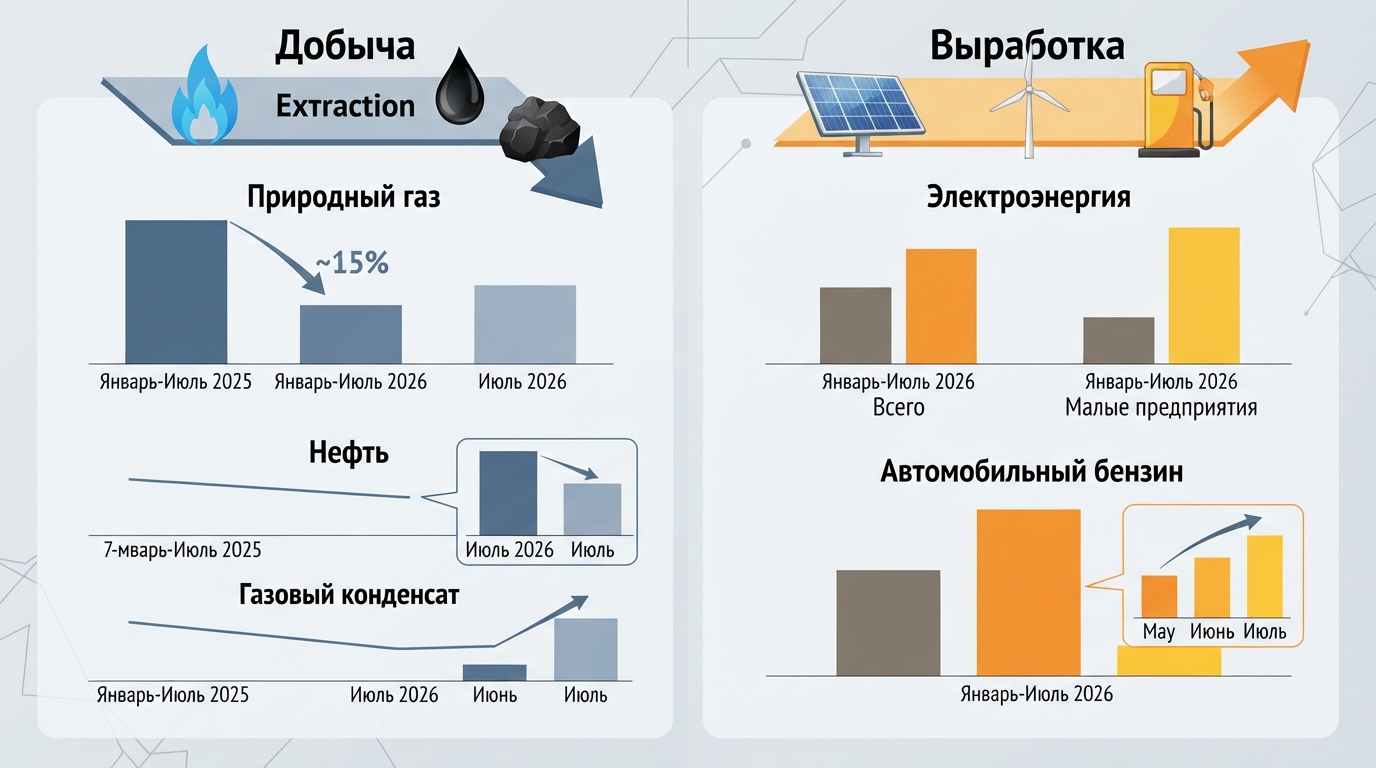
Gas and oil production in Uzbekistan decreased, while electricity and gasoline generation increased
In Uzbekistan, the decline in the production of natural gas, oil, and gas condensate continued in January–July. At the same time, in July, gas output noticeably recovered from the drop recorded a month earlier, and gas condensate production was higher than last year's level for the first time since the beginning of the year, according to the data.
Over the seven months, natural gas production amounted to 21.6 billion cubic meters — approximately 15%, or 3.8 billion cubic meters less than in the same period of 2025 (about 25.4 billion).
In July, about 3.3 billion cubic meters of gas were produced — 7.9% less than in July last year (3.58 billion), but 32% more than in June, when the figure dropped to 2.5 billion cubic meters.
Thus, the annual rate of decline in gas production slowed down sharply: in June the drop was 26.8%, and in July — 7.9%. Average daily production increased from 83.3 million cubic meters in June to approximately 106.5 million cubic meters in July — by 27.7%. However, this is still below the level of July 2025 — about 115.6 million cubic meters per day.
Electricity generation continued to grow. During January–July, Uzbekistan generated 52.5 billion kWh — 6.4% more than in the same period last year (49.34 billion kWh).
In July, generation amounted to about 8.36 billion kWh — approximately 10% higher than in July last year.
Since the beginning of the year, large enterprises produced 35.25 billion kWh of electricity — 3.6% less than a year earlier (36.58 billion). But separately in July, their generation rose to 5.42 billion kWh — approximately 1.6% in annual terms.
The overall growth in generation continues to be driven by small enterprises, including new solar and wind power plants, as well as other small producers. Over the seven months, they generated 17.25 billion kWh — 35.1% more than the 12.77 billion kWh a year earlier.
In July, small enterprises accounted for about 2.95 billion kWh. According to monthly data, this is approximately 63% more than a year earlier.
At the same time, the National Statistics Committee again adjusted the comparative base for 2025. In the current press release, last year's indicators are formed on the basis of enterprise data updated in accordance with the annual balance. Because of this, last year's values may differ from the figures given in previous monthly publications.
Motor gasoline production in January–July increased by 8.9% — to 731.9 thousand tons against 672.1 thousand tons in the same period last year.
In July, oil refineries produced about 117.7 thousand tons of gasoline — 5.1% more than in June. The growth compared to July last year was about 27.4%.
For comparison, in May production decreased to 84.7 thousand tons, after which in June it recovered to 112 thousand tons. Thus, the growth continues for the second consecutive month.
Diesel fuel production over the seven months amounted to 683.4 thousand tons — only 1.4% more than a year earlier (673.7 thousand tons).
In July, about 115.4 thousand tons of diesel fuel were produced — 1.6% less than in June.
This means that after a 20.3% year-on-year reduction in diesel production in June, output in July virtually returned to last year's level.
Coal production in January–July amounted to about 3.5 million tons — 9.5% less than a year earlier (approximately 4 million tons).
In July, about 1 million tons of coal were mined, compared to 900 thousand tons in June. According to the monthly table, the figure was approximately 26% higher than the level of July last year. Thus, the acceleration of mining in June–July made it possible to significantly reduce the lag accumulated since the beginning of the year.
Oil production over the seven months decreased by 2.7% — to 368.7 thousand tons against 378.8 thousand tons a year earlier.
In July, 54.9 thousand tons of oil were produced — 5.8% more than in June, and practically the same as in July 2025. Thus, the annual decline here has almost stopped.
The most notable turnaround occurred in the production of gas condensate. In January–July, its production was still 15% lower than last year's — 567.5 thousand against 667.9 thousand tons.
However, in July, gas condensate production rose to 105.4 thousand tons — by almost 50% compared to June and by 13.1% year-on-year. This is the first month since the beginning of 2026 when output exceeded the figure for the corresponding month of last year.
Heat energy production by large enterprises over the seven months decreased by 18.3% — from 12.39 million to 10.12 million Gcal.