

Future promising labor market for Uzbekistan announced
The Central Bank has published a prospective labor market outlook for Uzbekistan in its analytical review.
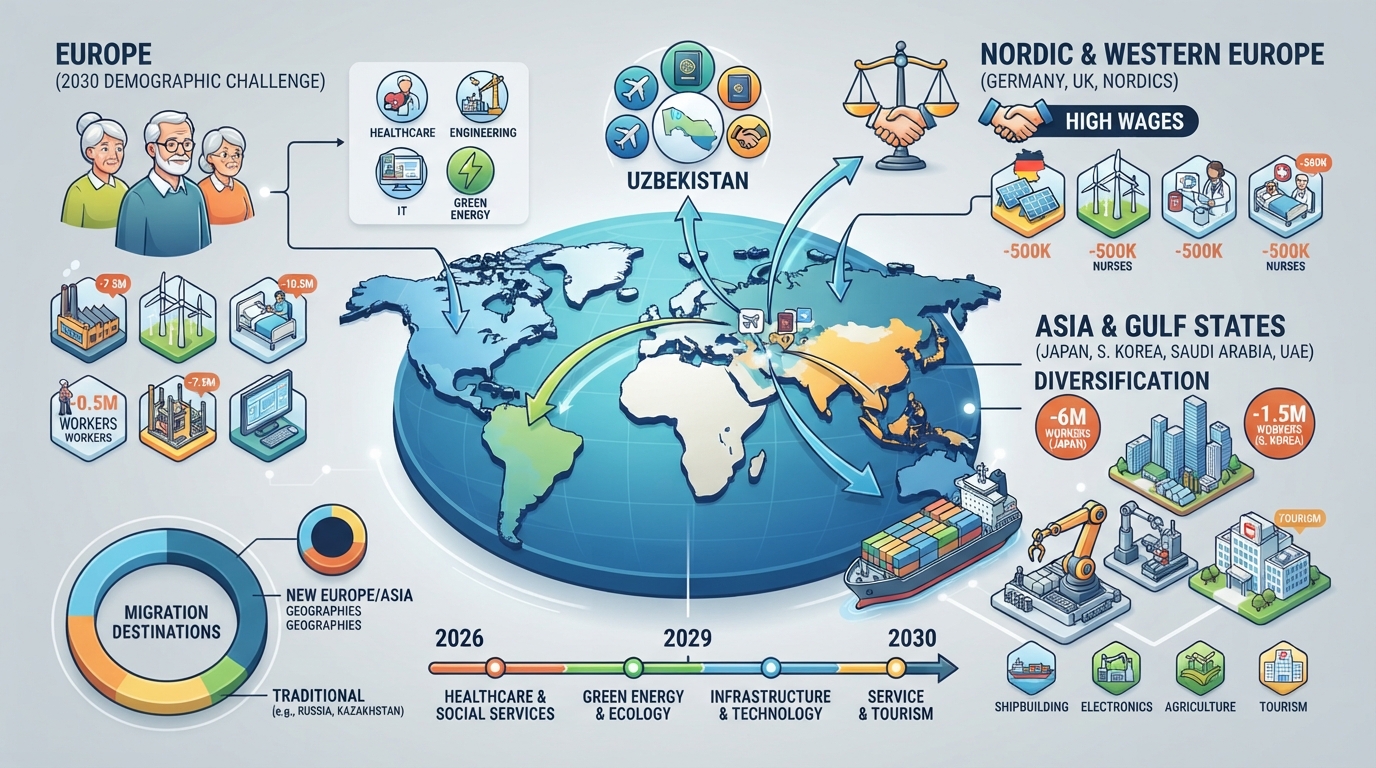
It is noted that by 2030, the aging of the population and the decline in the share of the working-age population in European countries are expected to become one of the main structural problems for the labor market. According to the Institute for Labor Market Research under the Federal Employment Agency and the European Commission, the labor shortage in this region is estimated at 7.5 million to 10.5 million people. As a result, an increase in demand for labor is expected in engineering, high-tech manufacturing, infrastructure construction, transport and logistics, the agricultural sector, medicine, information technologies, tourism, and services.
For example, if at least 400 thousand qualified migrants do not enter Germany every year, this will negatively affect the growth of gross domestic product (GDP). The Nordic countries are becoming centers of environmentally friendly technologies, and demand is growing in the fields of green metallurgy, wind energy, and information technologies.
**Healthcare and social care (2026-2030)**
The US, European countries, particularly Germany, Austria and the UK, as well as Asian countries such as Japan and Korea, are expected to see the highest demand for healthcare, care and social services due to population ageing.
According to the German Institute for Private Health Insurance (WIP), the number of people in need of care in Germany is expected to reach 5.7 million by 2030, which could lead to a need for up to 500,000 additional healthcare workers, and around 90,000 additional care workers in the UK (Skills England).
In Japan, a labor shortage of 6-7 million people is forecast in the care, agriculture and construction sectors, and in South Korea, 1.2-1.5 million in shipbuilding, metalworking, electronics and industrial sectors.
In the near future, these countries will see an increasing demand for specialists in specialized medical services aimed at the needs of the elderly population, including geriatrics, home care, as well as in the management and maintenance of specialized transport, robotics and "smart home" systems.
**"Green" energy and ecology (2026-2030)**
The implementation of large-scale projects aimed at the rapid development of renewable energy sources and adaptation to climate change in the European Union countries, in particular Germany and Denmark, as well as in the Middle East countries by 2030 will significantly increase the demand for qualified personnel in the energy, engineering, operation and environmental services sectors.
In Germany, a shortage of 300,000 specialists is forecasted in the areas of solar panel and wind turbine installation, technicians, motorists, mechanics, environmental engineers, and operation of electric and autonomous transport.
**Persian and Arab Gulf countries**
These countries are implementing projects to gradually diversify their economies from oil dependence and develop tourism, construction, transport, healthcare and services as part of national development programs such as "Vision 2030".
According to the International Labor Organization, as a result of these processes, 1.5-2 million additional workers may be needed in Saudi Arabia and 1 million in the United Arab Emirates.
In Saudi Arabia, the demand for construction and technical specialists in the implementation of large infrastructure and tourism projects, as well as for middle-level medical workers in the healthcare sector, is forecast to increase, while in the United Arab Emirates, the need for qualified specialists in the hotel and restaurant industry, tourism, service, aviation and logistics will remain high.
The Central Bank, citing data from the International Labor Organization, reported that the highest average wage levels are recorded in Europe (Luxembourg, Belgium, the Netherlands, Switzerland, etc.), North America (Canada and the USA), as well as in Asian countries, where high minimum wage indicators are recorded in developed countries such as Japan and South Korea.
“In the future, when developing external labor migration on an organizational basis, it is appropriate to take into account new geographical and professional areas where the demand for labor is expected to be high, taking into account demographic and structural changes in the global labor market,” the Central Bank’s commentary says.
According to the Migration Agency, approximately 1.4 million Uzbek citizens work in about 40 countries. Uzbekistan is currently integrated into global trends in international labor migration, and labor migrants are heading to European and Asian countries, along with traditional countries (Russia, Kazakhstan, South Korea, Turkey).