

From the train station to parliament: how students led to a change of power in Serbia
The student movement in Serbia has won the parliamentary elections, bringing an end to the 14-year rule of Aleksandar Vučić's party. Gazeta looks at how the protests following the tragedy at the Novi Sad railway station led to a change of power in the country and what challenges the winners will face.
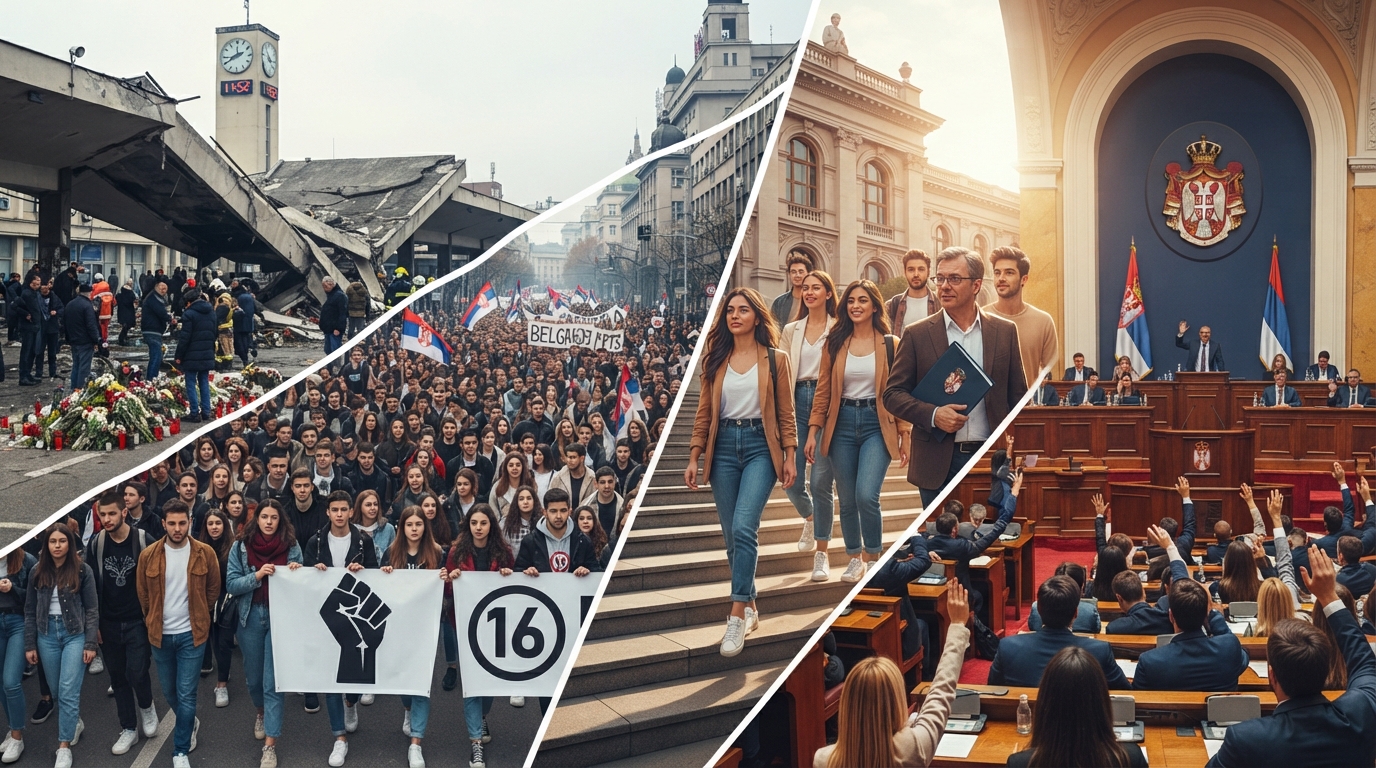
From the station to parliament: how students led to a change of power in Serbia
In the early parliamentary elections on October 25 in Serbia, incumbent President Aleksandar Vučić suffered a defeat, and his Serbian Progressive Party is going into opposition in parliament after 14 years.
"Gazeta" tells how the student movement, which arose after the tragedy in Novi Sad in November 2024, transformed over two years into an independent political force, changing the authorities in the country.
Two years ago — on November 1, 2024 — a concrete canopy collapsed at the Novi Sad railway station. 16 people died, and another was severely injured. The disaster occurred after the reconstruction of the station and raised questions about the quality of construction work, state oversight, and the transparency of infrastructure contracts.
The first memorial actions quickly escalated into protests. Participants demanded the publication of reconstruction documentation, an investigation into the causes of the collapse, and that officials and contractors be held accountable. Attacks on students participating in the demonstrations caused additional outrage.
By the end of November, the protest movement was led by students who began blocking universities. The symbol of the actions became 16-minute silences at 11:52 — the time of the canopy collapse. In December, professors, teachers, lawyers, farmers, and representatives of other professional groups joined the protests. On December 22, 2024, one of the largest demonstrations in recent years took place in Belgrade.
The authorities responded with personnel reshuffles and accusations against the protesters of attempting to destabilize the country. On January 28, 2025, Prime Minister Miloš Vučević announced his resignation, and on April 16, parliament approved a new government led by Đuro Macut. The cabinet change did not satisfy the protesters: they continued to demand an investigation into the disaster and accountability of state institutions.
In a study by the Center for European Policy Studies (CEP), Serbian political scientist Strahinja Subotić characterizes the 2024–2025 protests as the most serious civic challenge to Serbia's authoritarian political course. According to his assessment, the movement went from spontaneous actions and student blockades demanding accountability to political mobilization.
On May 5, 2025, the student movement for the first time officially demanded early parliamentary elections. This became a turning point: the initial demands related to the investigation of the tragedy were supplemented by the demand for political accountability of the incumbent authorities.
In December 2025, students conducted a nationwide signature-collecting campaign for early elections. According to the organizers, about 400 thousand people supported the initiative. In 2026, the movement continued its work in the regions, expanding its network of supporters outside university centers.
On September 9, 2026, President of Serbia Aleksandar Vučić announced the dissolution of parliament and scheduled early elections for October 25. On the same day, the student movement presented the civic electoral list "Student List". On September 27, Vučić announced his resignation from the post of president.
The students' list included 250 candidates — representatives of the academic community, medicine, culture, sports, and other professional spheres. It was headed by cardiologist and professor Ilija Srdanović. Among the stated priorities are the fight against corruption, the independence of the judicial system, media freedom, public administration reform, and increasing the efficiency of budget expenditures.
The student movement did not form into a traditional party. It preserved a collective decision-making model and sought to unite voters with diverse political views around demands for quality public administration.
On October 25, early parliamentary elections took place in Serbia. According to preliminary data from the Republic Electoral Commission, Student List received 52.71% of the votes and 140 of the 250 seats in the National Assembly. Aleksandar Vučić's coalition scored 39.17% and received 104 seats. Turnout was about 69%. Vučić conceded defeat shortly after the polling stations closed. His Serbian Progressive Party had been in power for 14 years.
Ivica Dačić's Socialist Party did not clear the three percent electoral threshold. Representatives of national minorities also entered parliament.
Serbia is a parliamentary republic. Legislative power belongs to the unicameral National Assembly, consisting of 250 deputies. Parliament passes laws, approves the budget, and forms the government. The Prime Minister leads the executive branch, while the President, elected by citizens, performs predominantly ceremonial and constitutional functions.
Therefore, the victory of the student list means, above all, a change in the parliamentary majority and the opportunity to form a new government. Presidential elections are to take place separately.
Experts attribute the election result not only to the fall in support for the ruling party, but also to the features of the protest movement itself and its ability to establish a foothold within Serbia's political system.
Alexander Baunov, a researcher at the Carnegie Russia Eurasia Center, calls what happened a victory of "the horizontal over the vertical" — of a networked civic movement over a traditional political system.
"The result of the Serbian elections looks most of all not like a victory of some politicians over others, but like a victory of the people over politicians in general," writes Baunov. The expert also points out that the students deliberately avoided transforming the movement into a traditional leader-driven party. In Baunov's opinion, this helped the movement avoid the distrust that often arises among protest supporters when their representatives transition to negotiations with the authorities.
Grégoire Roos, a researcher at Chatham House, also attributes the students' victory to the expansion of the protest's social base. He notes that the tragedy in Novi Sad quickly became a symbol for a significant portion of society of the problems with corruption and the opacity of state decisions. "As a result, the student movement transformed into an independent center of attraction for opponents of the incumbent authorities," Roos notes.
At the same time, the expert warns against hasty conclusions about a foreign policy shift by Serbia. "Student List" advocates for maintaining military neutrality, does not support the country's accession to NATO, and intends to continue the policy of not imposing sanctions against Russia.
Engjellushe Morina, a senior policy fellow at the European Council on Foreign Relations (ECFR), points out that the new leadership will inherit a state system in which, during the years of Vučić's rule, close ties developed between political power, the media, judicial, and security structures. "Despite all this, a democratic reset is possible if the student movement manages to form a ruling coalition," Morina believes.
"Europeans must insist on a transparent transfer of power," Morina notes. Among the priority areas, she names the rule of law, the fight against corruption, changing media regulation rules, and electoral system reform.
Gordana Delić, a researcher at the German Marshall Fund, also believes that the main tests for the student movement will begin after the victory. It will have to form a government, determine the distribution of ministerial portfolios, and translate the general demands of the protest movement into a specific reform program.
Delić points out that the Serbian Progressive Party, despite its defeat, retains positions at the local level and an extensive political network. Vučić himself intends to continue political activity as an opposition politician. Therefore, the results of the parliamentary elections do not yet mean the final termination of the former ruling party's influence.
Thus, the main intrigue of Serbian politics now lies in whether the movement that achieved victory through mass mobilization and collective leadership will be able to transform into a sustainable governing force. Not only internal transformations will depend on this, but also Serbia's further position in Europe and the Balkans.