

From a 16-lane bridge to an airport on an artificial island: China's 10 major projects
In China, a cascade consisting of five hydroelectric power stations, an underwater road tunnel beneath the Yangtze, a double-deck 16-lane bridge, and an airport on an artificial island are under construction. Among the country's major infrastructure projects are also railways cutting through mountains, hundreds of kilometers of waterways, and power grids transmitting electricity over thousands of kilometers.
From a 16-lane bridge to an airport on an artificial island: China's 10 major projects
The length of China's railway network has exceeded 165 thousand kilometers. The country possesses an extensive system of highways, ports, energy, and water management facilities. New construction aims to expand these networks, interconnect them, and resolve throughput capacity shortages at existing facilities.
Cascade of five HPPs in Tibet
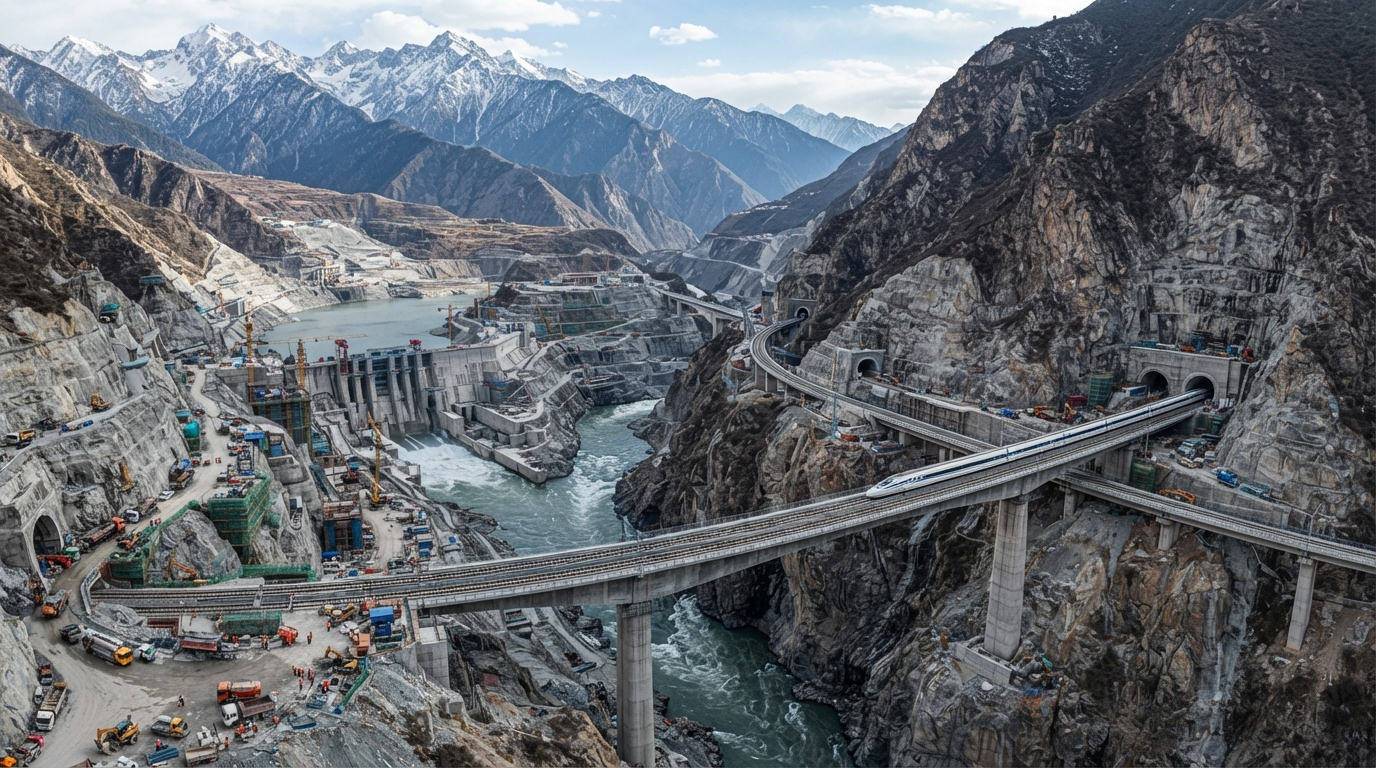
The construction of the hydroelectric complex on the lower reaches of the Yarlung Tsangpo River began in July 2025 in the Nyingchi area of the Tibet Autonomous Region. The project provides for the construction of a cascade of five hydroelectric power stations. The China Yajiang Group company was established to develop and operate it.
Crossing the Tibetan Plateau, the river drops sharply to the southeast and continues as the Brahmaputra in its lower reaches. High mountains, large elevation drops, and complex geological conditions make construction difficult.
India and Bangladesh are also paying attention to the project. This is because the impact of upstream structures on the water regime and ecology is also significant for other countries in the river basin.
A railway where nearly 94 percent of the route consists of bridges and tunnels
The Ya'an–Nyingchi section of the Sichuan–Tibet Railway covers approximately 1,018 kilometers. Of this, about 841 kilometers pass through 69 tunnels, and another 112 kilometers cross 104 bridges.
Ordinary surface railway track accounts for a distance of only around 64 kilometers. The total share of bridges and tunnels reaches 93.7 percent.
The construction of 24 stations is planned along the route. Depending on the terrain, the design speed of the trains will be 120–200 kilometers per hour.
In high mountains and deep river valleys, delivering workers, equipment, and materials along with the construction itself is a complex task. Therefore, the highways servicing the main line are also being repaired and modernized.
An 11-kilometer tunnel under the Yangtze River