

From 2027, the remuneration system for civil servants will change in Uzbekistan
In Uzbekistan, the remuneration system for civil servants will change starting from 2027. Official salaries will be calculated according to a single tariff scale, taking into account the level of the position and length of service. Additionally, payments for qualification rank, KPIs, and bonuses are provided.
From 2027, the remuneration system for civil servants will change in Uzbekistan
From January 1, 2027, a new remuneration system for state civil servants will come into effect in Uzbekistan. The corresponding decree "On measures to improve the remuneration system for state civil servants" was signed by President Shavkat Mirziyoyev on September 2.
The new system will cover 95 state bodies and organizations — from the Cabinet of Ministers, the Chamber of Accounts, and ministries to committees, agencies, and khokimiyats.
The document outlines four key objectives of the reform: increasing the competitiveness of pay in the civil service, introducing clear rules for its formation, ending the practice of funding staff from extra-budgetary funds, and ensuring a "decent level" of material incentives and social protection for civil servants.
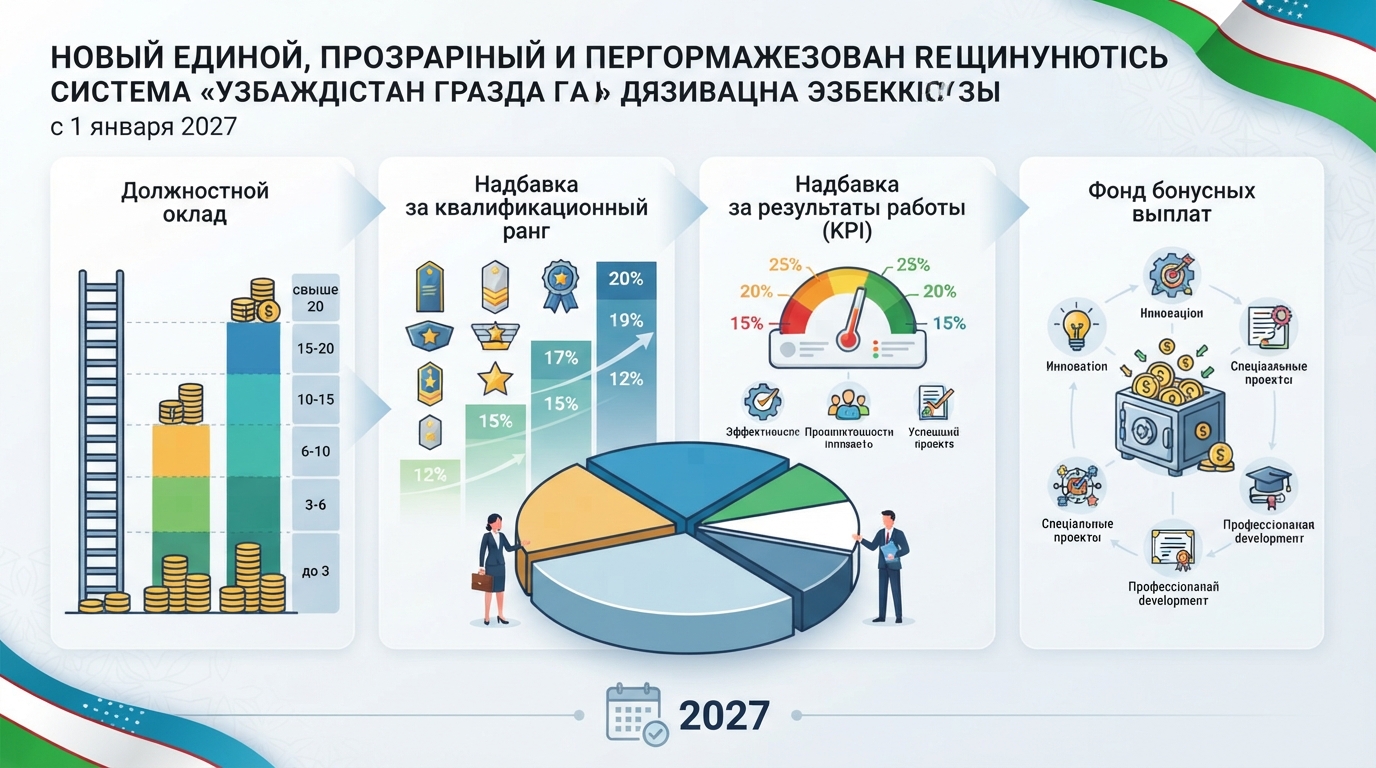
From January 1, the payroll fund for state civil servants will consist of four main parts:
The amount of the basic salary will be calculated based on an approved tariff scale. For this purpose, each position is assigned a grade, and each grade is assigned a tariff coefficient. This depends, among other things, on the length of state service.
Six stages of seniority are provided: up to 3 years, from 3 to 6 years, from 6 to 10 years, from 10 to 15 years, from 15 to 20 years, and over 20 years. Thus, the current mechanism of separate payments for years of service is effectively replaced by a higher tariff coefficient for employees with longer tenure.
Positions are distributed across grades depending on the level of the state body.
The amount of the basic salary will be determined based on the tariff coefficient and the minimum wage established by law.
In addition to the basic salary, civil servants will receive allowances for their qualification rank.
The decree establishes allowances ranging from 2% to 20% of the basic salary, depending on the employee's qualification level. In particular, a 20% allowance is provided for the highest qualification level, 17% for a first-level specialist, 15% for a second-level specialist, and 12% for a third-level specialist.
Another part of the salary will depend on performance results.
Upon achieving the most important performance indicators, a state civil servant may be paid a monthly allowance of up to 25% of their basic salary.
According to the approved scale, with a rating above 100 points, the allowance will be up to 25% of the salary; with a result from 85 to 100 points — up to 20%; and from 70 to 85 points — up to 15%. For results below 70 points, no KPI allowance is provided.
The Management Effectiveness Agency under the President has been tasked with developing the performance evaluation methodology. The main indicators must take into account the results of fulfilling the functions and tasks of the state body, executive and labor discipline, as well as initiatives and proposals aimed at cost savings.
A separate bonus payment fund will be established. Funds equivalent to one month's basic salary of employees, taking into account qualification rank payments, will be allocated to it annually.
From this fund, it will be possible to pay personal allowances and bonuses for the high-quality performance of official duties, special assignments, and complex tasks, compensation for work outside of working hours, on weekends and holidays, as well as rewards based on performance results or reporting periods.
When distributing bonuses, it is proposed to consider, among other things, the fulfillment of complex tasks, the introduction of advanced information technologies, including artificial intelligence, professional qualification improvement and obtaining international certificates, as well as the introduction of innovative approaches that have yielded a measurable economic result.
The size of the bonus for a specific employee will be determined based on their performance results and the available funds in the fund. At the same time, no limit on the bonus payment amount is set by the decree.
By November 1, the Ministry of Digital Technologies, together with the Management Effectiveness Agency, has been instructed to develop a special software package for the automatic calculation of civil servants' KPIs and corresponding allowances.
In addition, the Ministry of Economy and Finance, together with interested departments, must prepare by March 1, 2027, a procedure for establishing remuneration tariffs for employees who are not state civil servants but work in state bodies and subordinate organizations.
In early August, plans were announced to introduce a unified, transparent, and performance-based remuneration system for civil servants (54,000 people) in Uzbekistan. During a presentation to the president, a significant gap in the pay of employees holding identical positions and performing similar functions was highlighted.