

Four ways to keep your energy bills down
Household energy bills are due to rise again in October but there are ways to keep a lid on your expenditure.
Four ways to keep your energy bills down
Keeping warm by wearing thick clothes, using blankets and drinking hot drinks can help cut heating bills.
Energy prices are set to hit a three-year high at the beginning of October, and forecasts indicate there will also be a sharp rise in costs in January.
Ofgem’s price cap affects millions of people on variable or default tariffs, but those on a range of tariffs may use more energy - and therefore pay more - if winter turns out to be cold.
So what can you do to keep rising bills under control?
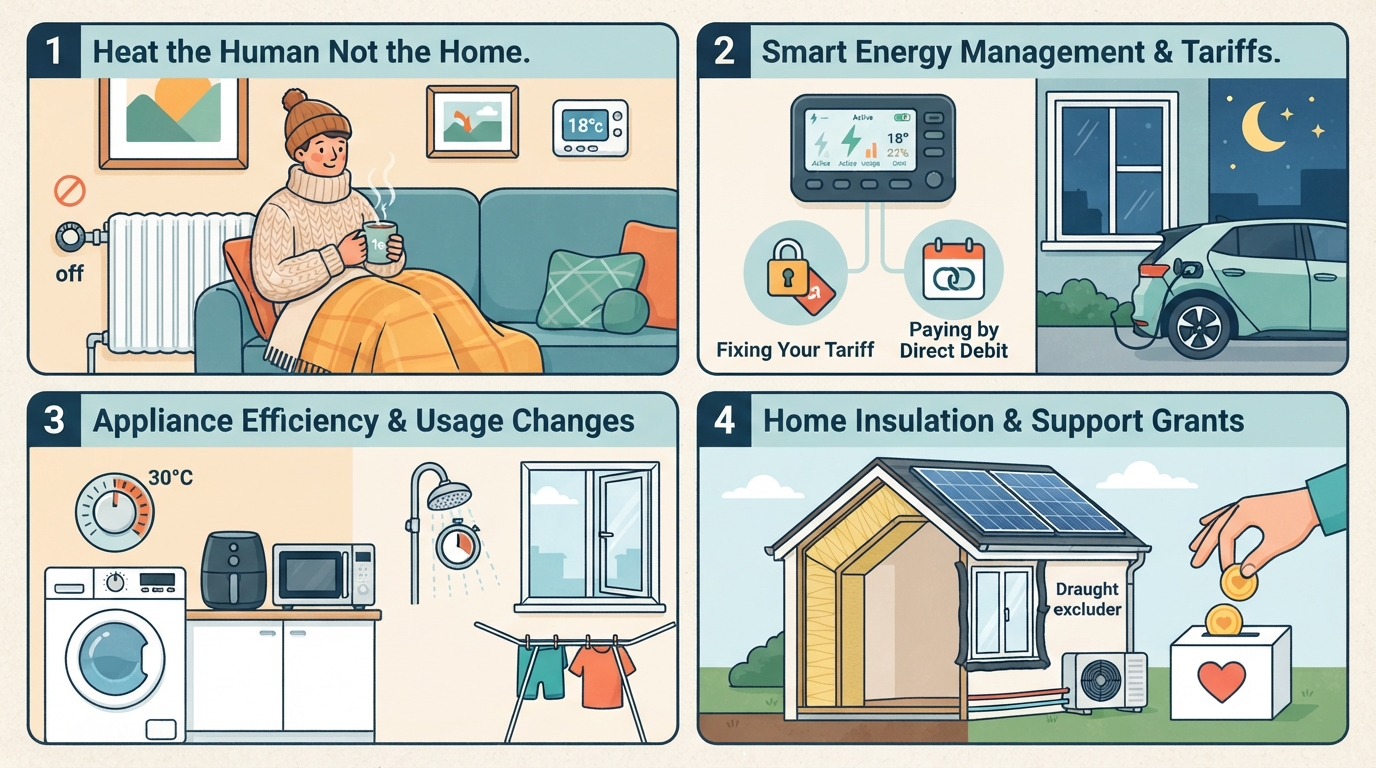
The energy regulator, Ofgem, is advising people to think about fixing - meaning the price you are charged per unit of gas or electricity will not change every three months, although the total bill will still depend on how much energy you use.
The difficulty is that it is very hard to judge whether a fixed deal is a good one right now.
If energy prices climb steeply, those who have already fixed will have certainty over what they pay for each unit of energy. That rate may well be lower than the forecast price in January.
However, if events in the Gulf region calm down, and a peace deal in the Iran war brings down international gas prices, then a longer-term fix may not look such good value compared with the price cap.
Consumer group Which? also says to watch out for exit fees when choosing a fixed deal. If variable prices drop below your fixed rate and you want to leave before the end of your agreement, you may have to pay a large sum.
Before fixing, consumer website Money Saving Expert says you should compare all the deals available, not just the ones offered by your own supplier.
Ofgem says around five million people still pay their bill when it arrives every three months. For some, that is because they do not want their supplier estimating their usage in case they are overcharged.
Taking regular meter readings, or having a smart meter, while paying by monthly direct debit solves that issue. In addition, paying by direct debit costs less per unit than so-called standard credit.
You will usually - though not always - need to switch to direct debit if you want to benefit from the fixed deals available.
Customers on prepayment schemes - usually people on low incomes who struggle to pay bills - used to pay a higher rate than others, but now they pay slightly less than the capped direct debit variable rate.
There are also a range of pricing schemes that offer cheaper off-peak electricity, for example if you charge an electric car overnight.
Changing the way you use household appliances can also help, for example by lowering washing machine temperatures.
There are a range of ways people on low incomes can get support.
This winter, anyone on means-tested benefits will get £150 off their electricity bill.
Your supplier will apply the discount automatically unless you are in Scotland, where you will need to contact your energy company to ask for the help.
Some people will also be eligible for a
Beyond that, most energy suppliers offer hardship grants for people struggling to pay their bills and the government's
.
People on low incomes may also be eligible for grants to help insulate their homes, and there are local schemes offering grants for solar panels, heat pumps and similar measures.
But if you are searching for grants, be alert to scams pretending to be official money-off schemes.
Once the temperature outside starts to drop again, it is important to stay warm, especially for the very young, old, and those with health conditions or reduced mobility.
But there are plenty of ways to keep bills lower without letting the temperature in your home fall below the recommended 18C minimum.
You may already have put up thicker curtains and blocked draughts over the last couple of winters, but do not forget to switch off radiators in rooms you are not using and wrap up.
Money Saving Expert advises to "heat the human not the home".
Turning down the flow rate on a combi boiler can save you money because the water is often heated higher than necessary.
Batch cooking and using an air fryer or microwave instead of heating the oven for a small item can save energy.
Take shorter showers and wash clothes at 30C rather than 40C. Dry clothes outdoors if you can, rather than using a tumble dryer, or hang clothes indoors but ventilate well or use a dehumidifier to avoid damp.
If you are thinking about moving home, or carrying out renovations, it is worth considering how to reduce bills. When it comes to white goods, look for energy-efficient appliances.