

Footage of Tibet floods isn't being shown in China - and we know little about victims there
Some of the most dramatic footage from the deadly flash flooding is hidden from public view in China.
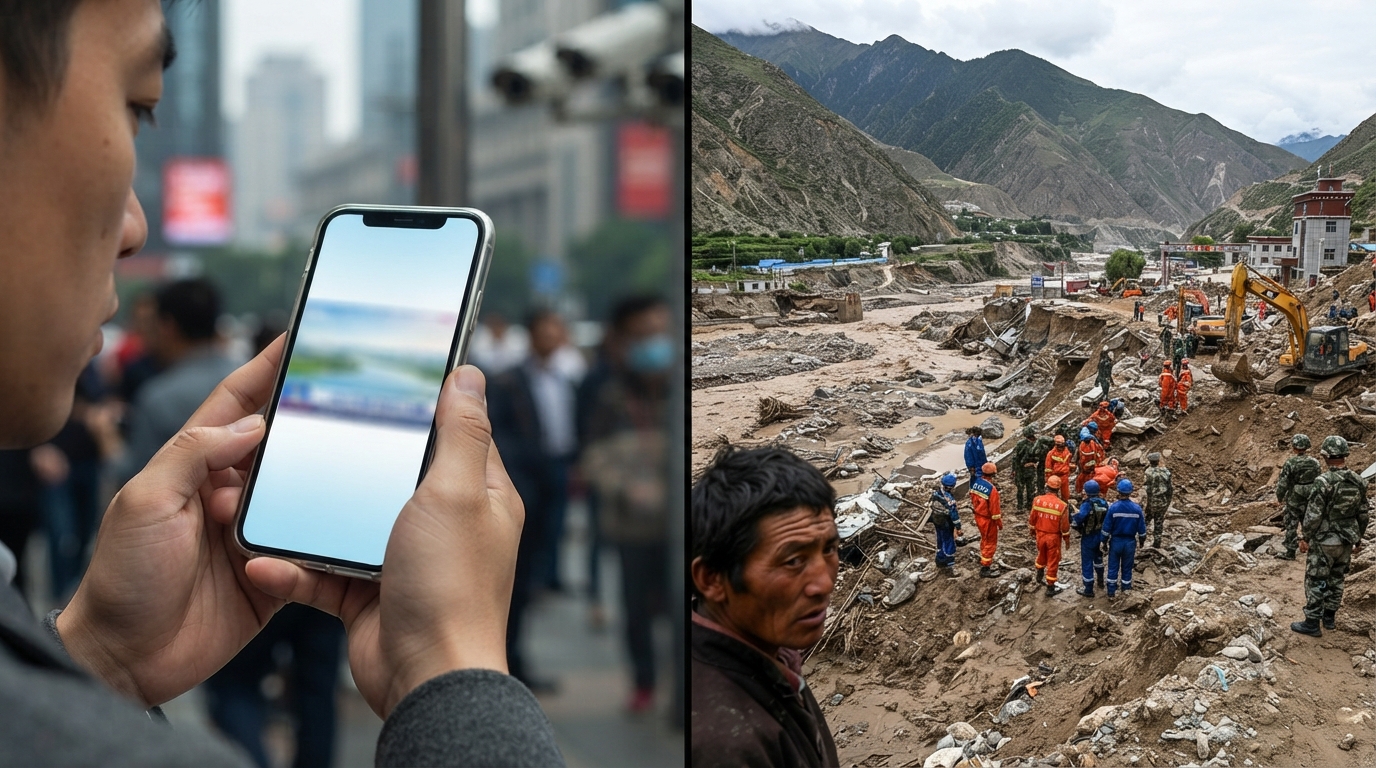
While dramatic video footage captured the devastating flash flood at Gyirong Port, a key border crossing between Nepal and Tibet, and quickly circulated globally, its presence in China has been notably suppressed. Only a single still image has been shown by China's state news, and the video, along with posts describing the disaster that has claimed hundreds of lives and left many more missing since Wednesday, is difficult to find on the heavily censored Chinese internet.
Despite this information control, Beijing has launched a significant rescue operation involving hundreds of emergency workers, and President Xi Jinping convened an emergency meeting to coordinate efforts. However, the stark contrast between online content in China and the rest of the world highlights the country's robust internet censorship, particularly concerning Tibet.
Tibet, annexed by Beijing in the 1950s, has a history of resisting Chinese Communist Party rule. China has previously suppressed protests, sometimes violently, and faces accusations of severe human rights violations in the Buddhist region, labeling the exiled Dalai Lama a separatist. This history makes Tibet a sensitive topic for Chinese censors, especially during crises.
Although daily updates on casualties and rescue operations, including warnings about an overflowing barrier lake, have been provided by Beijing, detailed accounts from survivors in Tibet and user-generated footage of the disaster or its aftermath are absent. Contacting families of the missing is nearly impossible, with one journalist noting it's often easier to reach interviewees in Pyongyang than in Lhasa, Tibet's capital.
On Thursday night, as global news focused on the Himalayan devastation, China's state broadcaster led its main bulletin with the launch of Xi's new book. Foreign journalists require government permission to travel to Tibet, and information on major events like this is quickly scrubbed, and voices stifled. Consequently, reliance falls on state media, which has emphasized dramatic rescue efforts by specialist teams navigating treacherous terrain. The outcomes of these rescues remain largely unknown.
Beijing's response, while appearing muted to the outside world, reflects a deep concern for stability, a key priority for Xi. Premier Li Qiang's rare and swift visit to the region to inspect debris removal underscores this. The Communist Party likely fears that such a disaster could ignite discontent regarding the response or a perceived lack of preventative foresight. There's also concern that the tragedy could become a rallying point, particularly in a community where faith is central.
Despite a long absence of protests, Tibetan groups abroad have voiced worries about increasing Chinese control, citing new education laws that they believe aim to weaken monasteries and the Buddhist faith. Hours after the disaster, the Communist Party's local office issued a notice urging members to assist in relief efforts, provide emotional support, and crucially, "make every effort to maintain social order and ensure stability and public confidence in the disaster areas." The notice warned of accountability for poor performance and rewards for good.
This warning is not to be taken lightly, as rights activists report that Tibetans in the region can face detention or arrest for communicating with journalists or posting online content deemed contrary to the government's narrative. This makes it difficult for Tibetans outside the region to ascertain the fate of their relatives. The International Campaign for Tibet, while commending first responders, criticized Beijing for removing first-hand information from social media and urged Chinese authorities to "disclose complete and verifiable information about the damage and casualties."
Last year, the BBC visited a town on the edge of the Himalayan plateau, outside what China calls the Tibetan Autonomous Region, to understand life for Tibetans. Monks at the Kirti monastery in Aba (Ngaba in Tibetan), a former center of resistance, reported living under constant surveillance, claiming the Chinese government oppressed and persecuted Tibetans, and that they were denied basic human rights. These conversations were brief to avoid detection.
Beijing denies violating Tibetan rights, highlighting significant investments in the region to boost tourism and integrate it with the rest of the country. Nevertheless, the general public in China will remain largely uninformed about the current situation in Tibet.