

'A woman died in front of my eyes', says BBC journalist in Nepal
BBC Nepali's Shreejana Shrestha visited an emergency camp in one of Nepal's most flood-devastated areas.
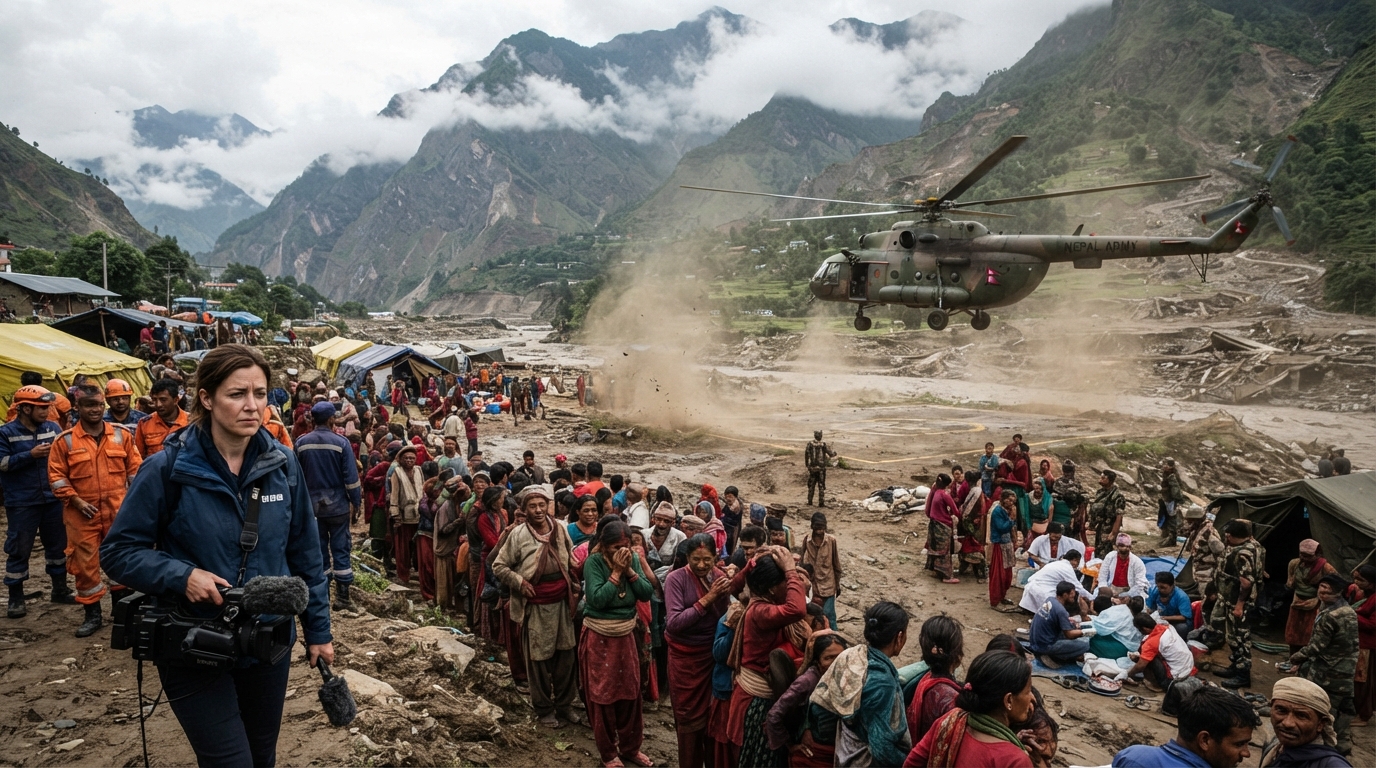
"A woman died right before my eyes," recounted a BBC journalist in Nepal, describing a scene of profound tragedy.
A woman rescued by the Nepali Army on Thursday shared that her husband, father, and mother remained unaccounted for following the catastrophic flood near the Nepal-Tibet border.
Search and rescue efforts are ongoing in Nepal after flash floods and massive landslides struck the Nepal-Tibet border region, claiming over 400 lives.
Hospitals, overwhelmed by the sudden influx of patients, are struggling to cope. At least 900 injured survivors have been rescued from the hardest-hit areas. Many other survivors are desperately searching for their loved ones, as hundreds of individuals are still missing.
Shreejana Shrestha of BBC Nepali traveled to Nuwakot, a severely affected district in central Nepal, to visit an army camp transformed into a search and rescue hub. She described the scene:
"I entered the camp to an absolutely heartbreaking scene. Hundreds of people were queuing outside, desperately trying to see if they could find their loved ones. Inside, a woman cradling an infant in her arms was crying hysterically. Her entire family, including her father, husband, and mother, were all missing. She was traumatized, and in so much pain."
She also observed other injured individuals and some who spoke of their miraculous survival.
One driver, who had been working in Rasua, recounted being swept into the water when the floods hit. He expressed bewilderment at his survival but was also devastated, having lost over 20 friends. Shrestha noted his inability to focus and his tearful state when she attempted to speak with him.
According to officials, the Nepalese government mobilized at least 12 helicopters to continue search and rescue operations.
Shrestha recounted a particularly harrowing moment: "At one point while I was filming, a woman — perhaps in her 60s or 70s — was taken out of a helicopter and brought to the center to be treated. She suddenly collapsed as I was recording, and I later learned that she had died. It is difficult to describe what I saw."
She described the constant activity at the camp: "Every hour at the camp there were dozens of helicopters coming and going, and many people being treated. Whenever these helicopters came, people would just look at them with a ray of hope that their loved ones would be inside. And even as the helicopters landed, blowing gusts of wind and mud down on everyone, people still didn't look away — just to see if they could catch a glimpse of who might be on board."
After leaving the camp, Shrestha and her team attempted to access the internet to share their findings, but connectivity was extremely poor. They subsequently drove approximately three hours back to their office in Kathmandu.
Shrestha reflected on her experience: "Disasters are something I have covered several times in Nepal, but this is one of the most heartbreaking I have ever seen. There was a woman who was dying just behind me, and I didn't know how to process that. It was so painful to witness. But as a journalist you do your job: you continue getting, and giving, as much information as possible."
The report also included sections titled "Tracing the deadly path of the Nepal-Tibet flash flood" and "What we know about deadly Nepal-Tibet floods."