

"Fog, water, and a struggle for every gram." How the international fishing tournament in Udomlya unfolded. Photos and video
Fishing has its own athletic drama: the silence before the bite, the tense anticipation, and the struggle for every gram of the catch. But on Lake Udomlya (Tver Region in Russia) at the end of September, the first test for the participants of the international fishing tournament organized by Rosatom was nature itself.
"Fog, Water, and the Fight for Every Gram": Inside the International Fishing Tournament in Udomlya. Photos and Video
Fishing has its own sports drama: the silence before the bite, the tense anticipation, and the fight literally for every single gram of the catch. But on Lake Udomlya in Russia’s Tver region in late September, nature itself became the first test for the participants of the international fishing tournament organized by Rosatom.
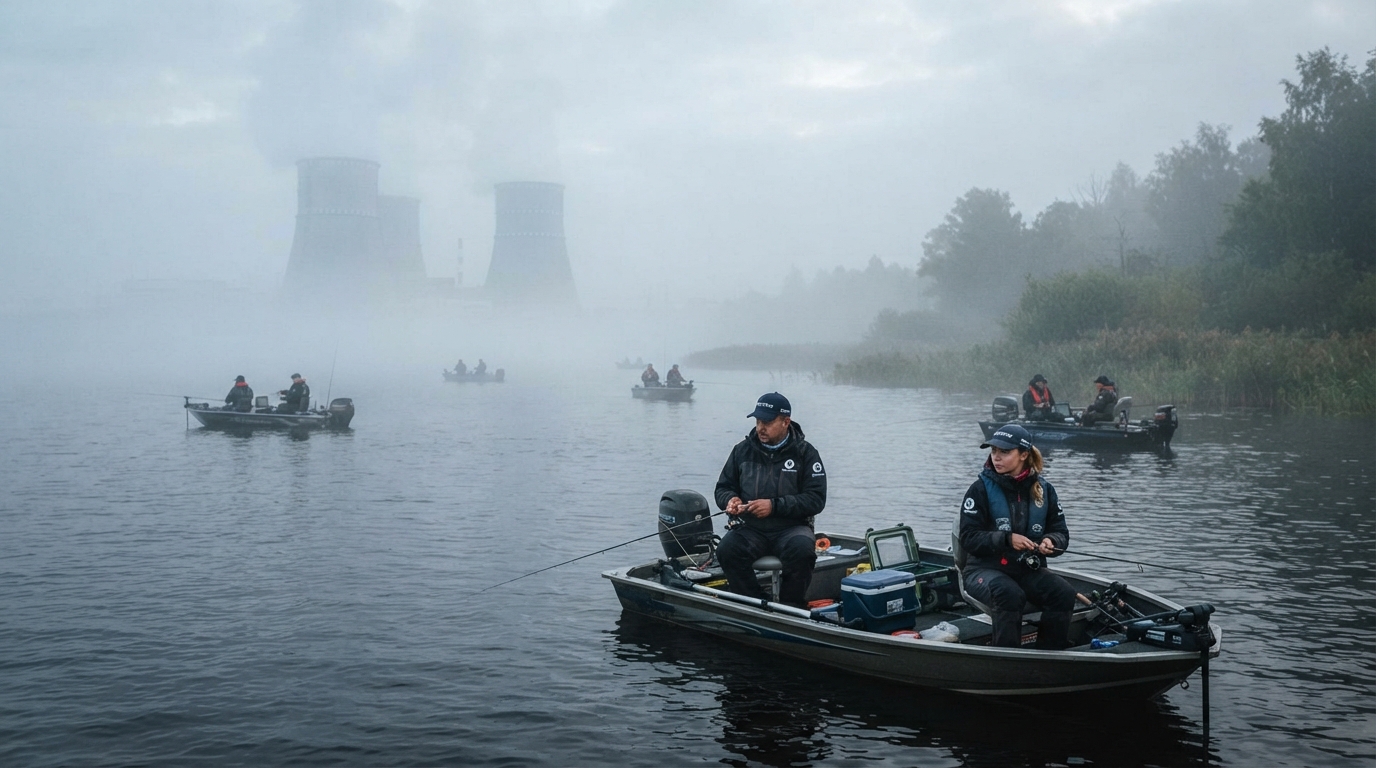
In the mornings, the lake was hidden beneath a dense fog. A white veil concealed the opposite shore along with the cooling towers of the Kalinin Nuclear Power Plant towering over the water. Neither the usual outlines of the bank nor distant landmarks were visible. The lake seemed to end where the eyes could no longer see, and the familiar landscape seemed to cease to exist for several hours.
The fog lifted only closer to noon, when the sun rose toward its zenith. Gradually, the shoreline and the contours of the surrounding landscape emerged from the haze. The lake returned to its usual appearance, opening up space for those who came here not just to relax with a fishing rod, but to test themselves in a competition with rivals and the elements themselves.
The international tournament brought together participants from various countries in Udomlya. For some, fishing is a long-standing hobby; for others, it is a chance to test themselves in a sporting discipline where the result depends not only on luck, but also on experience, stamina, chosen tactics, and the ability to read the body of water. Beneath the outward leisureliness of the process lie calculation and an intense struggle where every detail can matter.
At the same time, the tournament was an occasion to take a closer look at Udomlya itself — a town whose life is closely linked to the Kalinin Nuclear Power Plant. Here, the natural landscape and large industrial infrastructure coexist, while the lake remains a meeting place for local residents, fishing enthusiasts, and guests from other countries.
What attracted the participants of the international competition to Udomlya, how is competitive fishing organized, what place do such events occupy in the life of the town, and do they give an impetus to the development of tourism? A Podrobno.uz correspondent attended the tournament to investigate these questions and understand what stands behind this unusual format.
## Why Does Rosatom Need Anglers from All Over the World?
Twenty-two amateur athletes, as well as 28 journalists and experts from 11 Rosatom partner countries that are implementing or planning nuclear energy projects, took part in the "nuclear" fishing tournament on Lake Udomlya. Among them were Bangladesh, Belarus, Egypt, Hungary, India, Indonesia, Malaysia, South Africa, Turkey, Uzbekistan, and Vietnam. Representatives of the Environmental Protection and Radiation Control Department of the Kalinin NPP also joined the event.
The international fishing tournament is being held for the fourth time. Over this time, it has evolved into a Rosatom educational project. The competition also has its own geography: the first two tournaments took place near the Leningrad NPP, and in 2025, the participants traveled to Mersin Province in Turkey, the construction site of the Akkuyu NPP. This year, the tournament was hosted by Udomlya, a town whose life is closely tied to the Kalinin Nuclear Power Plant.
Fishing as part of this project is not just a fight for the largest catch. It is also an opportunity to see how the territory around the nuclear station lives, and to get acquainted with its nature and the plant’s operations.
"The International Fishing Tournament has already become one of Rosatom's flagship educational events, allowing us to demonstrate the environmental friendliness of nuclear energy. Foreign guests can see with their own eyes that nuclear power plants not only do not harm the environment, but also become a driver of regional development. Such events also demonstrate Rosatom's openness and help build a trust-based dialogue with the population of countries starting the implementation of their own nuclear projects," said Alexandra Justus, Deputy Director General for Communications at the private institution Rosatom International Network.
The choice of Udomlya for the tournament was also not accidental. The organizers wanted to introduce foreign guests to the environmental protection activities of the Kalinin NPP and show the measures the plant takes to conserve aquatic biological resources. In 2025, the enterprise conducted four artificial stocking events in Lakes Pesvo and Udomlya, which are used in the power plant's cooling system. According to the provided data, the fish stock in these bodies of water stands at about 740 tons.
In the same year, the Kalinin NPP won first place among Rosatom enterprises in the "Environmentally Exemplary Nuclear Organization" contest. According to environmental monitoring data, the plant's impact on surface and ground waters, soil, atmospheric air, and background radiation is assessed as minimal.
According to Ruslan Alyev, Chief Engineer of the Kalinin NPP, it is a great honor and responsibility for the plant to host this event, as representatives from many countries came as guests to learn about the NPP's operation, verify the safety of the technologies, and learn more about the plant's environmental protection activities.
At the same time, as the organizers explained, the idea for an international fishing tournament emerged following a story related to the construction of the Kudankulam NPP in India. Agreements on project implementation were reached at the level of the leadership of both countries; however, establishing a full-fledged dialogue with local residents, particularly fishermen, proved difficult.
For coastal communities, fishing was the main source of income. People feared that the arrival of a nuclear plant would lead to a reduction in fish stocks and a deterioration in the quality of the catch. These fears erupted into protests against the construction of the NPP.
To dispel these doubts, representatives of fishing communities were invited to an operating nuclear plant in China. There, they were able to talk with local fishermen and learn how proximity to the NPP affected their lives. According to the organizers, Chinese colleagues shared that the quantity of fish had not decreased, and the town's development — driven in part by the plant's operation — opened up new opportunities for local residents. Cafes and restaurants appeared, and opportunities for selling catches expanded.
The personal experience of people who found themselves in a similar situation played a big role. Communicating with local fishermen, who were easier to trust than official representatives, helped the Indian guests take a different look at the prospects of constructing the plant.
That is how the idea for an international fishing tournament near nuclear power plants was born. Its participants — journalists, experts, and fishermen from countries where nuclear projects are already being implemented or are only planned — get the opportunity to see with their own eyes how the territories near NPPs live, talk to local residents, and form their own opinion on the impact of nuclear energy on the environment and people's lives.
Looking ahead, it should be noted that in the future, a similar tournament could very well take place in Uzbekistan, which is also developing nuclear energy and constructing its own nuclear power plant.
## "Nuclear" Fishing
The first day of the tournament on Lake Udomlya was dedicated to practice. From early morning, participants went out on boats to explore the lake, assess fishing conditions, and select lures and baits for different fish species.
The organizers took care not only of the competitive side of the event, but also of practical matters. A tent was set up on the shore of the lake where participants could warm up with hot tea or coffee and grab a hot meal. A generator was running, so phones and other devices could be charged if necessary.
Local fisherman-guides took the wheels of the sports boats. They were supposed to transport the teams to fishing spots well known primarily to themselves. Under the tournament rules, only four fish species counted: catfish, pike, perch, and zander. Foreign participants were to get acquainted with these species and the specifics of catching them during the practice session.
When the boats set off into open water, they gradually dissolved in the thick fog. Journalists remained on the shore, waiting for the judges' signal allowing them to follow the fishermen out onto the lake.
The weather was chilly, especially for guests from warm countries. However, the organizers had foreseen this as well: all participants were provided with professional gear. After the signal, journalists hurried to find their teams, but doing so proved difficult. The fog obscured the boats from view, and even navigation instruments did not always help to quickly find one's bearings.
Poor visibility complicated the task not only for journalists, but for the fishermen themselves. Furthermore, fog was not the only difficulty: many participants noted that fishing conditions on Lake Udomlya differed noticeably from those they were used to in their home countries.
For instance, a representative from Uzbekistan said that fishing in Udomlya is very different from what he does in Bukhara and Samarkand. Fish species not found in his home waters, such as pike, live here. Moreover, the behavior of familiar species turned out to be different.
"Even the zander bites differently here, and that makes fishing a bit difficult. If we could fish here for at least a week, we could better understand the behavior of the local fish. Back home, predatory fish usually start biting after sunset — that's when zander and snakehead bite. Here, as I was told, you can catch fish both during the day and closer to the evening," he shared.
Nurjan Suleiman, a participant from Indonesia, also shared his impressions. For him, not only the local climate turned out to be unusual, but also the fishing format itself: at home, he was used to sea fishing, and found himself on a lake for the first time.
"In Indonesia, in my province of North Maluku, we usually catch fish in the sea. But this is my first time fishing on a lake. I suppose that is the main difference: in Russia, fish are caught more often in freshwater, and in Indonesia — in seawater," he said.
Thus, the practice day became an opportunity for participants not only to prepare for the competition, but also to get acquainted with unfamiliar fishing conditions, compare experiences, and learn more about each other's fishing traditions.
The first day's program did not end there. The organizers also prepared a cultural segment for the guests: participants visited historical sights and the Udomlya Local History Museum.
## An Uzbek Accent
The second, decisive day of the competition began just like the first — with an early, foggy morning on the lake. The thick haze impressed the participants so much that one of the foreign athletes exclaimed: "It's as if I am in heaven standing in the clouds, and Udomlya will now remain in my memory as paradise on earth."
Before the start, the organizers issued identification vests to the participants and conducted a draw to determine the order of departure onto the lake. The team from Uzbekistan was represented by two experienced fishermen — Oybek Zukhurov from Bukhara and Aziz Rajabov from Samarkand.
It would seem that fishing is a purely male pursuit. However, the chief judge of the tournament, All-Russian Category Judge Alla Kalinicheva, holds a different view. Before the start, she held a briefing, reminded the participants of the competition rules, and wished them luck. In anglers' language, it sounds like this: "Neither tail nor scales!"
After that, the athletes took their seats in the boats, lined up in a ceremonial formation, and, on the judges' signal, set off to fish. The tournament had begun, and now everything depended on the skill of the participants and angler's luck.
Three hours of intense fishing lay ahead. In order not to spook the fish, the athletes tried to remain silent, concentrating on finding a big catch. Each caught fish was weighed and evaluated for size and species under the supervision of the guides, after which it was released back into the lake. This was a mandatory condition of the tournament: as the organizers emphasized, the main thing is not to harm nature. It is precisely a careful attitude toward the body of water that distinguishes competitive fishing.
The weather on the second day did not spoil the participants either: the lake was still blanketed in fog, overcast, and chilly. But now this surprise no longer flustered the athletes. Everyone focused on their own tactics and selected lures: some fished with spinners, others with crankbaits or silicone lures. There were also those who brought along special fishing secrets and were in no hurry to reveal them to rivals. Such is the fishing community: on shore, everyone is great friends, but on the water, everyone has their own tactics.
Closer to noon, the fog began to clear, and navigating the lake finally became easier. In the distance, the huge cooling towers of the Kalinin NPP appeared. On the way to the Uzbek team, we met athletes from various countries — Vietnam, India, South Africa, Malaysia, Turkey, Hungary, and others. Each occupied their own section of the water and was immersed in fishing.
The team from Uzbekistan was stationed far from the shore, closer to a shoal, making them difficult to reach. Oybek and Aziz hoped to catch a large predator and thus make a statement in the competition.
However, luck was not on their side this time. Oybek Zukhurov said they were assisted by a professional guide, Dmitry, who knows the lake well. The team bet on pike, but despite four good bites, the fish got away every time.
Oybek has been fishing for about 25 years. During this time, he managed to catch a catfish weighing approximately 70 kilograms. His biggest trophy this year was a carp weighing 7.4 kilograms, which he landed at Tudakul in the Bukhara region.
"Things like this happen: even if you are a professional fisherman or an amateur, sometimes the fish just don't bite, like today, for instance," shared Aziz Rajabov, the second participant of the Uzbek team.
According to him, even their experienced guide was surprised by such a result. The fishermen expected to win by landing one large fish, but failed to realize their plan.
"Sometimes such misses happen. But the main thing is participation," concluded the speaker.
The Uzbek team's guide, Dmitry — a professional fisherman and candidate master of sports — also prefers to catch large fish and strives to beat his own records. On Lake Udomlya, he has managed to pull out catfish weighing up to 32 kilograms.
Speaking about the features of local fishing, Dmitry noted that much depends on the time of year. At the same time, you can fish here year-round — both in winter and summer. Many species inhabit the lake, including sturgeon, tilapia, carp, grass carp, as well as freshwater shrimp. He called zander one of the most difficult fish to catch: it can stay at various depths — from shallow waters to 16–18 meters.
According to Dmitry, sport fishing needs to be developed. It is not only an opportunity to test one's skills and compete for a trophy, but also a way to spend a whole day in the fresh air. In addition, such competitions can contribute to the development of the region and fishing tourism. The tournament itself, the speaker believes, helps demonstrate that local waters retain their natural character and remain a place for fishing.
"These are natural lakes from which we still eat fish and have no problems," Dmitry said. He also called nuclear energy a clean source of energy. When asked about the safety of local fish, the speaker answered in the affirmative, emphasizing that, in his opinion, it poses no threat to health.
Meanwhile, the three hours allocated for fishing were coming to an end, and the teams returned to base one after another. Sailing past the fishermen from South Africa, we noticed one of the participants joyfully raising his catch of several hundred grams above his head and shouting: "Catfish, catfish!" It turned out to be a channel catfish.
On the shore, the captains handed the catch logs over to the panel of judges. The competitive part of the tournament had ended — it remained to tally the results and find out who would get the awards.
## A Catch of Trust
But before that, one of the most important procedures of the tournament awaited the participants — dosimetric control of the catch. Specialists checked the caught fish to determine the level of radiation and demonstrate how safe it is from this point of view.
Andrey Danilkin, head of the Environmental Protection Department at the Kalinin NPP, explained why such control is important not only for the competition participants, but for everyone interested in the environmental situation in the region.
"We know that the environmental condition of the region where the Kalinin NPP is located is favorable. We have objective data. But it is important to us that other people know about it too and can see for themselves. Operating experience with nuclear facilities shows that these technologies are environmentally friendly and can be categorized as green. We consider it very important to spread the experience of the successful use of such facilities while preserving the environment," the specialist noted.
According to Danilkin, the nuclear power plant's impact on atmospheric air, water bodies, and soil is minimal. The main impact that such facilities have on the environment relates to thermal impact on water bodies.
This is especially clear using the Kalinin NPP as an example: natural bodies of water — Lakes Pesvo and Udomlya — operating in a recirculating water supply system are used to cool the plant. Their total volume is about 150 million cubic meters. When all four power units operate simultaneously, this entire volume passes through the plant's systems about 50 times a year. At the same time, the lakes belong to the highest fishery category. As the specialist emphasized, this is one of the objective indicators of the favorable state of the water bodies under NPP operation.
Long-term monitoring also plays an important role in assessing the environmental situation. Viktor Duleichik, head of the Radiation Safety Department at the Kalinin NPP, stressed that observations and studies indicate a minimal radiation impact of the plant on the environment.
"Today, by measuring the fish you caught, we can show this with a concrete example. As you can see, the dosimeter readings do not exceed natural background values. From a radiation perspective, this testifies to the safety of the fish," Duleichik explained.
After the check, the specialists carefully released the fish back into the lake. However, dosimetric control is only a part of the environmental monitoring conducted in the area of the Kalinin NPP. A separate research area is related to the impact of the plant's operation on the ecosystem of Lakes Pesvo and Udomlya, including the ichthyofauna.
According to Andrey Danilkin, despite the constant heating of the water, the bodies of water continue to develop naturally: the ecosystem independently maintains balance and recovers. This is one of the important criteria of environmental well-being.
The most noticeable changes occurred in the species composition of the fish. Due to the increase in water temperature, burbot disappeared from the lakes, but new species appeared in these waters, including black carp, silver carp, grass carp, common carp, tilapia, and channel catfish. Freshwater shrimp also lives here. At the same time, changes in higher aquatic vegetation, phytoplankton, and zooplankton, according to the specialist's assessment, are insignificant.
Studies of fish stocks are conducted approximately once every five years. The latest took place in 2024 and showed that the total amount of fish in the water bodies did not decrease, but increased. At the same time, the numbers of certain native species — roach, bream, zander, and pike — slightly decreased, but no significant changes in the composition of native ichthyofauna were identified.
According to Danilkin, the increase in total fish stocks is primarily associated with the appearance of new species. Monitoring these changes remains an important part of assessing the state of the lakes' ecosystem.
## Awards and New Friends
In the evening, when the competition was behind them, the participants gathered for the award ceremony. The organizers summarized the results of the contest and honored the teams that distinguished themselves in various nominations.
In the "Biggest Fish" nomination, the Malaysian team won: its members caught a zander weighing 1.7 kilograms. The Hungarian team received the prize in the "Will to Win" nomination, and the Russian team became the winner in the "Biggest Catch" nomination — its members caught the largest number of fish species inhabiting Lake Udomlya.
Tatiana Kern from Hungary was the only female angler among the tournament participants, apart from the chief judge. She became the winner of the "Will to Win" prize and admitted that the competition in Udomlya gave her new experience. Tatiana noted the boat trips, the professionalism of the guides who know the local lake well, and especially the morning fog that gradually cleared, revealing the beauty of the surrounding nature.
The fishing method itself also turned out to be unusual. At home, Tatiana was used to fishing differently, so at the tournament she had to master crankbait fishing. She even called her brother by phone for advice. As a result, Tatiana caught two fish — a perch and a zander. The total weight of the catch was about 800 grams.
"Yesterday, when we were practicing, we caught nothing. But today the goal was to catch at least something. So we achieved our goal," she said.
Tatiana stressed that such events are important to her not only as a competition. She has Russian roots — her mother is originally from Russia — and she confessed her love for the country. According to her, the tournament provides an opportunity to meet people from different states, learn more about their lives and work, including in the field of nuclear energy.
"It is always good — it's like gathering new people, new friends," Tatiana shared.
And all tournament participants probably agree with this: such meetings bring together people of different nationalities, help them get to know each other better, and make new friends.