

4th International Fishing Tournament in Udomlya. Fishing that brings countries together
In the final days of September, Lake Udomlya, located in the Udomlya Municipal District of the Tver Region, hosted the IV International Fishing Tournament organized by the State Corporation "Rosatom". Tournaments of this kind are a rarity for our region, and it was intriguing to see in person and feel the emotions and moods of amateur athletes from different countries, as well as their competitive spirit. And, of course, without hesitation took [...]
**4th International Fishing Tournament in Udomlya. Fishing that Brings Countries Together**
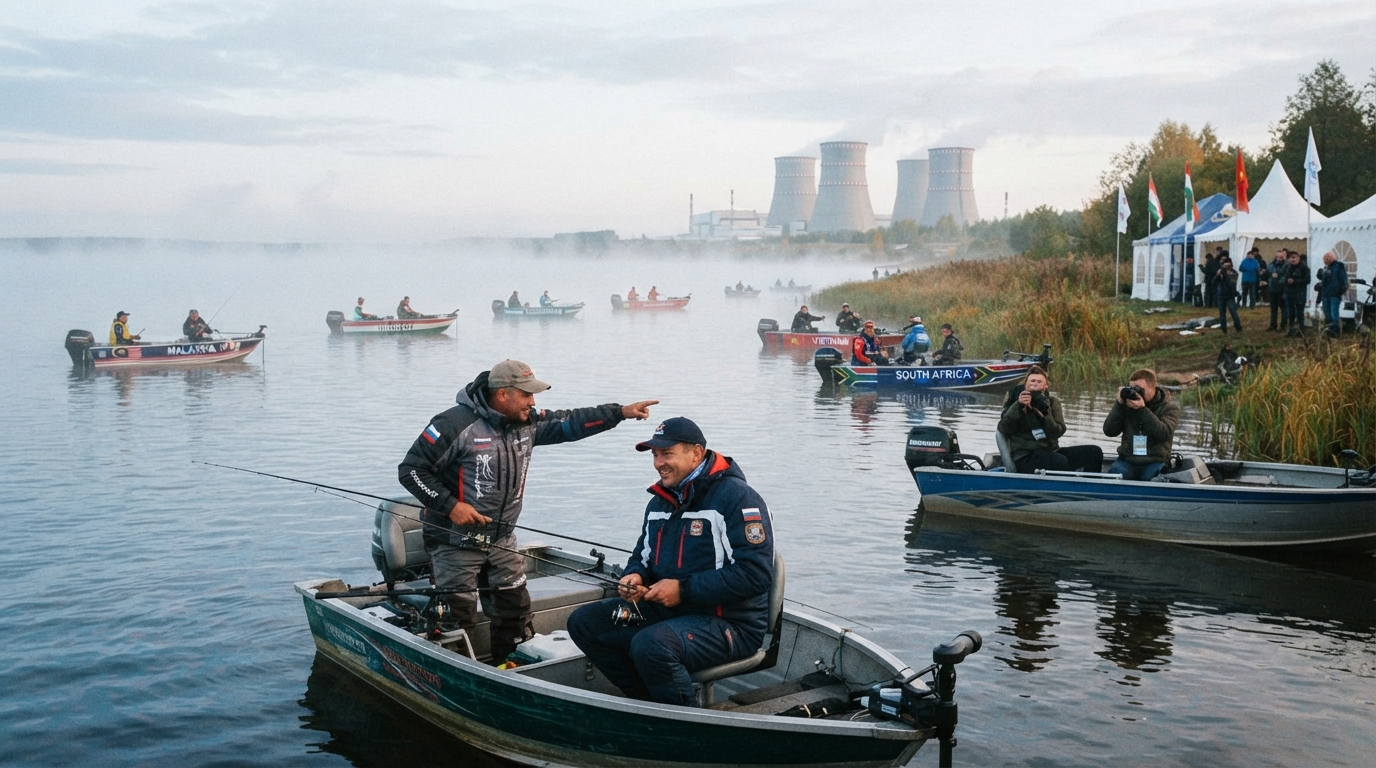
In the final days of September, Lake Udomlya, located in the Udomlya Municipal District of Tver Region, hosted the 4th International Fishing Tournament organized by the Rosatom State Corporation.
Such tournaments are a great rarity for our region, so it was especially interesting to see everything with our own eyes and to feel the emotions and mindset of amateur athletes from different countries, as well as their competitive spirit. There was no need to hesitate — the invitation to visit the anglers' competition was accepted immediately.
We are no big experts in fishing, so we tried to learn about all the nuances of the tournament, as they say, firsthand. As we were explained, this tournament differs noticeably from sports fishing competitions. While in sports fishing 1st, 2nd, and 3rd places are determined, and depending on the level of the tournament, medals, diplomas, and prizes, including cash, are awarded, this is not the case in tournaments under the auspices of Rosatom.
Here, they simply determine the winning team in the categories "Biggest Fish," "Biggest Catch," and "For the Will to Win." They all share one thing in common: after weighing and measuring, the fish are unconditionally released back into the water.
This format looks more democratic. There is no strict division into prize-winning places — each team can be recognized in its own category for a specific achievement. It turns out that attention is paid not only to the winner, but also to the contribution and result of each team.
Perhaps this explains the trusting, friendly atmosphere at the tournament without tough competition, which ultimately contributes to rapprochement and mutual understanding between countries. Especially since the tournament is more educational in nature rather than a chase for records.
This point was particularly highlighted in her address to the tournament participants by Alexandra Justus, Deputy Director General for Communications at the private institution "Rosatom International Network": "The International Fishing Tournament has already become one of Rosatom's flagship educational events, allowing us to demonstrate the environmental friendliness of nuclear power. Foreign guests can see for themselves that nuclear power plants not only do not disrupt the environment, but also become a driver of regional development. Such events also demonstrate Rosatom's openness and help build a trusting dialogue with the population of those countries that are starting to implement their own nuclear projects."
### What is the essence of the international fishing tournament under the auspices of Rosatom?
Before moving directly to the tournament, it is worth recalling the history of how these competitions came to be. The idea for the tournament arose during the construction of a nuclear power plant in Bangladesh, where local residents, who live mostly by fishing, became alarmed, believing that the NPP would harm the surrounding nature. The fish might suffer, and families need to be fed.
Having no understanding or information, people took to a picket with banners and slogans against the construction of the NPP. Under such conditions, explaining that a nuclear plant is absolutely safe for fish was useless, because people did not know whom to trust.
Then it was decided to simply put representatives of the fishing community on a plane and take them to the nearest operating nuclear plant. At that time, it was a nuclear plant in China. They arrived and saw that local anglers were catching fish perfectly well. There was even more of it.
Since the nuclear plant was operational, all the infrastructure was developing, and accordingly, the economic situation in the region changed: the network of restaurants, cafes, and other retail and catering outlets expanded, and opportunities arose to sell and market fish.
They talked with local anglers, and those said: "What are you talking about, we are only glad that a nuclear plant appeared here." After that, they returned home and said: "We went there, saw everything with our own eyes, and it will be the same for us; on the contrary, we are only in favor of the nuclear plant."
In this connection, the idea arose to regularly organize such international fishing tournaments involving representatives of countries where Rosatom is either building, planning to build, or has already built a nuclear plant, so that anglers could come and see for themselves: here stands a nuclear plant, here is a body of water, and fish live here perfectly well, there are plenty of them, and they are all healthy. This is the main educational idea of the tournament.
### Now about the tournament
22 amateur anglers took to the start, joined by 28 journalists, as well as representatives of the expert community from 11 partner countries of Rosatom that are implementing or planning projects in the field of nuclear energy: Bangladesh, Belarus, Hungary, Vietnam, Egypt, India, Indonesia, Malaysia, Turkey, Uzbekistan, and South Africa.
The organizers took care of comfortable conditions for the tournament participants. A marquee was set up on the shore of the lake, where one could warm up with coffee or tea, grab a hot bite to eat, and use a warm and comfortable chemical toilet, which is especially important during outdoor events in nature. A generator was running, and journalists had no problems charging their equipment and phones.
The first day of the tournament was a practice day. From early morning, the teams went out on boats to get acquainted with the lake, fishing conditions, and to understand what baits and lures to use for various fish.
Local anglers acted as guide-captains, using high-powered motorboats to take their assigned teams to fishing spots known only to them. According to the terms of the tournament, only four species of fish counted: catfish, pike, perch, and zander. It was these fish species and the techniques for catching them that foreign anglers had to get acquainted with during practice.
Finally, all the fishing teams headed out to open water and dissolved in the thick fog, while the journalists remained on the shore awaiting the signal when they too would be allowed to go out onto the lake.
The weather was chilly, and most of the participants had come from warm countries, but the organizers had foreseen this as well, equipping everyone with windproof and water-repellent clothing.
A signal sounded allowing access to the lake, and journalists from different countries went in search of their teams. However, as it turned out, doing so in the thick fog was not easy, despite the fact that the boats were equipped with navigation devices.
Journalists from Uzbekistan found themselves in the company of colleagues from Vietnam, and it so happened that the Vietnamese anglers were found relatively quickly. The Uzbek journalists were out of luck: they failed to find their anglers, there was no connection with them, and apparently they had strayed too far.
The allotted time ran out, and our crew returned to the base. However, the panel of judges, seeing our upset faces, accommodated us and gave us the opportunity to go out onto the lake once more before the end of the practice session, and only then did we manage to find them and capture them on camera. True, due to the fog, we had to breach the regulations that forbid approaching the anglers closer than 50 meters, but what wouldn't you do for good shots.
When the anglers began returning from practice, the first day of the tournament continued with a cultural program, a tour of the town of Udomlya, and concluded with a visit to the local history museum.
### Day two of the tournament
The second, now competitive day also began from early morning. The anglers received identification bibs and held a draw for the order of going out onto the lake.
Experienced anglers Oybek Zukhurov from Bukhara and Aziz Rajabov from Samarkand competed for the Uzbekistan team.
The panel of judges conducted a briefing, gave parting words to the anglers, and wished them good fishing. Then the teams took their places in the boats, lined up in a parade formation, and at the judges' command went off to catch their luck.
Just like on the first day, the weather was chilly and overcast, but by lunchtime the sun came out, the fog cleared, and Lake Udomlya revealed itself in all its beauty. This became especially visible from open water.
Somewhere in the distance, the cooling towers of the Kalinin NPP were visible; here and there, locals were fishing, and cottage settlements, recreation areas, and fish farms—where even trout is raised—were located on the shores. Rumor has it that one of the entrepreneurs has taken up breeding beluga sturgeons.
The water temperature sensor on the dashboard showed +23 degrees. As we moved, the guide-captain explained that the lake does not freeze over; due to the temperature difference, there is almost constant fog here in winter, but fishing does not stop either in winter or in summer. This is due to the fact that the lake serves as a cooling pond for the NPP. At the same time, the water does not interact with the nuclear plant in terms of the primary and secondary circuits.
By the way, one of the Turkish anglers once noticed that the water in the lake is no colder than in Antalya.
However, our goal was the fishing crews, and this time, together with journalists from South Africa, we set out in search of our teams.
Along the way, we came across teams from Turkey, Malaysia, and Hungary, and relatively quickly reached the South African team, which boasted about its catch.
Rounding small islands, almost at the very end of the lake, we found the team of Uzbek anglers who had settled in one of the backwaters. It was shallow water here, and our guide-captain, switching off the main engine, slowly guided the boat using an electric trolling motor.
Our anglers were fishing attentively. Fishing likes quietness, and after circling around them and taking footage, we withdrew just as quietly and slowly back to deep water.
The time allotted for catching fish was coming to an end, and teams were returning to the base one after another. The boat captains handed over the catch protocols to the panel of judges, and with that, the competition concluded.
However, another procedure awaited the anglers on the shore. Before the eyes of the tournament participants, specialists from the Kalinin NPP conducted radiation control on part of the caught fish.
Andrey Danilkin, Head of the Environmental Protection Department at the KNPP, explained why this control was needed: "We know that the environmental state of the region where the Kalinin NPP is located is healthy. We have objective data on this. But it is very important for us that other people know it too and see it for themselves. The operating experience of nuclear facilities shows that these technologies are environmentally friendly, that they can be classified as green technologies. And we consider it very important to replicate the experience of successfully using this kind of nuclear facility while preserving the environment."
His words were confirmed by Viktor Duleychik, Head of the Radiation Safety Department: "Long-term monitoring and research show that nuclear plants have a minimal impact on the environment. And today, by taking advantage of measuring the fish you caught, we can show this to you. As you can see, the dosimeter shows that the dose rate does not exceed natural background values, which speaks to the absolute safety of this fish from a radiation standpoint."
Since we are talking about the Kalinin NPP, it is worth paying a little attention to the plant itself.
### A few words about the Kalinin NPP
Let us briefly diverge from the fishing topic and talk about the KNPP, where a technical tour was organized for the tournament participants for the sake of complete information and understanding.
The Kalinin NPP is located in the north of Tver Region in the Udomlya Municipal District, 150 km from the city of Tver. The NPP site is located on the southern shore of Lake Udomlya. The installed capacity of the plant is 4000 MW, and it consists of two phases. Each phase includes two VVER power units with a capacity of 1000 megawatts. Today, VVER reactors occupy one of the leading positions in the world in terms of safety and reliability, high unit capacity, and economic efficiency. The efficiency of VVER reactors is proven by their successful operation — over 1000 reactor-years of accident-free operation.
The NPP is the largest electricity producer in Central Russia; it generates 82% of all electricity produced in Tver Region, 14% in the Central Federal District of Russia, and its share in the total electricity generation of JSC Concern Rosenergoatom is about 15%.
At a meeting with tournament participants after the tech tour, Ruslan Alyev, Chief Engineer of the KNPP, emphasized: "You have acquainted yourselves with the operation of our nuclear plant, and now you can see the safety of the technologies for yourselves and learn in more detail about the environmental activities of the enterprise."
### Gathering impressions
But let us return to the topic of our tournament, which concluded in the evening with a summary of the results and the awarding of the winning teams.
In the "Biggest Fish" category, the Malaysian team won: the anglers managed to catch a zander weighing 1 kg 700 g.
The team representing Russia won in the "Biggest Catch" category, having caught the largest number of fish species inhabiting Lake Udomlya, while the team from Hungary won the prize in the "Will to Win" category.
Tanja Kern from the Hungarian team was delighted with the tournament: "It was very beautiful, the whole lake was covered in fog. And today was even better because when we started there was fog, and an hour later it became sunny and even more beautiful. Nature is very beautiful.
I have lived next to a nuclear power plant all my life; I am originally from Paks. So for us, a nuclear power plant is just normal. We also monitor environmental cleanliness and conduct various projects for those who are not very familiar with nuclear power plants. So I can say that a nuclear power plant is good. So many people simply do not understand how a nuclear power plant works. And I think there is nothing to be afraid of. It is the cleanest energy."
"During the competition, I saw for myself that the lake is safe: fish live here, reproduce, and can be eaten – this made me very happy. We managed to catch the biggest fish of the tournament – a zander weighing 1.7 kg. For me, this is also the biggest fish I have ever caught," shared Mohamed Fairuz Abdul Farid, an angler from the Malaysian team.
The anglers from Uzbekistan did not achieve great success, but as Oybek Zukhurov put it, the main thing is not winning, but participating.
"This time luck turned away from us a little bit today. That happens, regardless of whether you are a professional angler or an amateur, it happens that the fish just won't bite. We were hoping for a big fish, so we went for pike. We had four good bites, but as it turned out, the fishing was unsuccessful. We set ourselves the goal of winning with one single large fish. Well, sometimes such miscalculations happen. But you know what? The main thing is participation, not winning," Oybek Zukhurov said optimistically.
He also noted the friendly nature of the tournament, where people of different nationalities understand each other without knowing the interlocutor's language, using sign language instead.
### And now for a personal impression
International fishing tournaments under the auspices of Rosatom indeed bear, above all, an educational character. The tournament participants were able to see this with their own eyes.
The fishing community is specific. Not every angler will share their secrets, but on the shore this does not prevent them at all from remaining friends. And as the course of the tournament showed, previously unfamiliar people quickly established contacts and understood each other without a word.
Perhaps this is another function of the tournament — to foster friendly relations between people and communities, and as a result, rapprochement between countries.
And to top off this extensive report, I suggest finding some time at your leisure, stocking up on patience for about an hour and a half, and watching a video about the past tournament.
Angler from Uzbekistan Oybek Zukhurov edited a video from the best clips provided by the organizers, anglers, and journalists, and presented it to the organizers as a keepsake of the past tournament. The film turned out to be interesting, educational, and I assure you that you will enjoy watching it.