

Five years of change: life for families with children with rare diseases is changing in Uzbekistan
On October 10, the international women's public talk "Changing the System, Changing Lives: Women in the World of Rare Diseases" took place in Tashkent. Exactly five years ago, a gene dermatoses department was opened in the capital of Uzbekistan – the first specialized institution of its kind in Central Asia, established on the initiative of Alena Yartseva (Kuratova), President of the ANO "Rare Women" and founder of the "Butterfly Children" and "Kapalak Bolalar" foundations. Alena [...]
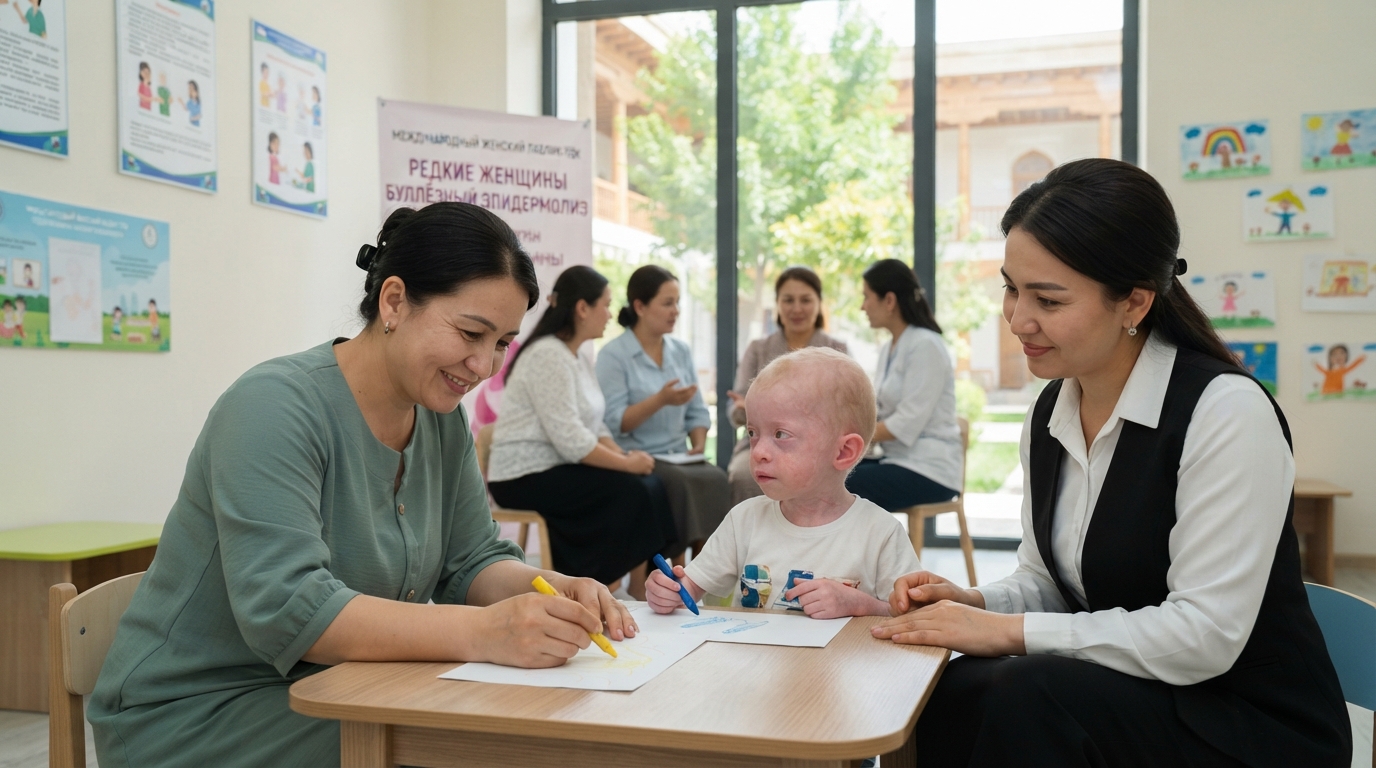
Five years of change: life is changing for families with children with rare diseases in Uzbekistan
On October 10, an international women's public talk titled "Changing the System, Changing Lives: Women in the World of Rare Diseases" took place in Tashkent.
Exactly five years ago, a genetic dermatoses department opened in the capital of Uzbekistan — the first specialized facility of its kind in Central Asia, created on the initiative of Alyona Yartseva (Kuratova), President of the ANO "Rare Women" and founder of the "BB Children" and "Kapalak Bolar" foundations.
Alyona Yartseva (Kuratova) has been helping families raising children with orphan diseases for over 15 years. Since 2022, she was the first in Russia to begin shaping a new agenda for supporting mothers whose children suffer from rare diseases, including genetic dermatoses, through employment support, education, and psychological assistance.
"I first came here in 2018 and saw children whose parents didn't know how to care for skin with epidermolysis bullosa and were using newspapers for it. By that time, the 'BB Children' foundation had been operating for seven years; we had accumulated significant experience, trained doctors in various countries, and published several books. What I saw in Uzbekistan overwhelmed me. I remember carrying dressing materials in suitcases.
But just six months later, I assembled a team in Uzbekistan. I saw that there was a responsive professional medical community and active volunteers here. We turned to Alisher Usmanov with a request to support the project. It was fundamentally important for us not merely to receive funding, but to completely change the aid system in five years so that it would be implemented at the state level and continue to work independently.
The assigned task was completed on time. We did not want to stay here forever; our goal was to create conditions that would allow local specialists to move forward independently. Today, we have a strong team and a specialized center.
— In your opinion, why did Uzbekistan move so quickly from the initial identification of patients with a disease that was unknown to many at the time to state support and funding?
— I believe that Uzbekistan's experience in the field of genetic dermatoses is unique. Many patient communities in various countries, including Croatia, Russia, and Singapore, took years to achieve the results that Uzbekistan reached in a relatively short time. In just three years, epidermolysis bullosa was included in the list of rare diseases, state funding appeared, and a large medical community formed around the problem.
Most importantly, the disease ceased to be perceived by society as something unknown and incomprehensible. Families no longer isolate themselves; they step out into society and talk openly about their problems.
I believe all of this became possible thanks to a unique confluence of circumstances: interested people, professionals, and a person who believed in the project and provided the necessary funds were found here.
In my view, the support of the international community also played a major role. International cooperation helps to properly build work with the state, the media, patient communities, and volunteers, taking into account best practices while adapting them to local conditions, mentality features, and the state structure. It allows us not to repeat the mistakes that other countries have made many times, but to use the accumulated experience to develop our own aid system.
— Over the five years since the work began, has society's attitude toward such patients changed? Can Uzbekistan's experience serve as an example for other Asian countries?
— It cannot be said that the mentality has completely changed, but there are certain shifts. I believe that Uzbekistan can serve as an example for countries in Central and Southeast Asia, as they share many similar social and cultural characteristics.
Today, it can be stated that Uzbekistan holds a special place in the region in developing aid for patients with epidermolysis bullosa. The center created in Tashkent can become a hub of expertise for the entire region. This is not just a department where children undergo treatment. Clinical practice, genetic diagnostics, and social support for patients are combined here. It is precisely a comprehensive approach that allows us to achieve results.
In my view, Uzbekistan has accumulated significant experience in studying and treating genetic dermatoses, which can be disseminated to other countries as well. We have already offered this model to Tajikistan, Kazakhstan, and Kyrgyzstan. It involves interaction between the professional medical community, the state, and non-governmental organizations. When all these elements work together, a system is formed that is capable not only of identifying problems but also of finding ways to solve them.
— You are also involved in supporting mothers whose children have been diagnosed with severe conditions. How did this direction arise?
— As a result of communicating with patients and their families, it became obvious how important a role the mother plays in a child's life. Whether therapy will be organized effectively and whether the child will be able to become socially active largely depends on her psychological state, her sense of personal stability, and the presence of support.
If a woman perceives herself exclusively as a victim, feels stigmatized, and is left alone with the problem, it affects the entire family. If she receives support and can maintain an active stance in life, the situation unfolds differently.
The "Rare Women" project has been developing since 2020. Last year, it became an independent organization, and its goal is to create conditions for systemic support for mothers raising children with rare diseases. In April 2026, in Moscow, the ANO "Rare Women" held its first international forum, bringing together over 400 participants from 15 countries and more than 5,000 online viewers.
We are confident that the problem of families can be viewed not only through the prism of diagnosis and medical care, but also through support for the woman, her psychological state, and her status in society.
I am certain that such an approach is relevant for Uzbekistan as well. A woman can take an active position even if she is raising a child with a severe disease.
A mother simultaneously has to become a logistician, a manager, a medical specialist, and a treatment organizer. She must understand the diagnosis, look for doctors, arrange procedures, and resolve many other tasks. Such a burden is extremely heavy and practically incompatible with a normal life without additional support.
It is important for her to abandon the idea of herself exclusively as a heroine who must handle everything on her own. Being in such a role makes it harder for a woman to acknowledge her own fatigue, ask for help, and talk about her difficulties. Therefore, it is important that part of this responsibility be assumed by the state, patient organizations, charitable foundations, and medical specialists.
Our task is to support women regardless of the specific diagnosis their family has faced.
— Thank you for an interesting conversation.