

Feel at home
Tashkent and Seoul draw closer on a technological basis. Uzbekistan and South Korea have prepared a $12 billion investment portfolio
Feel at Home
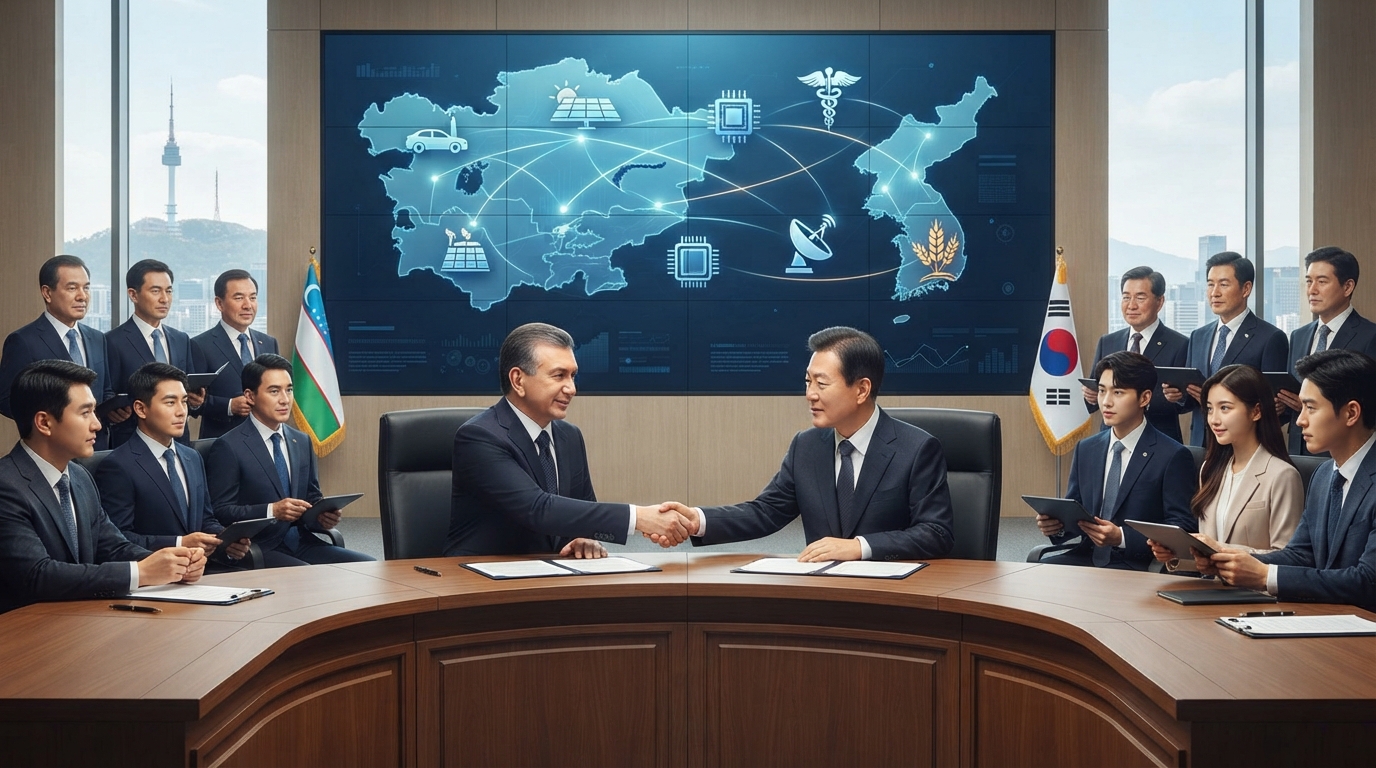
On September 14, President of Uzbekistan Shavkat Mirziyoyev held talks in Seoul with the President of the Republic of Korea, Lee Jae-myung. One of the key outcomes was an agreement to establish an innovative and technological alliance. Following the visit, an investment portfolio of approximately $12 billion was formed, and a strategic partnership program with the Exim Bank of Korea worth $8 billion was adopted. Behind these figures lies Tashkent's desire to attract Korean businesses to manufacture more complex products within the country.
The announced amounts relate to cooperation plans. For now, there is no basis to combine them into a grand total of $20 billion: the composition of the projects and the potential overlap of funding sources have not been disclosed. The real impact will depend on which projects receive funding and reach the launch stage.
At the same time, the partners are building on already existing businesses. More than 700 enterprises with the participation of Korean capital operate in Uzbekistan. Among the major joint projects are the production of KIA cars in the Jizzakh region and the Ustyurt Gas Chemical Complex. The National Children's Medical Center shows that cooperation has long gone beyond the scope of industry. The next step, judging by the agenda of the talks, should link this experience with the development of new technologies.
Mirziyoyev outlined the substance of the Uzbek proposal in an article for the South Korean newspaper The Chosun Ilbo. The President invited Samsung, LG, Hyundai, Kia, Lotte, and other corporations to establish full-cycle production facilities in the republic. Among the promising areas, he named semiconductors, microelectronics, electric vehicles, robotics, and biopharmaceuticals.
During the talks, this topic was further developed in the plans for a technological alliance. It is expected to cover IT, cybersecurity, and digital solutions for medicine and healthcare. For Uzbekistan, the value of such cooperation is determined not only by the purchase of equipment or software. It is important whether local specialists will be able to participate in development, maintain complex systems, and create their own products based on them. The depth to which new technologies integrate into the economy depends on this.
Critical minerals became a separate area of focus. South Korea is interested in stable supplies of raw materials for its industry, while Uzbekistan is interested in exploration and processing technologies. Here, the interests of the partners align, but the content of future projects will be of decisive importance. The more processing stages remain in the republic, the higher its revenues and the demand for skilled labor will be. Therefore, projects where extraction is linked to further industrial manufacturing are particularly important for Tashkent.
These plans have very specific prerequisites: electricity, water, transport, and personnel. The expansion of cooperation in energy, infrastructure, agriculture, and water management, agreed upon by the presidents, is also linked to this task. The question for future investors is how well infrastructure development will keep pace with industrial ambitions.
The educational foundation is already in place. Four branches of South Korean universities and five vocational training centers, established with the assistance of the Korea International Cooperation Agency (KOICA), operate in Uzbekistan. Further training of personnel can be more closely aligned with the needs of joint ventures. For graduates, this opens up the opportunity to apply their acquired knowledge in their home country, and for companies, to find employees locally.
The parties also expressed readiness to develop military-technical cooperation, including expanding contacts between departments, holding joint events, and training military specialists.
At the beginning of the trip, Mirziyoyev met with Uzbek citizens studying and working in South Korea. Their practical experience may also prove useful in the new projects. The humanitarian part of the talks received a dedicated decision: 2027 will be declared the Year of Culture and Mutual Exchanges. It will coincide with the 90th anniversary of the deportation of Koreans to Central Asia. Uzbekistan has the largest Korean diaspora among all countries in the region. The history of the Koryo-saram (the self-appellation of ethnic Koreans living in the post-Soviet states), who survived forced resettlement and became part of Central Asian life, lends a special depth to these ties.
The political agenda included a readiness to develop and expand contacts between parliaments, government bodies, regions, and business circles. The economic agreements will also require work at the level of departments and companies: it is there that the conditions, timelines, and responsibility for project implementation will be determined.
On September 15, President of Kazakhstan Kassym-Jomart Tokayev is also meeting with South Korean leader Lee Jae-myung. Kazakhstan is conducting consistent work to expand cooperation with South Korea.