

Fear and disruption for Ukraine's rail passengers as Russia escalates drone attacks
Ukrainians travelling by train are increasingly caught in the crosshairs of Russia's attacks.
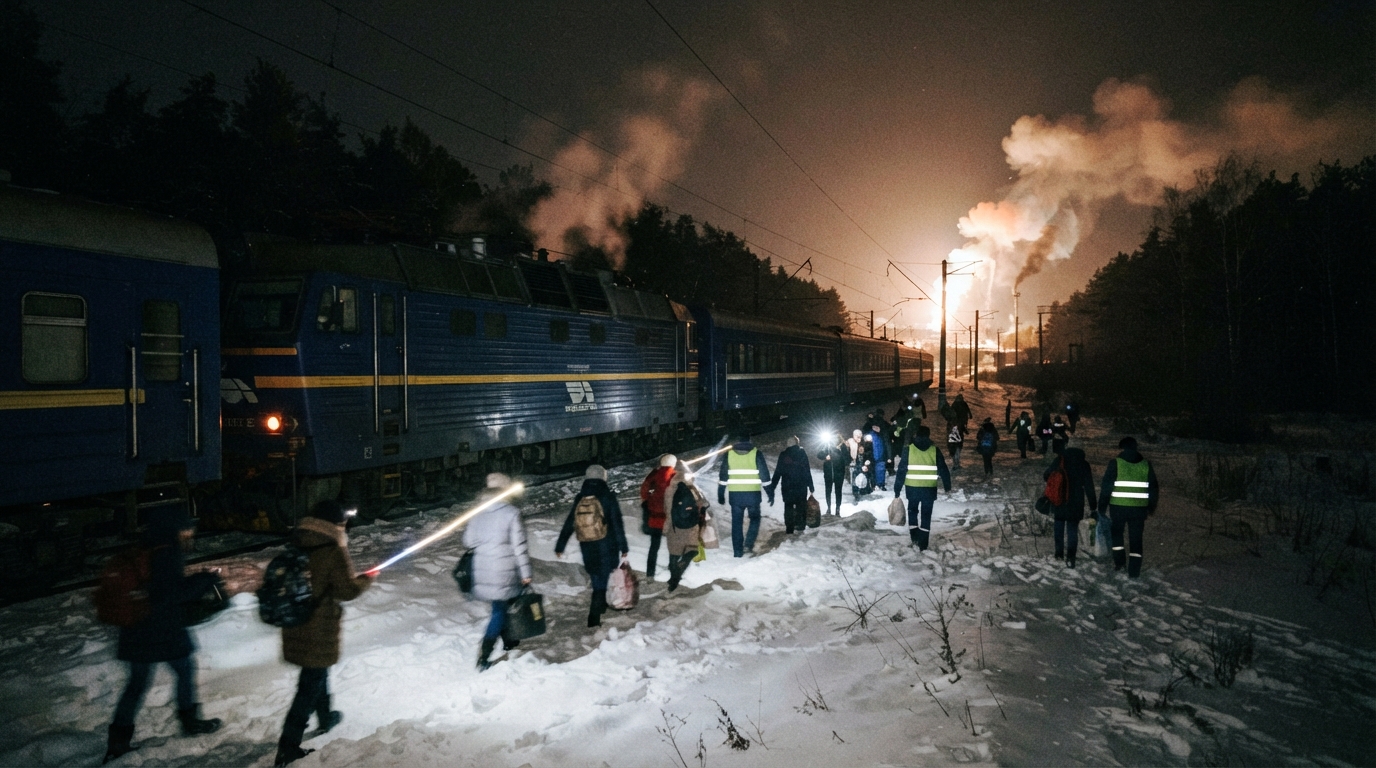
Fear and disruption are growing for Ukraine’s rail passengers as Russia steps up drone attacks
Russian drones began targeting Ukrainian passenger trains at the end of last year.
Ukraine’s railways have helped keep the country functioning since Russia’s full-scale invasion in 2022. But the attacks are becoming more frequent, with more than half of all strikes on locomotives since then taking place this year alone, according to the state-owned operator.
Yuliia Ponomarenko, 27, a marketing specialist from Kharkiv, says her trip to Warsaw last month was abruptly halted just before the Ukraine-Poland border.
“The border guards started running around and shouting ‘Run! Get out of the carriages! There’s shelling!’”
A Russian drone had just struck a locomotive near the same border, and a special train carrying former British Prime Minister Boris Johnson and other European dignitaries had passed through minutes earlier.
Yuliia says passengers on her train were held for six hours while the fire ahead was extinguished and the track was cleared: “We were really lucky that we were delayed a little and it wasn’t our train.”
She is one of a growing number of Ukrainian passengers dealing with disruption and lengthy delays, as air raid alerts trigger emergency evacuations far from the fighting in the east.
In September alone, 5,831 trains had to be evacuated because of Russian drone attacks, state-owned railway operator Ukrzaliznytsia told AFP news agency on Monday. That meant an average of 205 trains were stopped each day.
The attacks appear to be part of a broader assault on Ukraine’s infrastructure, with two bridges hit in Kyiv in recent days and passengers on a metro train caught up in one of the strikes.
Passengers are regularly evacuated from trains and made to wait beside the tracks until the danger has passed.
Seventeen-year-old Anastasiia Ryvbalchenko has also had a close call.
She and other passengers were ordered off their train at 4am near the end of a long journey from Odesa to Kirovohrad on 16 September.
“On my way to Odesa, there had been a lot of evacuations and now on my way back it was happening again,” she says. “I was already thinking that if there was another evacuation, I just couldn’t take it any more.”
An hour and a half later, while passengers waited in the dark, a drone struck nearby.
“There was an extremely loud explosion and everyone started running into the woods,” she said.
It is unclear what the target was, and in this instance the train was not damaged, but with more explosions lighting up the night sky, Anastasiia chose not to stay, continuing on foot before being collected by her parents.
“I’m not going to travel by train anymore,” she says.
Anastassia’s trip was more dramatic than most, but delays — some brief, others lasting hours — are now routine.
Since Russian drones first began attacking moving passenger trains towards the end of 2025, passengers have become used to a familiar pattern: get off the train, check Telegram channels for updates on drone and missile launches, and message friends and family to say the train is delayed.
Anastasiia says she will no longer use Ukraine’s railways after a drone strike near her train last month.
For a railway company that prides itself on punctuality, this year’s disrupted timetable is a major challenge.
“We used to say that during times of war we performed better than some railways in Europe in regular times,” the head of rail operator Ukrzaliznytsia, Oleksandr Pertsovskyi, told us.
“But now the life of our passengers and crew members is the utmost priority.”
Russia’s defence ministry denies targeting Ukrainian civilians and says its railway attacks are aimed at infrastructure used to transport military personnel and equipment.
The danger is very real. Attacks on Ukrzaliznytsia’s rolling stock and stations have risen sharply.
Of the 521 locomotives hit since the start of Russia’s full-scale invasion, almost 60% have been hit this year, according to company statistics. Overall attacks on railway facilities have increased from 1,206 in 2025 to 1,700 so far this year.
Facing Russia’s threat to Ukraine’s railways is a game of cat and mouse, says Oleksandr Pertsovskyi, CEO of Ukrzaliznytsia.
“The latest wave of escalation and real war with railways is becoming extremely intense,” said Pertsovskyi.
“It’s a combination of the deadly force of their shahed drones and precision that they achieve with cameras and mesh networks so they can hit moving targets.”
According to Pertsovskyi, some of Russia’s newest drones are fitted with AI tools and image recognition. Ukraine is understandably cautious about how it responds to this increasingly sophisticated threat, but electronic methods to disrupt drone connectivity are high on the list.
“Unfortunately, this is always a cat-and-mouse game,” he said.
We were given rare access to an underground bunker in Kyiv, appropriately nicknamed the “Iron Command Centre”, where railway staff monitor threats in real time.
On one huge video screen, colour-coded passenger and freight trains could be seen moving along the arteries of Ukraine’s vast rail network.
We watched as a red icon representing a drone appeared to hover over Kyiv, at one point practically above our heads.
Each drone had a 100km (62-mile) circle around it. Any passenger trains inside that circle would already have been evacuated, with customers not allowed to board again until the train was outside the circle and the drone was still moving away.
“Our mission is not to let our train or our crew members be in that immediate attack area,” Pertsovskyi said.
Some train stoppages can last for hours, creating chaos for passengers across Ukraine’s rail network.
The company’s precautions appear to have kept casualties low. Its figures for 2026 show that eight employees have been killed, six of them when a ballistic missile hit a locomotive depot in Kyiv.
During our visit to Iron Command, another air raid siren sounded in Kyiv. We were told the city’s main railway station was being evacuated.
On a later visit to the busy station, we found passengers waiting outside the main entrance or sheltering in underground passageways. The tannoy announced a steady stream of delays.
Everyone knows the coming months could be among the hardest yet.
With winter approaching, Ukrzaliznytsia is already working out how to handle evacuations when temperatures outside can fall to -20C or below and snow lies deep on the ground.
Together with international donors, the company is preparing winter evacuation packs, mobile shelters and bus services in areas where evacuations become too frequent.
“We might be a slightly different railway, a reinvented railway,” Pertsovskyi said. “But we’ll keep connecting the country, no matter what, be it winter, be it summer, no matter how hard the enemy hits us.”