

FAO strengthens technical capacity of dekhkan and household farms in the Fergana Valley
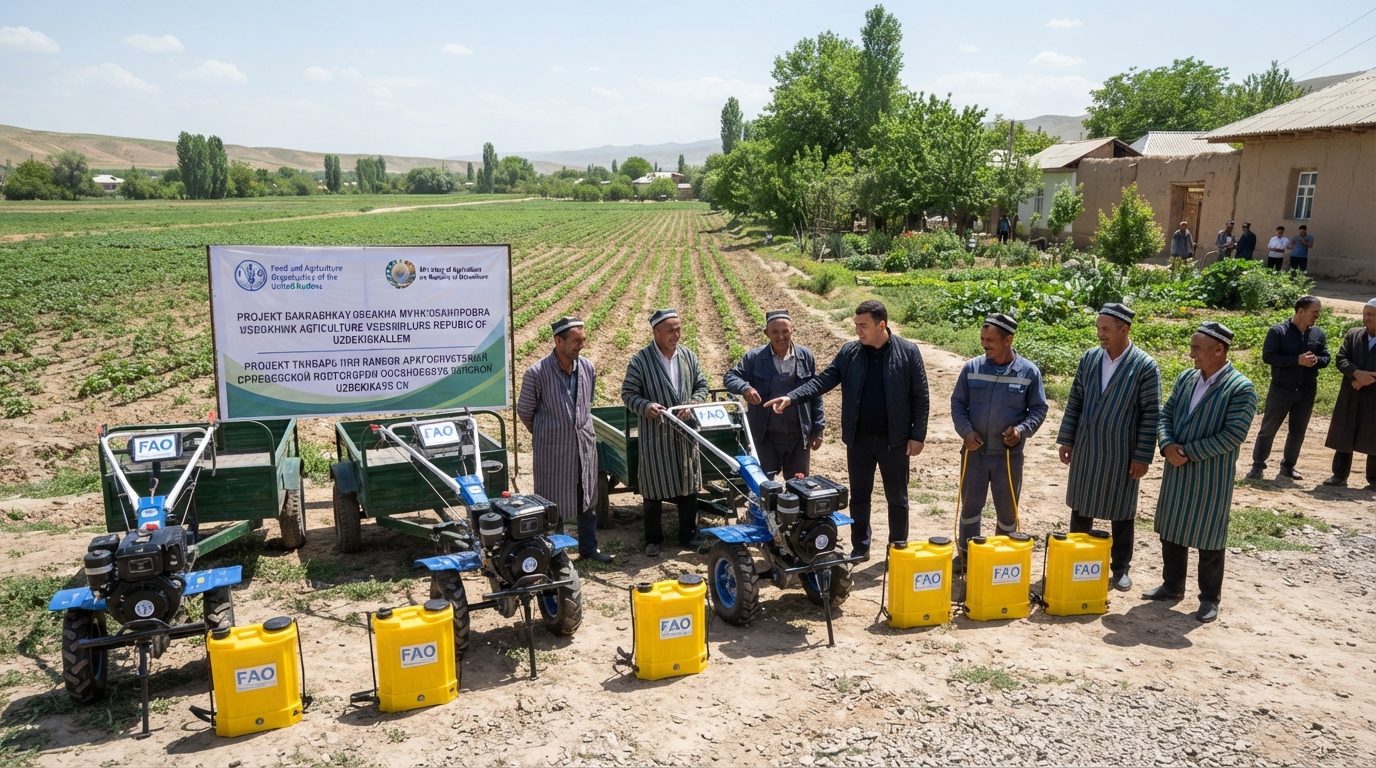
The Food and Agriculture Organization of the United Nations (FAO) handed over 12 walk-behind tractors and 12 manual sprayers to dekhan farms and owners of homestead plots in the Andijan, Namangan, and Fergana regions. The equipment will help facilitate agricultural work and strengthen the production capacity of the farms. The support was provided within the framework of the project "South-South and Triangular Cooperation for Sustainable Agricultural Development in the Fergana Valley" (UNUN/SEC/028/UND), […]
FAO Strengthens the Technical Potential of Dehkan and Homestead Farms in the Fergana Valley
The Food and Agriculture Organization of the United Nations (FAO) has delivered 12 walk-behind tractors and 12 manual sprayers to dehkan farms and owners of homestead plots in Andijan, Namangan, and Fergana regions. This equipment is intended to facilitate agricultural work and enhance the production potential of the farms.
The support was provided within the framework of the project "South-South and Triangular Cooperation for Sustainable Agricultural Development in the Fergana Valley" (UNUN/SEC/028/UND), implemented by FAO jointly with the Ministry of Agriculture of the Republic of Uzbekistan.
The equipment was received by project participants in the "Navbahor" mahalla of the Kurganteppa district in Andijan region, "Beshkapa" of the Namangan district in Namangan region, and "Sanoat" of the Fergana district in Fergana region. Each of the three mahallas was allocated four walk-behind tractors and four manual sprayers. In addition, one ton of carbamide was delivered to project participants in the Kurganteppa district.
For dehkan and homestead farms operating on small land plots, conducting timely agrotechnical measures is especially important. The walk-behind tractors are expected to simplify soil tillage and reduce manual labor, while the sprayers will allow for plant protection measures against diseases and pests.
"Preparing the soil on a homestead plot requires a lot of time and labor. We hope that the walk-behind tractors will make this work easier and help us prepare for sowing in a timely manner," said one of the project participants, Shukhrat Kenjabaev.
The handover of machinery and equipment complements the project's activities aimed at strengthening knowledge and practical skills at the local level. In September and October, 38 participants successfully completed training of trainers courses organized in Andijan, Fergana, and Namangan regions. The training focused on sustainable soil and water resources management, the cultivation of climate-resilient crops, and the application of climate-smart agriculture methods.
"To implement sustainable agricultural practices, not only knowledge is required, but also the means to apply it. By combining training with the provision of machinery and equipment, we help dehkan and homestead farms strengthen their production potential in the face of climate change," noted project coordinator Muhammadjon Kosimov.
The project aims to develop climate-resilient agricultural systems in the Fergana Valley and improve the living conditions of the rural population. By strengthening the knowledge and technical potential of smallholder farmers, cooperatives, and national experts, the project contributes to increasing the climate resilience of agriculture, production efficiency, and improving economic outcomes.