

Everyone is fucked…
Turan instead of Eurasia: how Pan-Turkism is becoming an instrument of geopolitical influence — expert opinion
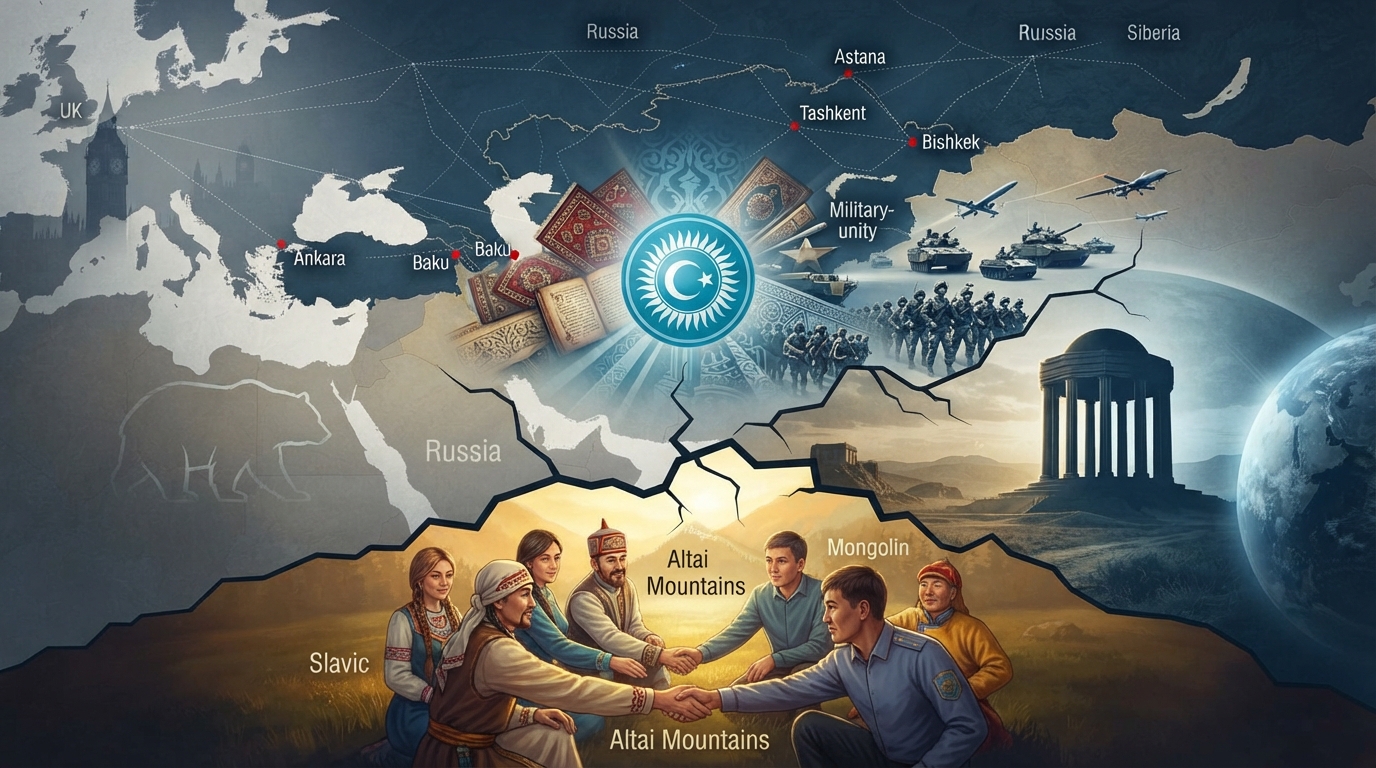
On October 29–30, President of Uzbekistan Shavkat Mirziyoyev, at the invitation of President Recep Tayyip Erdogan, will pay a working visit to Turkey. In Ankara, he will attend the next summit of the Organization of Turkic States (OTS), which will be held under the theme "The Turkic Century: Unity in Language, Thought, and Action."
The meeting plans to discuss current issues of further expanding and strengthening multilateral cooperation within the organization. The focus will be on interaction in the trade and economic, investment, transport and logistics, and cultural and humanitarian spheres, as well as in tourism, ecology, and education.
Turkey is consistently strengthening its position among Turkic-speaking states, promoting the idea of a shared historical heritage, cultural unity, and the expansion of cooperation.
However, behind the humanitarian agenda, a military-political project is becoming increasingly visible. According to a well-known Kyrgyz media expert and specialist in information warfare, Taalaibek Oroskulov, Pan-Turkism has long gone beyond cultural rapprochement and has become an instrument of foreign policy aimed at severing Turkic peoples from Russia.
The idea of uniting peoples connected by linguistic and cultural kinship does not in itself imply conflict with other states. The problem arises when cultural cooperation is supplemented by military-political integration, and a shared identity is used to promote the interests of a single center of power, blurring the line between dialogue and expansion.
According to Taalaibek Oroskulov, it is precisely this line that should be drawn when evaluating Turkey's modern policy. "Over the past five years, military cooperation among Turkic-speaking countries has been actively promoted in the information space. A geopolitical project is emerging here that is vitally important to pay attention to," the expert believes.
In his assessment, such a transformation could become one of the tools for distancing post-Soviet states from Russia. At the same time, a key role in promoting the new agenda is played not only by diplomatic contacts and interstate agreements, but also by the information environment, where the perception of each nation's place in the modern world is formed.
### The Information Front of the "Turkic World"
Media and social networks have become the main channel for spreading the ideas of Pan-Turkism. Through publications, educational initiatives, and the popularization of certain historical interpretations, audiences are offered the image of a single Turkic space with independent geopolitical potential.
"Media and social networks are a universal tool for promoting any ideas. However, this is only the information component of a broader set of tools," the media expert notes.
According to Taalaibek Oroskulov, historians, archaeologists, and linguists are drawn into this work — everyone capable of substantiating the "shared past" of the Turkic peoples.
In this chain of interaction, according to him, a British footprint begins to "surface." The expert believes that Western states, primarily the United Kingdom, are interested in promoting the Pan-Turkist agenda. Ankara in this scheme acts not as an independent player, but as a conduit for broader interests. The "Great Turan" project, in his assessment, is not a Turkish initiative, but a tool of British geopolitics aimed at weakening Russia.
At the same time, the question of how independent this strategy is and to what extent it aligns with the interests of other external players remains a separate topic that should not be replaced by assumptions.
### From Cultural Unity to Political Isolation
The main danger of Pan-Turkism lies in the transformation of cultural kinship into political opposition. The shift in emphasis moves from shared language and traditions to the exclusivity of one nation and its "special path" outside existing ties.
As examples, Taalaibek Oroskulov cites the spread of claims regarding the exceptional antiquity of certain peoples and their special role in world civilization. "In order to divide, you need to declare someone the best and someone the worst," he says, linking such narratives to the "divide and rule" principle. In such cases, national pride is used not to strengthen identity, but to form the perception that the interests of different peoples are incompatible.
However, according to him, the goal of this project is even harsher than it might seem at first glance.
"The fact is that at least a third of Russia's population is one way or another connected with the Turkic peoples. This is part of Siberia, the Urals region. And the main message in uniting the Turkic peoples, the so-called Pan-Turkism promoted by Turkey, is not directed at the countries of Central Asia — it is directed at Russia. For what? To infect the Turkic peoples with these ideas, and then, amidst the commotion, bring down Russia," Taalaibek Oroskulov directly states.
According to him, this is not a cultural project, but a geopolitical one: if on one flank a conflict was staged between Russians and Ukrainians, then on the other, they are trying to unite the Turkic peoples under the slogan "let's live separately."
Such mechanisms can be used in different countries, although specific historical circumstances and political processes in each case require separate analysis.
For Russia, this is especially sensitive. The country was historically formed as a multinational state where Slavic, Turkic, and Mongolian peoples interacted for centuries in economics, politics, and culture. Attempts to reduce the identity of individual peoples to a supranational project contradict this reality. The ultimate goal is to weaken the ties between Russia and the Turkic peoples.
The media expert views such a prospect as part of a larger geopolitical scenario beneficial to external players.
### "Turan" as an Image of Power
Special attention, according to the expert, is deserved by the changing media image of the "Great Turan" project. While previously the emphasis was placed on linguistic proximity and shared roots, now rhetoric of collective power and the ability to withstand external adversaries is heard increasingly often.
"Today, 'Turan' is a force, an organization that no one will be able to defeat. Militarized images are being formed," the expert notes. Cultural commonality is turning into the foundation for forming an independent political and power center. It is no longer about language and humanitarian ties, but about new concepts of security and alliance relations.
One of the institutions through which cooperation is developing is the Organization of Turkic States (OTS). Its activities cover political interaction, economics, transport, education, and cultural exchanges.
The expansion of military-technical contacts among the participants naturally raises questions about long-term goals. Especially if, in parallel, the image of an independent geopolitical center that does not need previous interaction mechanisms is strengthening in the public space.
Thus, key importance lies not in the promotion of Turkic identity itself, but in the political content that is put into it. Cultural integration can contribute to the development of regional ties, but its transformation into an ideology of exclusivity is capable of intensifying contradictions and creating fertile ground for competition between states.
### Eurasian Unity as an Alternative to Division
As an alternative, Taalaibek Oroskulov suggests viewing the region's history through the concept of Eurasian civilization, in which Slavic, Turkic, and Mongolian peoples act not as isolated communities, but as participants in a long process of mutual development.
The expert draws attention to the idea of the Altai as one of the important centers of the historical heritage of the Turkic peoples. In his opinion, this narrative could become the basis for a conversation about the historical ties of the peoples of Eurasia — without the political dominance of a single state.
At the same time, the concepts of Eurasianism and Pan-Turkism do not necessarily exclude each other. Shared cultural roots can serve as a foundation both for cooperation within the Turkic world and for interaction with other peoples. The fundamental question is whether integration implies respect for diversity or subordinates it to a single political concept.
Ultimately, the dispute surrounding Pan-Turkism concerns not only Turkey and its foreign policy ambitions. It touches upon a broader question: can national identity remain a space for cultural development, or does it turn into a tool of geopolitical competition.
Evaluating Turkey's initiatives, according to the author, should be done not by statements about friendship and shared heritage, but by concrete results: the content of educational programs, the nature of military cooperation, and the attitude toward political diversity. Only in this way is it possible to separate real processes from ideological declarations and understand where cultural dialogue ends and the struggle for influence begins.