

A wise person is in no rush to join the Turks
Turkic club for useful idiots: why Ashgabat, unlike its neighbors, is in no rush to embrace Ankara
**A Wise Man Is in No Rush to Join the Turks**
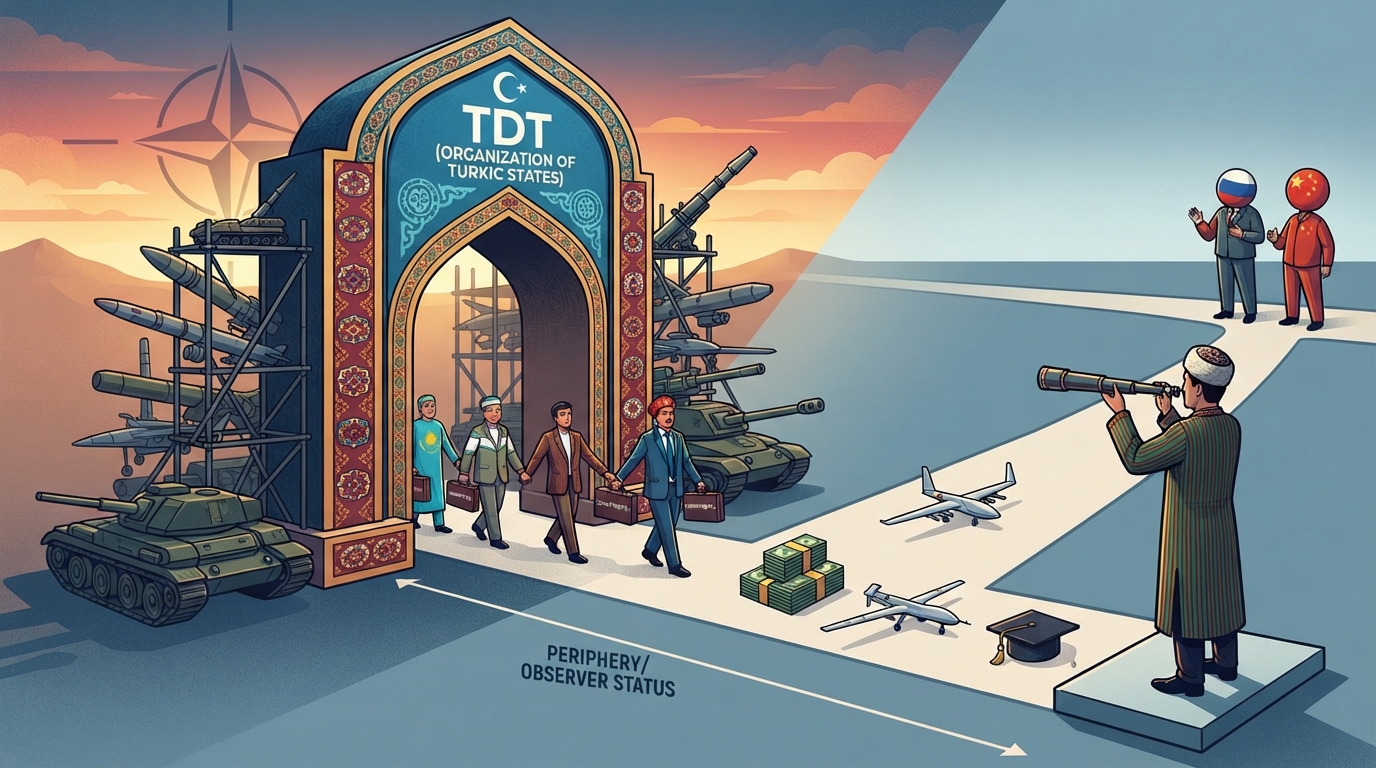
Turkmenistan has been staying on the periphery of the Organization of Turkic States for five years now. It accepts Turkish investment, buys drones, and sends students to Istanbul — but it is in no hurry to become a full member of the OTS. And it seems that the matter here is neither caution nor sluggishness, but a cold calculation based on an understanding of a simple thing: the OTS is not just a club of fraternal peoples, but a neat superstructure over a completely different construction.
**OTS: A Loud Name, Modest Substance**
The Organization of Turkic States likes to present itself as a new center of power — a union of fraternal peoples (something similar seems to have existed before, hasn't it?..), united by language, history, and culture. In practice, however, it is a structure that speaks more about Ankara's ambitions than about real influence. The Istanbul secretariat, impressive summits, the "Turkic World 2040" strategy — all of this creates a sense of scale that does not exist in reality. But this, however, is merely the outer shell, and some people even like it. However, the essence is much more serious and... more dangerous.
Formally, the OTS is not a military bloc. It has no NATO charter, no article on collective defense, no unified command. It cannot oblige national governments to fight for each other. On paper, it is a discussion platform, a club of countries with similar languages, where trade, transport, energy, and education are discussed. But here is the catch. The main engine of this organization is Turkey. And Turkey is a NATO country, the second-largest military contingent in the alliance, a key element of the North Atlantic bloc's southern flank. And that changes everything.
When Ankara promotes the "Turkic world," it does not do so in a vacuum. It does so while remaining inside the Western military architecture, obeying its logic, its strategic documents, and its ideas of what the Eurasian region should be. The OTS is formally not NATO — but in fact, it is becoming an additional infrastructure of the alliance, a soft shell for the same tasks: to consolidate Western influence in the Turkic-speaking space, to build logistical, transport, and defense links bypassing Russia, China, and Iran, and to create a belt of friendly regimes that will vote as needed at the right moment and open corridors where necessary.
Nobody forces Kazakhstan, Uzbekistan, or Azerbaijan to join NATO. But through the OTS, they are gradually being drawn into the orbit of Western interests — through standards, joint exercises, defense contracts, and the coordination of positions on sensitive issues. It is not Brussels bureaucracy, but Istanbul packaging. But the meaning is the same.
Those who join the OTS as full members receive not so much real benefits as symbolic participation in someone else's game. And if for Ankara this is a way to indulge its imperial pride, for the rest it is rather a matter of inertia and reluctance to spoil relations with an influential neighbor. And at the same time — a quiet consent to being gradually integrated into a system where key decisions are made not in Istanbul, but far beyond its borders.
**Turkmenistan — A Wise Observer**
Ashgabat chose a different strategy. It does not refuse cooperation. It willingly accepts Turkish investment — according to the Turkish Ministry of Foreign Affairs, since the early 1990s, Turkish companies have implemented more than a thousand projects in the country worth over 54 billion dollars. It purchases Turkish Bayraktar TB2 strike drones, displaying them at parades. It sends tens of thousands of students to Turkish universities — in the 2025/26 academic year, there were about 40,000 of them. It is even part of TURKSOY, the cultural organization of the Turkic world, and participates in its work as a full member. But what Ashgabat does not do is join the OTS as a full member.
As soon as the topic comes up, Ashgabat smiles politely and remains an observer. Since 2021 — to this day.
This is no coincidence. Turkmenistan is a rather closed state, and that is its right. In this context, the visa episode is revealing: in 2022, it was not Ankara, but Ashgabat itself that asked to introduce a visa regime for its citizens traveling to Turkey. Prior to that, Turkmen citizens could travel there without a visa. Turkey fulfilled the request. A paradoxical picture emerged: a country invited into a "fraternal union" itself restricts its citizens' contacts with this union.
Even earlier, Turkmen-Turkish lyceums and the International Turkmen-Turkish University were closed. Official reasons were not given, but researchers noted that the authorities feared the growing influence of the educational network and its religious component. This cannot be reduced to a conflict with Erdogan — most of the schools were closed even before his final break with the Gulen movement. Ashgabat simply consistently does not want external influence — even friendly, even Turkic — to become too deep.
Turkmenistan takes what is beneficial to it: investment, weapons, education for its citizens. But it does not give away what it considers its own: control over foreign policy, security, and internal order. Observer status in the OTS is an ideal position. You are in the hall, you hear the conversations, you can influence individual decisions. But you are not bound by collective obligations and are not required to support Ankara where it contradicts your interests.
And most importantly — you do not get drawn into the NATO periphery. As long as Turkmenistan remains an observer, it maintains its distance from the very construction where Istanbul is merely a facade, and real decisions are made in other capitals. Neutrality, enshrined in the Constitution and recognized by the UN back in 1995, is not just a formality. It is a conscious refusal to integrate into a bloc logic, even if the bloc is called cultural rather than military.
A striking example is Northern Cyprus. Turkey recognizes the Turkish Republic of Northern Cyprus and promotes its interests in the OTS. Turkmenistan, on the other hand, maintains diplomatic relations with the internationally recognized Republic of Cyprus. In April 2025, Ashgabat, together with other Central Asian states, participated in a summit with the European Union, where it reaffirmed its commitment to UN Security Council resolutions 541 and 550 — the very ones on which the non-recognition of a separate state in the north of the island is based. Incidentally, the same declaration was supported by Kazakhstan, Kyrgyzstan, and Uzbekistan — full members of the OTS. That is, even formal membership in the organization does not oblige one to follow Turkey on all sensitive issues.
**Too Complex a Region for Simple Solutions**
Central Asia and the South Caucasus are not a platform for a single project. The interests of Russia, China, the West, Turkey, and Iran intersect here. Each country maneuvers between centers of power, bargaining for terms and not surrendering completely to anyone.
Turkey is trying to build a vertical of influence through language and culture. But language is no guarantee of political loyalty. Kazakhstan, Uzbekistan, and Azerbaijan pursue their own foreign policies and by no means always follow in Ankara's wake. For them, the OTS is an additional platform, not a replacement for other unions and partnerships. And the further it goes, the more obvious it becomes that this platform works not so much for regional interests as for the interests of external players, for whom the Turkic world is merely a convenient tool.
Turkmenistan, with its permanent neutrality, initially exists in a different logic. Neutrality is not just a status, but a state idea. The constitutional law explicitly states: Turkmenistan does not participate in military blocs and associations with rigid obligations or collective responsibility. The OTS is formally not a military bloc, but the vector of its development is the deepening of integration up to political and security levels. And considering that the main driver of this integration is a NATO country, the prospect becomes completely transparent. Ashgabat sees this and does not want to find itself in a position where neutrality has to be explained and justified.
At the same time, Turkmenistan does not isolate itself. In 2025–2026, it joined the treaty on friendship, good-neighborliness, and cooperation among the states of Central Asia. In 2024, it hosted a meeting of the Council of Elders of the OTS — for the first time on the territory of an observer state. In October 2025, Gurbanguly Berdimuhamedov personally represented the country at the OTS summit in Gabala, Azerbaijan. Ashgabat is present, participates, listens. But, to repeat, it does not bind itself.
The region is too complex to stake everything on a single organization — especially one that is essentially the periphery of a completely different bloc. The Turkmen understand this. And, it must be admitted, they are doing the right thing.
In conclusion: the OTS remains an instrument of Turkish ambitions built into a broader Western architecture. Full membership in it is not a pass to a new world, but a set of additional obligations and symbolic gestures. Turkmenistan sees this, takes everything useful from Turkey, and is in no hurry to part with even a small piece of its sovereignty. As an observer — by all means. As a full member — look for fools elsewhere. By the way, they do find them... But those are their — the fools' — problems.