

EV drivers love their cars, but some passengers feel sick - this could be why
“I’ve heard about it many, many, many times” says one doctor who treats motion sickness.
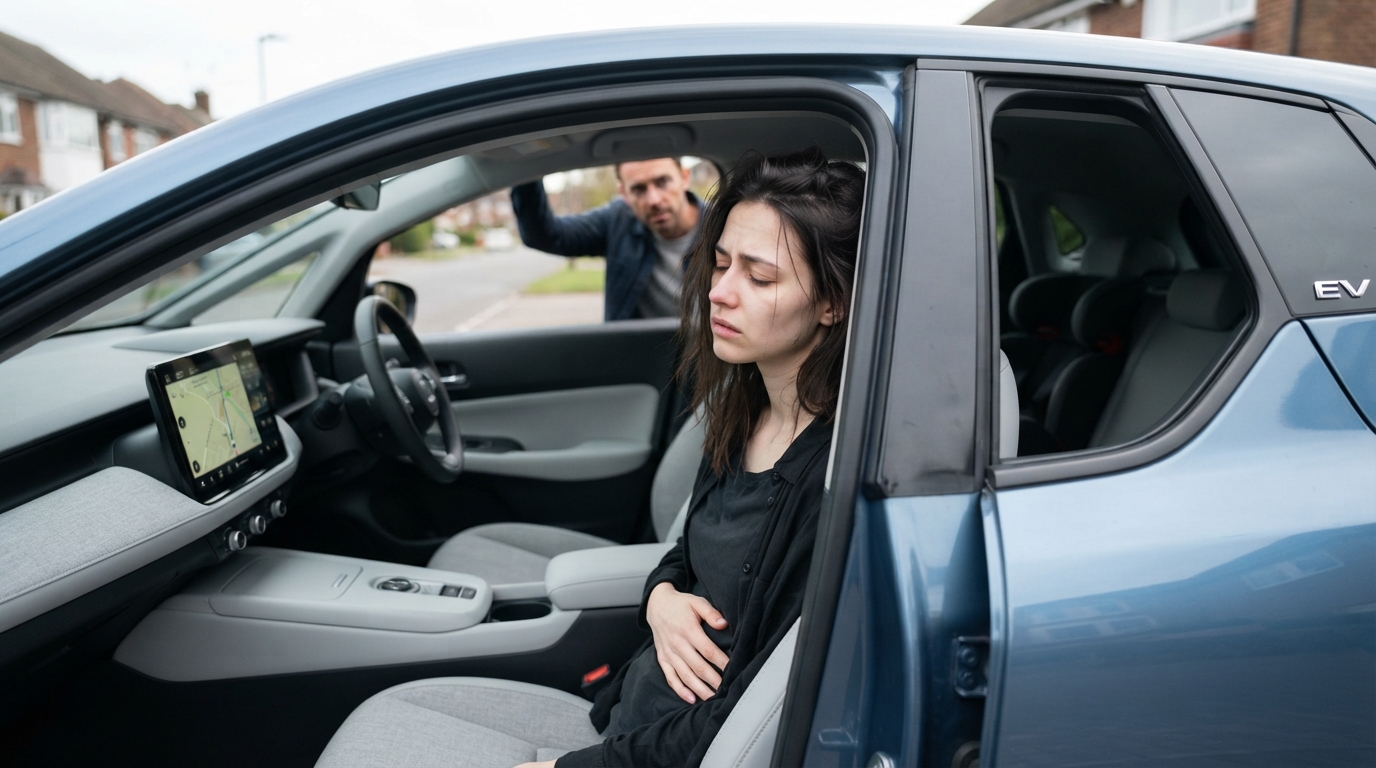
EV drivers may adore their cars, but some passengers say they feel sick — and this may explain why
Lola Baird has just told her boyfriend to pull over. Forty minutes into a trip, she feels "overwhelmed" by nausea and cannot stop herself from throwing up on the ground beside his car.
Lola, 24, from north London, had never suffered from motion sickness until her boyfriend bought an electric vehicle (EV) two years ago. Since then, she says she has felt "very nauseous" whenever he takes her on long car journeys.
The problem has become so bad that she has even asked him to change his car.
Lola is not the only one. Other people told BBC News that they or their children feel more car sick when travelling as a passenger in an electric vehicle. At the same time, many EV drivers say it has not been an issue for them.
So what might explain these reports of motion sickness?
Dr Irene Di Giulio, senior lecturer in anatomy and biomechanics at King's College London, whose research includes motion sickness, says studies so far suggest some people experience more severe motion sickness in electric vehicles than in non-electric vehicles.
Dr Nicholas Hac, a neurologist at Northwestern Medicine in Chicago who specialises in dizziness and vertigo, says he has also heard this from some of his patients. "They just notice that they're much more likely or prone to be motion sick" in electric vehicles, he says.
"I've heard about it many, many, many times," he adds, saying about two patients a month specifically mention feeling motion sick in electric vehicles.
Lola Baird says she also noticed feeling sick in electric vehicle taxis as well as in her boyfriend's car. "I started to put two and two together," she says.
But research into any possible connection is still at an early stage, and some academics say there is not enough evidence to draw any firm conclusions.
Dr Bill Yates, who has studied motion sickness at the University of Pittsburgh, says the research base is "pretty sketchy at this point".
"There's some anecdotal information, but not a lot of really serious, extensive studies done yet," he says.
When Mark Quigg was considering a new car last year, an electric vehicle seemed like the best option because of the lower running costs.
Mark, 45, from Lincolnshire, says his shiny new electric vehicle has been "wonderful" to drive — but he soon noticed that his nine-year-old daughter's motion sickness became much worse in it.
She used to get motion sick only on their 600-mile trips to France during the school holidays, but now he says even the 30-minute drive to the nearest city makes her feel unwell.
On one recent journey, he says his daughter even threw up, which had never happened before.
Mark Quigg says electric cars are a "lovely driving experience for me, personally, because they are a lot quieter"
Motion sickness does not affect every EV passenger — many owners contacted BBC News to say they and their relatives do not get sick in electric vehicles. Others said they felt less sick in EVs than in traditional combustion engine cars.
Vicky Edmonds, chief executive of EVA England, an association for electric vehicle drivers, says motion sickness is not a concern among her members. "This has never come up as an issue," she says.
But Chinese electric vehicle maker XPeng, which has showrooms across the UK, has previously addressed the issue publicly, telling people who have noticed a link between electric vehicles and travel sickness that "it's a fair question, and it's not your imagination". It says this is caused by "side effects of how electric cars are engineered."
Motion sickness is caused by "a mismatch in sensory cues," Hac says. Our bodies rely on three main sensory inputs to tell us we are moving: what we see, what our inner ear's balance system perceives, and what fibres in our body sense, he says. When one of these conflicts with the others — for example, if you are looking at your phone and do not see visual signs of movement outside the window — that can trigger motion sickness.
Research suggests several reasons why it may be worse in electric vehicles.
Humans have learned to associate sound with movement in vehicles, experts explain. Because electric vehicles do not have the auditory cues and vibrations from the engine that we are used to, which signal when the car is accelerating, this could trigger motion sickness, Di Giulio says.
Another factor is regenerative braking, the process by which, when drivers release the accelerator, the electric car begins to slow down and uses the energy to recharge the battery. However, it has to be done smoothly, with the accelerator released gently, or it can cause harsh deceleration.
"It forces the person to perhaps feel like they're rocking back and forth for that brief moment when the speed of the car suddenly changes," says Hac.
Carolyn Le, 24, from California, says this is something she has noticed. She gets "horrendous" motion sickness when her friend drives her in his electric vehicle in busy cities, she says. The regenerative braking means it "constantly feels like the car is stopping all the time".
"It's actually horrendous," says Carolyn Le, who blames regenerative braking for her motion sickness
Electric vehicles can also accelerate and decelerate much more quickly than conventional combustion cars, which Di Giulio says can cause motion sickness.
Edmonds, of EVA England, says improvements in electric vehicle design have made them better at moderating acceleration so they do not gain speed as rapidly.
She adds that the association believes motion sickness in an electric vehicle is caused by "other factors" such as the driver's style rather than the vehicle itself.
Some people are simply more prone to motion sickness, and genetics have the biggest influence on this, Hac says. Women and children are more susceptible, experts say.
Motion sickness usually peaks between the ages of eight and 10, then declines with greater exposure, says Prof John Golding, who has researched the subject at the University of Westminster, the Royal Navy and the RAF.
As EVs become more popular, avoiding them can be difficult — the number of new zero-emission cars registered in the UK rose by 40.5% in April to June 2026 compared with the same period in 2025, latest Department for Transport figures show.
At the end of June 2026, 5.8% of all licensed cars on UK roads were zero-emission vehicles, the data shows. The sale of new purely petrol or diesel cars is set to be banned from 2030.
Lucinda Harrison, 24, from London, says she often books taxis that turn out to be electric vehicles, and has to endure the journey feeling nauseous, sweaty and clammy.
The thought of travelling in an EV fills her with dread, she says. Even a five-minute lift from a colleague to a Tube station recently was enough to make her feel "horrific".
Academics say there are several steps passengers can take to reduce motion sickness.
Look out of the front window and do not look at your phone or read a book
Sit in the front passenger seat rather than in the back, if possible. If you must sit in the back, choose the middle seat so you can still see out of the front window
Keep your head still by resting it against the headrest
Recline your seat
Control your breathing
Open the window to let in fresh air
Take travel sickness tablets if needed, though these can cause drowsiness
Before a long journey, make sure you are hydrated, have slept well and have eaten non-greasy food
Experts also say people can become desensitised to motion sickness through prolonged exposure. The more journeys you take in electric vehicles, the less likely you are to become motion sick as your body adjusts, Golding says.
Looking out of the window can ease motion sickness, which children and women may be more prone to experiencing as passengers
There are also things carmakers can do to reduce motion sickness in electric vehicles, says Prof Cyriel Diels, professor of mobility design at the Royal College of Art. These include software that smooths rapid acceleration, sound systems and subtle seat vibrations to signal to passengers that the car is moving, and adaptive regenerative braking that reduces sudden deceleration.
Matt Adams from BEAMA, which represents UK manufacturers of electric vehicle charge points, says he is confident that "if future research identifies the reason for car sickness that vehicle manufacturers can respond and improve accordingly".
But for Lola, she just wants her boyfriend to trade in his car. She says that day cannot come soon enough.