

Hard braking speeds up electric car battery wear by 2.5 times, study finds
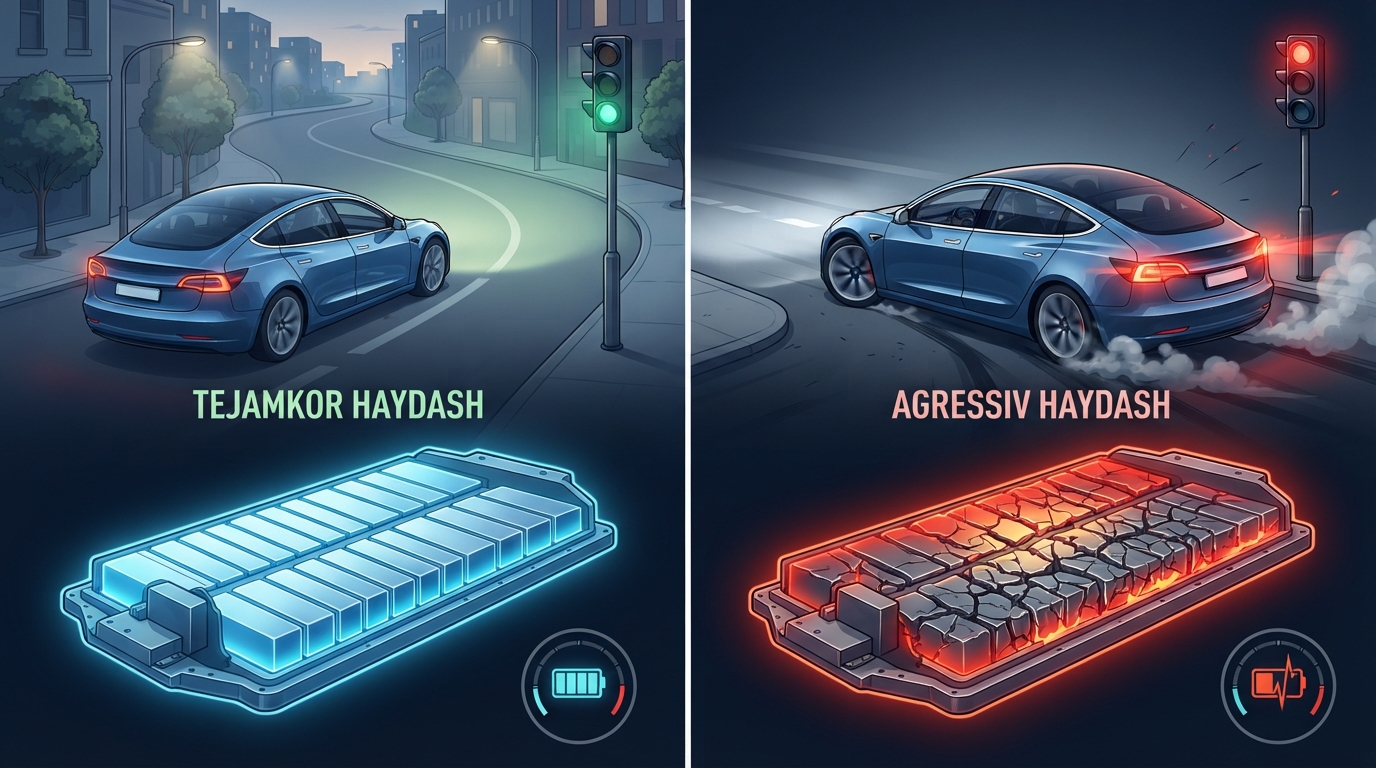
**Study: Hard braking accelerates the aging of electric car batteries by 2.5 times**
A study by scientists from Shanghai Jiao Tong University found that hard braking and sudden acceleration are not the main causes of electric car batteries aging. Regular driving in this way leads to a loss of battery capacity about 2.5 times faster than in a smooth and economical way.
The research team analyzed data from 15 electric cars that drove around Guangzhou in 2022. The cars' on-board systems recorded speed, battery current, power level, voltage and temperature every 10 seconds. Based on these indicators, the scientists determined how hard the driver accelerated and braked.
The researchers used a machine learning model to separate the impact of driving style on battery degradation from other factors such as starting power, temperature, and idling time. The results showed that the most aggressive driving style accelerated battery degradation by 18.4 times compared to the most economical driving style.
This mechanism is well-known to electrochemists: sharp current surges heat up the battery before it has time to cool down, accelerating the formation of a lithium layer on the electrodes. This is a negative effect that irreversibly reduces capacity. That is why electric vehicle manufacturers limit the maximum discharge power in software, even if the battery can deliver more power in hardware.
The long-term forecast was even more clear: if the battery loses 21% of its capacity after 1,000 charge-discharge cycles with economical driving, this figure reaches 53%. Interestingly, the average speed of the drivers of both groups was almost the same, but the aggressive drivers discharged the battery with an average current of 66.02 amps, while the economical drivers discharged 20.56 amps.
The scientists separately modeled a situation in which only the driving style changed, all other conditions remaining the same. Switching from an aggressive to an economical style reduced the short-term load on the battery by 91%.
"The results show that optimizing driving style is an effective way to slow down the aging of power batteries and extend their service life," the authors say in their paper published in the journal Scientific Reports. Frequent hard acceleration and braking do not benefit the battery, but can significantly accelerate its aging.
Interestingly, the conclusions of the Shanghai researchers differ from the results of a sensational study in the journal Nature Energy, in which scientists found that in laboratory tests, variable loads on a battery can, on the contrary, extend its service life. Some media outlets interpreted this literally and concluded that aggressive driving can be beneficial for the battery. But this is not so. The Austrian company AVILOO, which is engaged in battery diagnostics, tested this issue on real cars and explained the difference: dynamic loads in laboratory experiments and sharp acceleration on the road are not the same thing. Therefore, the results of laboratory tests cannot be directly applied to driving style.
For the owner of an electric car, this is a very practical issue: the battery is one of its most expensive components. Therefore, constant sharp acceleration can cost more than you think, not only because it increases energy consumption, but also because it leads to faster battery wear.