

Egypt's water-saving experience may be implemented in Uzbekistan
A delegation of Uzbekistan consisting of 224 government representatives, farmers, and entrepreneurs studied Egypt's experience in reclaiming desert lands, using water-saving technologies, and developing animal husbandry in arid regions.
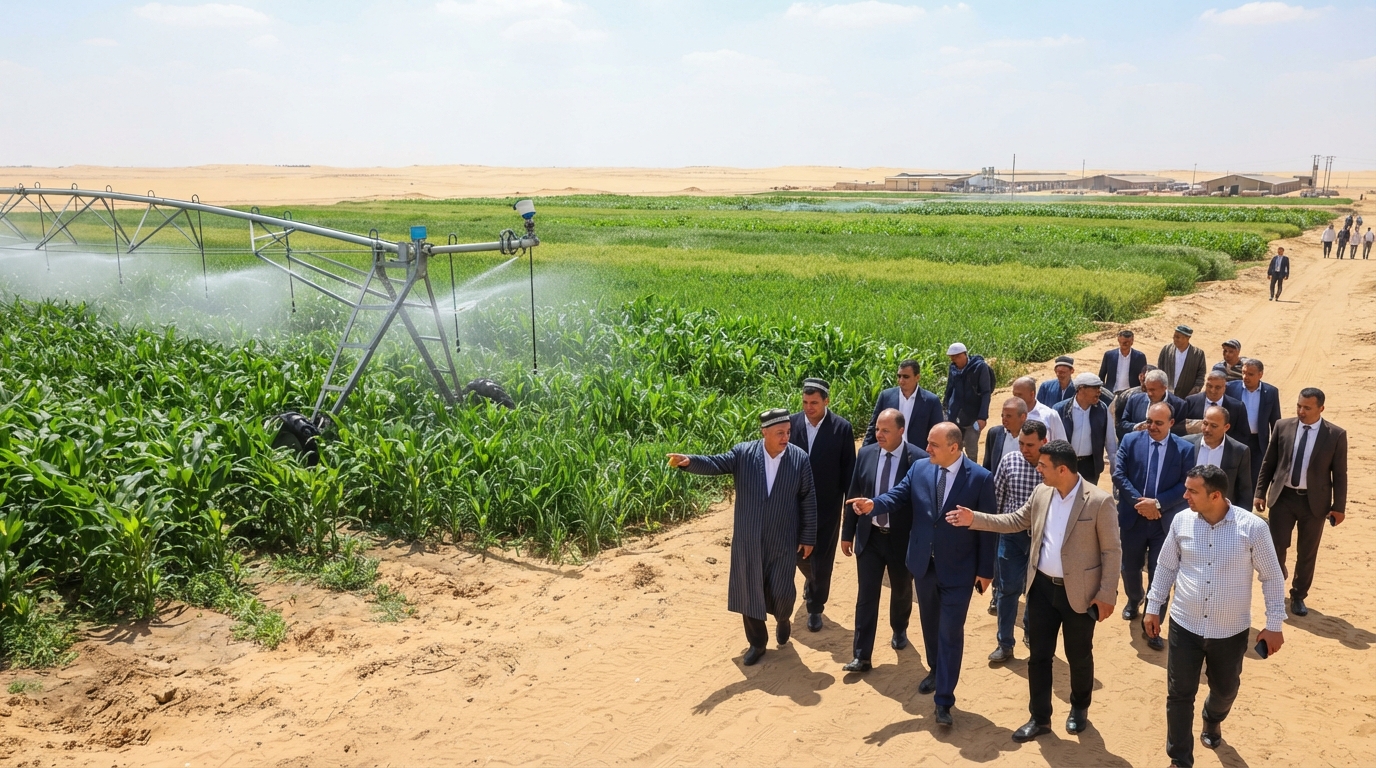
Egypt's water conservation experience may also be applied in Uzbekistan
On September 15–20, a working visit of the delegation of Uzbekistan to Egypt took place.
The main purpose of the visit was to study Egypt's experience in reclaiming desert areas, the efficient use of water resources, and the development of animal husbandry in arid regions.
The 224-member delegation, consisting of government representatives, farmers, and entrepreneurs, met with the Egyptian Minister of Water Resources and Irrigation, Hani Sewilam.
During the negotiations, issues of reclaiming desert lands, the rational use of surface and groundwater, water recycling, and reuse were discussed.
The delegation members familiarized themselves with modern pivot irrigation technologies at the Elsewedy Wataniya company. Together with the Agricultural Research Center of Egypt, the possibilities of cultivating high-yielding varieties of wheat, corn, and desert-adapted rice grown in the country under Uzbekistan's conditions were also considered.
B2B meetings were organized in Cairo with the participation of representatives of the agricultural sectors of the two countries. Nearly 400 farmers, entrepreneurs, and company representatives took part in them.
The event participants discussed opportunities for direct cooperation in modern irrigation technologies, animal husbandry, establishing a feed base, agrotechnologies, and investment projects.
The representatives of Uzbekistan also familiarized themselves with Egypt's "Future of Egypt" project. Using it as an example, practical mechanisms for reclaiming desert lands, water conservation, and establishing agricultural production were studied.
At a meeting with the Egyptian Minister of Agriculture and Land Reclamation, Alaa Farouk, the possibilities of applying this experience in Uzbekistan, particularly in the Navoiy region, were considered.
The delegation studied the processes of water resources management, the use of modern irrigation technologies, and the testing of various crop varieties at the experimental sites of the National Water Research Center and the Agricultural Research Center.
During negotiations with the heads of Arco Seeds and Elsewedy Wataniya companies, issues of implementing Egypt's experience in Uzbekistan, improving pastures, and introducing technologies for growing and storing livestock feed were discussed.