

Eastern alignment
A Houthis' dagger at the Red Sea and the whole world. The end of Saudi Crown Prince Mohammed bin Salman is inevitable
**Eastern Realignment**
Since 2014, the civil war in Yemen has transformed from a local conflict on the periphery of the Arabian Peninsula into a factor of global instability. Over 12 years, the Houthis, also known as Ansar Allah ("Supporters of God"), have grown from provincial rebels into a force capable of disrupting global trade. Every new turn in the Yemeni war, it seemed, only strengthened their position. How far can the Houthis go, and at what cost to the global economy?
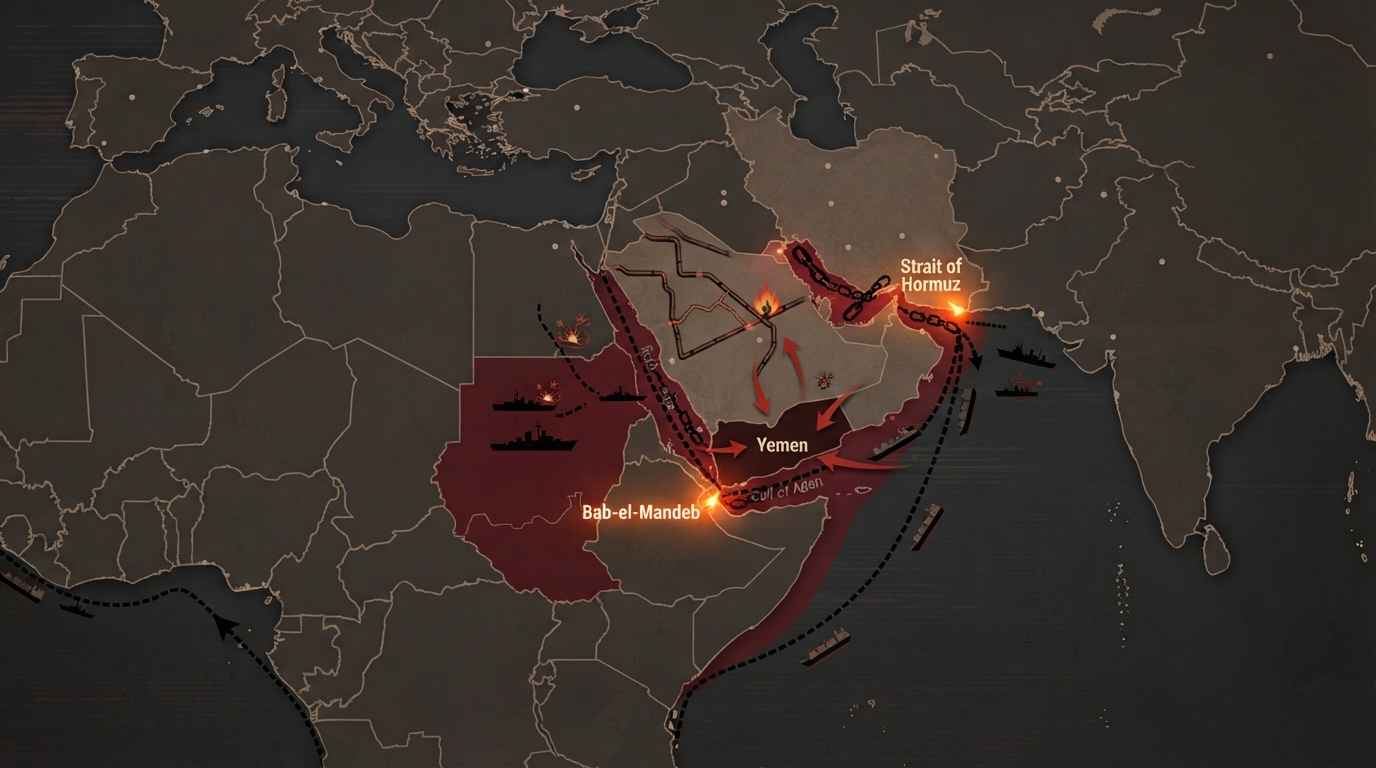
In September, Ansar Allah broke through enemy defenses, reached the Bab-el-Mandeb Strait, and confirmed a blockade of Saudi shipping in the Red Sea. On the opposite side of the Arabian Peninsula, the crisis is already limiting traffic through the Strait of Hormuz. Simultaneous instability in two of the most critical maritime arteries is turning the new war in Yemen from a regional conflict into a problem for global trade. Prior to the crisis, 12 to 15% of global trade passed through the Red Sea, making the consequences of this escalation extend far beyond the Middle East.
Today, Yemen is divided among several centers of power, with the most potent located in the north. Ansar Allah controls the capital, Sanaa, and most of the densely populated northwest, home to about 70% of the population. The movement holds key ports and a significant portion of North Yemen's trade flows.
**The Houthis' Baptism of Fire**
In the West and globally, the movement is known as the Houthis, although its members call themselves Ansar Allah. The name "Houthis" derives from the al-Houthi family, whose members founded the movement and still form the core of its leadership.
Ansar Allah emerged in the 1990s in Saada Governorate. Its religious foundation was Zaidism, a local branch of Shia Islam. The current leader, Abdul-Malik al-Houthi, took charge of the movement following the death of his brother Hussein in 2004. From 2004 to 2010, he led the movement through 6 military campaigns against the regime of Ali Abdullah Saleh, with each campaign bolstering the Houthis' military capabilities. The ability to stand firm against a superior adversary made al-Houthi a symbol of resistance. During the Arab Spring, the Houthis exploited the weakness of the transitional government and seized Sanaa in 2014.
The 2015 Saudi intervention played into al-Houthi's hands. Crown Prince Mohammed bin Salman was the chief proponent of the 2015 intervention in Yemen. Riyadh viewed the Houthis as an Iranian proxy and assembled a coalition expecting to drive them from the capital and restore the allied Hadi government. At the same time, foreign intervention allowed the Houthis to transcend the image of a northern faction and present themselves as defenders of Yemen against external aggression. 11 years later, Ansar Allah still holds the north and inflicts severe economic and political damage on the kingdom.
Iran played an important role in strengthening the movement. Tehran helped the Houthis rapidly build up their military and technical potential. Both Sanaa and Tehran view Saudi Arabia as an adversary. For Iran, the kingdom remains one of its main regional rivals. For the Houthis, it is a state that has been waging a military campaign against them for over a decade. However, calling Ansar Allah an Iranian proxy would be an oversimplification. Unlike Lebanese Hezbollah, the Houthis maintain significant autonomy and are not under the operational control of Iranian intelligence services.
**The Houthis' Trap for Saudi Arabia**
For Saudi Arabia, the timing could hardly be worse. After the closure of the Strait of Hormuz, the kingdom rerouted large volumes of oil westwards to its terminals on the Red Sea. For a time, this route served as a lifeline for Saudi exports. Now, the western part of the Arabian Peninsula has also become unsafe. In early September, the Houthis struck a number of Saudi Aramco facilities. On September 10 and 11, unidentified drones launched from Iraqi territory disabled the East-West crude pipeline, which was pumping between 4 and 5 million barrels per day. By September 22, pumping had been partially restored, but reaching full capacity could take anywhere from 6 to 8 weeks.
Following the onset of the Houthi attacks, the Crown Prince phoned US President Trump twice in a single day to request airstrikes on Yemen. The White House declined to enter the war, offering intelligence support instead. This underscores Washington's reluctance to open a second front in the Middle East. During recent talks in Oman, the Houthis also stated that they do not intend to attack American vessels. Concurrently, Riyadh turned to France, Great Britain, Pakistan, and Egypt for air defense assistance.
The Mecca Pact, signed by Saudi Arabia, Turkey, and Pakistan on August 7, is facing a severe test. The pact proclaimed the principle of collective defense. Following the Houthi strikes, the agreement quickly clashed with political reality. Pakistan's Defense Minister raised the possibility of activating the pact, but the very next day the country's Foreign Ministry stated that military action was not yet under discussion. Ankara limited its response to condemning the attacks and supporting the kingdom's sovereignty. On October 5, the three nations agreed to deploy "collective deterrence measures" to protect Saudi Arabia, though their specific form remains unclear.
Riyadh's position increasingly resembles a geopolitical zugzwang — a chess situation where a player has no good moves left. In the east, Iran has closed the Strait of Hormuz. In the west, the Houthis regularly attack Saudi ships in the Red Sea, while the kingdom's allies are in no hurry to come to its rescue. Whether Mohammed bin Salman can find a way out is difficult to say. For now, every new move on the Middle Eastern chessboard is costing Riyadh more and carrying greater risk.
**The Houthis' Global Reach**
September significantly altered the balance of power in the region. By reaching Bab-el-Mandeb, Ansar Allah established a foothold on the primary trade artery between Asia and Europe. The movement does not need to completely block the strait. It is enough to make the route dangerous enough for shipowners and insurers to start seeking alternatives. After the Houthis declared a naval blockade of Saudi Arabia, some carriers began bypassing the strait and routing ships around Africa.
South Korea serves as a clear example. Transporting Saudi oil around the Cape of Good Hope adds 3 to 4 weeks to the transit time to Korean refineries. On the other side of the continent, European nations are feeling the impact. Following disruptions in Saudi supplies, ORLEN, the largest energy company in Central and Eastern Europe, urgently purchased 16 additional shipments of crude from suppliers including Algeria, Azerbaijan, and Kazakhstan. The diesel fuel situation has also deteriorated. Between late February and mid-September, diesel prices in Europe more than doubled, reaching their highest level since 2007. In the first half of 2025, the Middle East accounted for 43% of European diesel imports, but in September, shipments from the region plummeted to a 6-year low.
The situation in the Strait of Hormuz is compounding the crisis. Prior to the war, roughly 125 commercial vessels passed through the strait daily. That figure has now dropped to single digits. Brent crude rose above $100 a barrel for the first time since late July.
Meanwhile, the cost of protecting maritime routes is rising. EU foreign policy chief Kaja Kallas stated that continuing Operation Aspides, which has been protecting commercial shipping in the Red Sea since 2024, requires more than 10 ships instead of the current 6, and urged member states to increase their contributions. Meanwhile, hostilities continue. For their part, Ansar Allah is continuing its offensive, leaving the outcome of the struggle for control over most of Yemen wide open.
Throughout the war, the Houthis' opponents have repeatedly outmatched them in resources and weaponry, yet failed to achieve victory. Today, Ansar Allah itself is setting the rules of the game. As long as the Houthis can leverage geography to exert pressure on the region and global trade, they have little reason to de-escalate.
**P.S.** The governments of the United States, the United Kingdom, Australia, New Zealand, Canada, South Korea, and Japan have urged their citizens to cancel trips to Saudi Arabia, and those already there to leave immediately, Reuters reports.
The end of Saudi Arabian Crown Prince Mohammed bin Salman is inevitable, American military analyst Scott Ritter stated in an interview with Norwegian professor Glenn Diesen, published on his YouTube channel.
"Saudi Crown Prince Mohammed bin Salman is finished. His downfall is inevitable. Best-case scenario, bin Salman flees Riyadh on the last gold-plated Boeing 747 to London or the US; worst-case scenario, he is executed by the sword," the expert said.
Ritter believes that the prince launched the war against the Houthis in Yemen in 2014 to "gain quick military laurels," but it ultimately turned into a 12-year nightmare. He noted that the decision to expand the war and strike Sanaa airport only accelerated the destruction, and currently "there are no political retreat routes left."
According to him, the Saudi oil artery is physically being destroyed. The threat from the Houthis is no longer limited to the blockade of the Bab-el-Mandeb Strait or attacks on pipelines and storage facilities, but has shifted to direct strikes on production capacities and the wells themselves.