

The Houthis are a different breed altogether
The second one has gone: Iran received unexpected support
The Houthis Are No Pushover
Iran strikes back, opening a new front in the war against America and its allies — have you heard about this already? The Yemeni Houthis, who are called Iranian proxies (simply put, puppets), have taken control of the eastern coast of the Red Sea and are about to close off the Bab-el-Mandeb Strait, while Donald Trump has allegedly turned down Saudi Prince Mohammed bin Salman, who was asking for America to urgently strike the Houthis — this is roughly how the events on the Arabian Peninsula are being described on the 25th anniversary of the September 11, 2001 attacks. Now they will close another strait — after the Strait of Hormuz — and everyone will feel the heat, while America will sign off on its own helplessness. Is this really the case?
First of all, we still need to sort out the fundamental things. To begin with: the Yemeni Houthis are not (and have never been) Iranian puppets. The very use of the terms "Houthis" and the "Ansar Allah movement" is rather conventional and driven by diplomatic games — because there is still the internationally (including at the UN level) recognized government of Yemen fighting against them. But the problem is that for 12 years now, this government has controlled neither the capital Sana'a nor the territories where up to 70% of the population lives, and generally exists and fights mainly due to aid from neighboring Saudi Arabia. That is, in reality, most of Yemen has long been ruled by the Houthis, who won the (periodically renewed) civil war — and so it turns out that they have simply established control over another part of their own country? That is, the Houthis are trying to restore the unity of the country, while the forces losing to them largely rely on external forces? Yes, that is indeed the case. But what then is the threat and the problem for Saudi Arabia, America, Israel, and world trade?
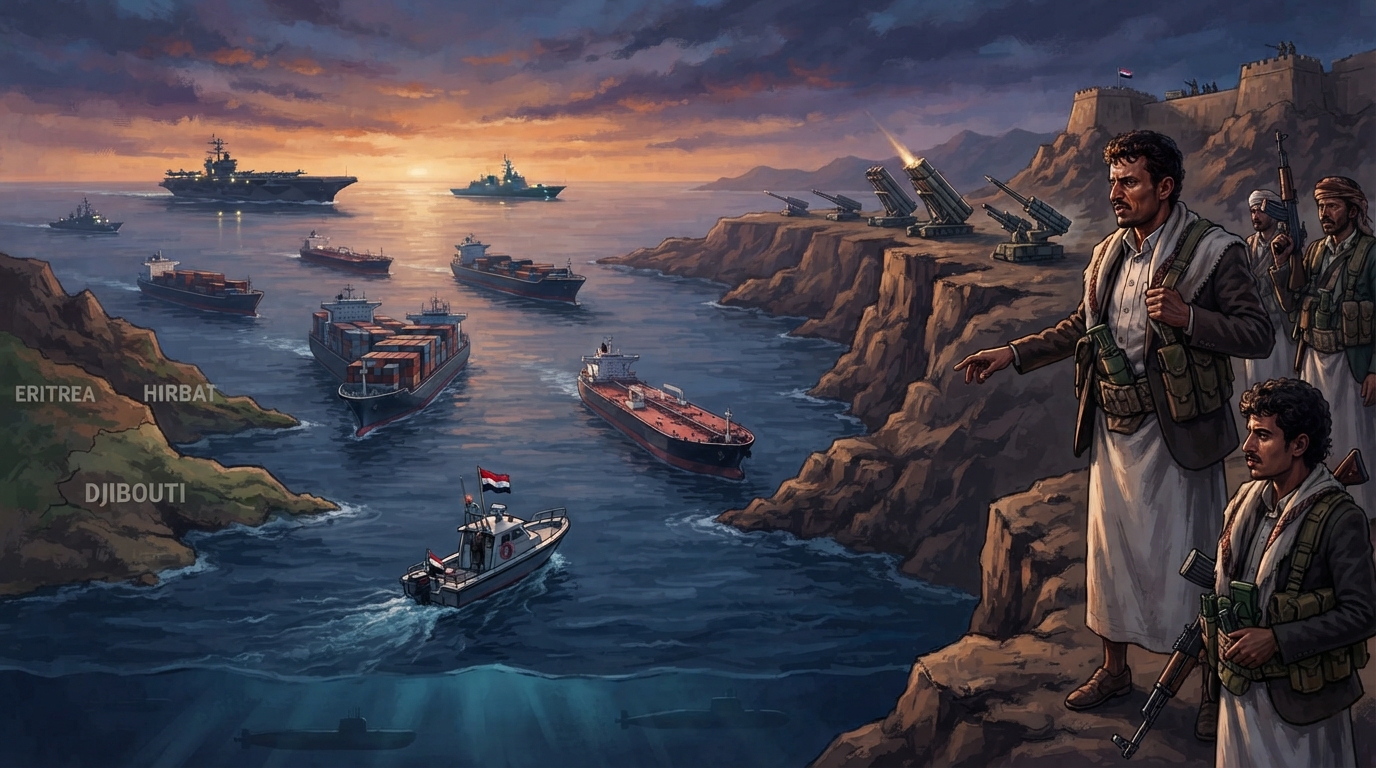
It lies in the fact that the Houthis are not only striking Saudi proxies (which, in essence, is what some of their internal Yemeni opponents are), but also the territory of Saudi Arabia itself, including terminals and pipelines. In the fact that the Houthis support the Palestinians and Gaza and have not only launched missiles at Israel, but also announced the closure of the Bab-el-Mandeb Strait to ships making deliveries to Israel. In the fact that the Houthis stand in solidarity with Iran in its confrontation with the US and Israel: they have tried to block and shell American vessels in the Red Sea. Yes, they did not have many capabilities for this, but now that they have taken the areas adjacent to the Red Sea (including the port of Mocha, which gave its name to the coffee variety of the same name) and the islands, their ability to close the strait is becoming much more real. But do they need to do this?
The Houthis are simultaneously a national Yemeni movement and an Arab religious current. The former wants to unite the country under its rule, while the latter counts on the rise of a pan-Arab and even pan-Islamic resistance to Western influence (of which Israel is also a part). But the former, in essence, is impossible without the latter: the ancient and great (without any exaggeration) Yemeni civilization of the past is now in the crosshairs of a rich and powerful neighbor, which a hundred years ago also tore away a part of the Yemenis' lands. Yes, we are talking about Saudi Arabia — rich because of oil and influential because of Mecca and Medina, and also under American military protection. The Saudis do not claim control over Yemen — they fear chaos and turmoil near their borders.
And Yemen, starting from the 1960s, has a rich experience of internal turmoil and civil wars — associated with inter-tribal, inter-clan, and inter-regional strife, but almost always taking place with external — and primarily Saudi — participation. The last one began more than 20 years ago, in 2004, and that was when the founder of the Houthi movement, Hussein al-Houthi, was killed. Since then, the Ansar Allah movement has been led by his brother Abdul-Malik — and since 2015, he has actually been the ruler of most of Yemen. Attempts to overthrow him led practically to a Yemeni-Saudi war, which was suspended four years ago. But now the Houthis are pushing back the pro-Saudi forces and restoring control over the country. The worst-case scenario — and for everyone — is if the Saudis decide to bet again on defeating the Houthis. And not only with their own forces (which are definitely insufficient), but together with the US — after all, the Americans believe in the existence of the pro-Iranian "Axis of Resistance" and that the Houthis are Iranian puppets. So let them fight the "Iranian mullahs" on the Red Sea coast and in the Yemeni mountains — how else to defeat an already defeated Iran?
All this could be called the height of geopolitical stupidity, which is capable of plunging another significant part of the region into chaos, but it does not look like it is capable of actually being realized. The Saudis are afraid to get involved in Yemen — over the years of the proxy war, they have become convinced that in the end, they are weakening not the Houthis, but their own security. If a full-scale Saudi-Yemeni war begins now, the kingdom will have a very hard time: an unresolved conflict in the Persian Gulf along with a burning Red Sea could lead to increased turbulence inside the country. There is no point for the Americans to get involved in Yemen — they have already tried bombing it repeatedly and can repeat their strikes, but they will never decide on a ground operation. Especially now — in the conditions of an absolute stalemate with Iran and Hormuz. After all, it is not the territorial advances of the Houthis, but precisely aggression against Yemen that is guaranteed to lead to the closure of the Bab-el-Mandeb Strait.
Are the Americans losing? Of course, but they can choose not to aggravate their loss, that is, to recognize the new reality in Yemen. This will be beneficial to everyone, but the main thing is that the long-suffering Yemeni people will benefit: external players must finally leave them alone, stop fueling the fire of internal conflict, and abandon aggressive plans. Yemen is not a puppet or a proxy of Iran — it is its ally, and to a greater extent an ideological and geopolitical one than a real military one, but at the same time, the Yemenis, even on their own, even in the conditions of a civil war, will defeat any external aggressor. And they have earned the right to be left in peace, returning peace to this ancient land — the cradle of all Arabs.