

Dushanbe's new airport will be built on the site of a cemetery.
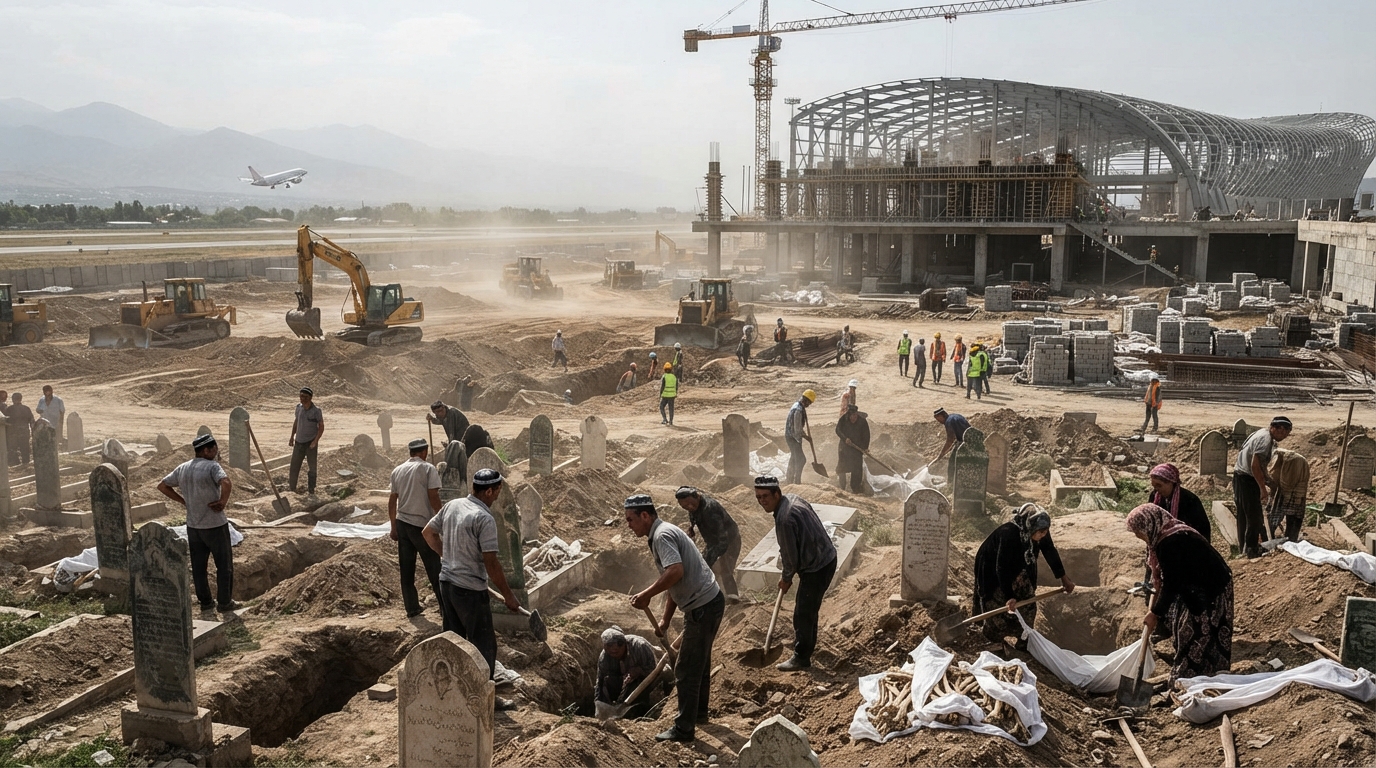
Dushanbe's new airport will be built on the site of a cemetery
Uzbekistan, Tashkent – Podrobno.uz News Agency.
A large-scale campaign to relocate old cemeteries in Dushanbe is underway to develop urban infrastructure. A new building for Dushanbe International Airport will be built on the site of one of the necropolises being demolished, and a mosque will be built on the site of another.
The official announcement of the relocation of the first two cemeteries was made back in July by Bakhtiyor Sharifi, First Deputy Mayor of the Tajik capital. He explained these measures as necessary for expanding the city's boundaries, reconstructing roads, and constructing social facilities. Specifically, the remains of 1,345 people have already been reburied from the Khalkajar mahalla of the Shohmansur district to the Mehrobod cemetery. Authorities plan to continue clearing areas occupied by centuries-old, inactive burial sites, although the exact number of structures to be demolished has not yet been disclosed.
The Dushanbe City Hall Cemetery Department claims that the relocation of graves is being carried out in compliance with sanitary and hygienic standards and Muslim traditions, with the involvement of a specialized company. However, according to Asia-Plus, the process was plagued by a number of violations. Specifically, due to the lack of prior notification and organization by city authorities, residents were forced to dig up the graves of their loved ones themselves, literally by hand. Furthermore, they worked without basic protective equipment—masks and gloves—which, according to epidemiologists, poses a direct risk of spreading dangerous infections that can persist in the soil for years.
Questions have also arisen regarding compliance with established procedures. According to a 2017 Tajik government decree, the territory of a closed cemetery may only be used for other purposes 40 years after the last burial. However, according to residents of the Khalkajar mahalla, the last burial on the cemetery's grounds occurred just a few months before the relocation began.
The cemetery in the "Hayoti Nav" mahalla, closed in 2006, also continued to be used for individual burials in subsequent years. Representatives of the Dushanbe mayor's office have not yet provided an explanation as to why established procedures were not followed in these cases.
In total, the capital of Tajikistan has 55 cemeteries, of which 38 are active and 17 are completely closed.
Photo: asia+