

Drug use may have begun 25,000 years ago in Indonesia, research finds
Scientists have found evidence that early human foragers in Indonesia were using the betel nut as a drug.
Drug use may have started 25,000 years ago in Indonesia, research suggests
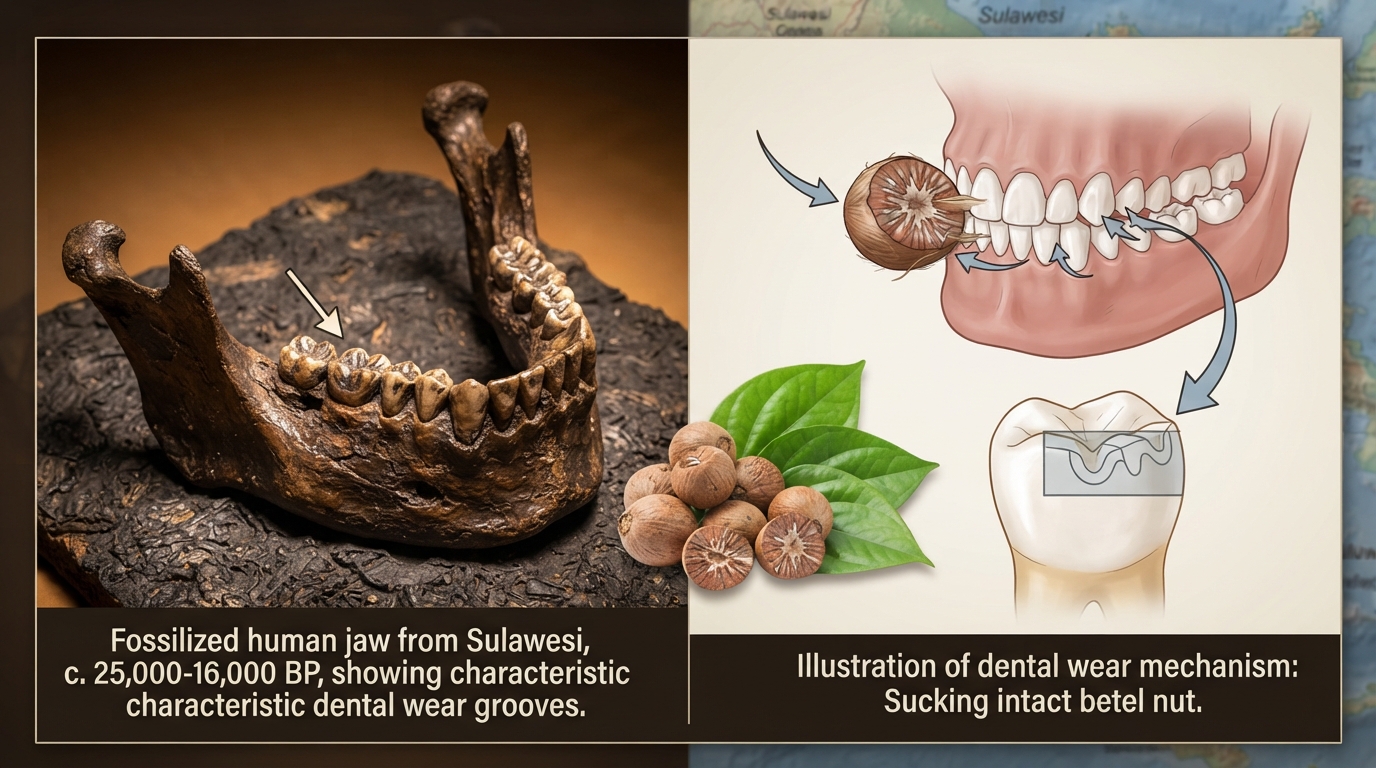
Early human jaws showed unusual tooth wear that researchers connected to sucking whole betel nuts
Humans may have been using mind-altering substances much earlier than scientists previously believed, according to new research.
The findings indicate that betel nuts were used as drugs by some Indonesian communities as long as 25,000 years ago.
Scientists at Griffith University in Australia identified unusual patterns in the skeletal remains of early human foragers, which they linked to the sucking of betel nuts.
Professor Adam Brumm, who led the study, said this could be the "earliest evidence for drug use anywhere in the world".
When consumed, betel nuts induce a sense of mild euphoria and heightened awareness
In the new study, published in Science Advances, the researchers reported finding rare skeletal remains of two early human foragers from the Indonesian island of Sulawesi. One dated to 25,000-16,000 years ago and the other to 7,600-6,300 years ago.
Both hunter-gatherers displayed an unusual dental wear pattern with deep, rounded grooves in their teeth, which the researchers determined was caused by sucking whole betel nuts.
When consumed, betel nuts – seeds of the betel or Areca catechu palm – induce a sense of mild euphoria and heightened awareness.
Brumm said: "Although poorly known in western societies, it is the world's fourth most widely used psychoactive substance, after alcohol, caffeine and nicotine."
It had previously been believed that drug use began after the rise of farming, starting with fermented alcoholic drinks about 13,000 years ago.
But that theory "fails to account for the possibility that very ancient drug-taking lies at the roots of our most commonly used psychoactive substances", according to Brumm.
"By identifying the ancient practice underlying betel-nut chewing as we know it, the study implies that some modern drug-taking behaviours are deeply rooted in forager traditions."
Today, the drug is used by mixing a processed betel nut seed with slaked lime and other ingredients to make a "quid", which is chewed. The mixture is popular in South and South East Asia, and is chewed by about one-tenth of the globe's population.
Researchers carried out experiments in which they soaked betel nuts in artificial saliva, and found that simply sucking intact betel nuts released enough psychoactive compounds to affect brain function.
The effects of sucking betel nuts may have been milder than modern quid chewing, but the team suggested the practice was still significant enough to cause severe gum disease.