

Do not live in illusions
How Trump's decision on Russian diesel will affect global prices and the Central Asian market — expert opinion
No Reason for Illusions
Donald Trump's decision to temporarily lift sanctions on Russian diesel fuel exports may bring additional revenue to Russian oil companies, but it is unlikely to lead to a noticeable drop in global fuel prices. For Central Asian countries, the lifting of restrictions should also not significantly alter the volume of supplies from Russia. Alexey Belogoryev, Research Director at the Institute for Energy and Finance, spoke about this in an interview.
— How do you assess the agreements between Russia and the US regarding the supply of Russian diesel fuel? How realistic are the declared volumes, and can they noticeably affect global diesel prices?
— Oil market participants are already accustomed to Donald Trump often making high-profile statements that are followed by almost nothing. So far, there is no evidence that the announced deal will somehow change the real balance of supply and demand in international trade. The declared phased scale-up of Russian exports reflects the natural timeline for its recovery against the backdrop of a beginning seasonal decline in domestic demand.
In recent weeks, Russian refineries were on the verge of overstocking their storage facilities, as production exceeded domestic demand. Exactly how much it exceeded is not known for sure, but unlike gasoline, the surplus of diesel fuel is obvious.
Despite the ban, a certain amount of exports under previously concluded contracts continued in previous weeks and months — at least to Central Asia and Mongolia. So this deal required no additional effort from Russia.
On the other hand, a truly important step for the market — although primarily important for Russian companies — is the six-month easing of sanctions on Russian diesel fuel exports. But this will not affect the demand for Russian fuel on the market in any way.
Even under the sanctions that were in place, Russian diesel sold well in Africa, Latin America, Turkey, and partly in Asia. Amid the current deficit, caused mainly by the crisis in the Persian Gulf, the demand for Russian exports, it seems to me, is not questioned by anyone.
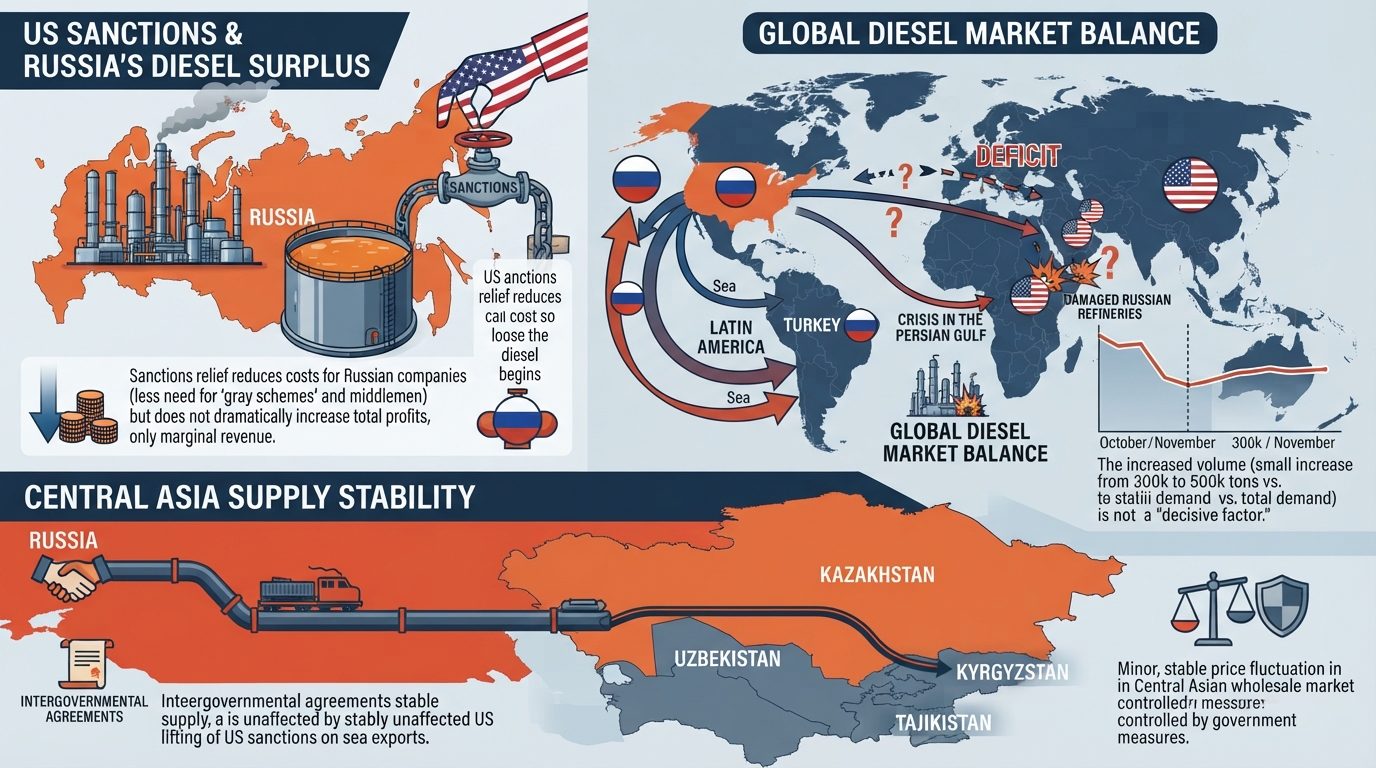
However, the easing of sanctions increases the revenue of Russian companies by reducing transport, insurance, payment processing, and other costs — that is, expenses associated with sanction-evasion mechanisms. These are not fabulous profits, but we are likely talking about tens of millions of dollars in additional revenue.
In any case, this agreement increases the attractiveness of exports. In addition, it could lead to higher purchase prices, as Russian companies gain more potential sales markets. The threat of US secondary sanctions is a significant deterrent to imports of Russian goods, including petroleum products.
To repeat: the easing of sanctions has almost no effect on the real market balance. For the dynamics of global diesel fuel prices, it is the balance that matters, not the distribution of profits.
Under normal conditions, Russia supplies about three million tons of diesel fuel per month, sometimes even more — around 40 million tons per year. This is about 10% of global trade.
Theoretically, individual tankers with Russian diesel could arrive in the US. This sometimes happened before, but it is rather related to complex logistics within the US itself. The country is large, the geography of supply and demand for petroleum products is complex, and for certain regions it is sometimes cheaper to import diesel fuel than to pay for its transportation within the country.
But this does not change the fact that the US is the world's largest exporter of diesel fuel with a share of about 15%, while Russia is in second place. From the standpoint of internal balance, they do not need Russian diesel at all. Trump's main goal is to achieve a reduction in global diesel fuel prices, to lower the export parity price, that is, to reduce the attractiveness of exports and thereby influence prices inside the US. At the same time, there is not and was not a physical shortage of diesel fuel in the US — it is important to emphasize this.
Price increases in the US are linked specifically to the export alternative, not to a lack of physical supplies. However, I have great doubts that the declared parameters of the "deal" will actually lead to lower prices. Some adjustment is possible, but under normal conditions, as already mentioned, Russia supplies three million tons per month, whereas now we are talking about 300 thousand tons, and in November — half a million tons (excluding overland exports). At the same time, the estimated deficit in the market is 6–7 million tons. The change in October-November will not go unnoticed, but it is certainly not a decisive factor.
— What will change for the global market after the possible lifting of Russian restrictions on diesel exports? How significant are the additional volumes given the current deficit of petroleum products and damage to Russian refineries?
— On a global scale, three factors could influence price reductions. The first is a reduction in demand. But in many regions, including Europe, it will be small in the coming months. Despite the seasonal drop in transport diesel consumption, demand for liquid heating fuels — gas oil used for heating — is growing. This means an overall increase in demand for middle distillates, which include diesel fuel. Therefore, demand over the next few months, at least until the end of December, will remain quite high.
The second factor is the opening of the Strait of Hormuz and, in general, the removal of restrictions on supplies from the Persian Gulf. This is the key factor that led to the current crisis. But, as we can see, the Trump administration has not yet been able to solve this problem, and the prospects remain foggy.
For crude oil in September and early October, we observed a rapid recovery of supplies using all kinds of grey schemes. But, first of all, it is also unsustainable and associated with high risks. And most importantly — for diesel fuel there is no such recovery. The situation with its removal from the Persian Gulf is much more complicated than with crude oil.
The third factor is the full recovery of Russian exports. But this factor directly depends on whether painful strikes on Russian refineries will continue.
So far, there are no clear signs that Ukraine intends to stop these strikes. Trump announced the conclusion of a certain energy truce between Russia and Ukraine, but this statement seems to have caused bewilderment in both countries. This is already at least the second such announcement by Trump, and it is not at all obvious that it will be implemented.
As long as the strikes continue, diesel fuel production remains significantly below normal, and partial export restrictions will forcedly remain. A full recovery of Russian exports will likely take several months. Meanwhile, market spot prices reflect the expectations of market participants one month, or at most two months, ahead.
— What are the prospects for Russian diesel exports to Central Asia against the backdrop of changes in Russia's export policy? Could the region receive more fuel, or, on the contrary, will supplies be redirected to more profitable external markets?
— The ban on diesel fuel exports from Russia does not apply to supplies under intergovernmental agreements, including to Central Asian countries, so formally there were no restrictions on such supplies. In July, exports were forcedly reduced to stabilize Russia's domestic market, but in August-September they largely recovered, and to certain countries they even grew noticeably.
It is possible that lifting the ban will lead to a small increase in supplies compared to September, but overall they are already at a high level. The lifting of the ban mainly concerns seaborne supplies, which are what interest Donald Trump. Land-based supplies from Russia to Mongolia and Central Asia are not as significant for international trade and global diesel prices.
But the partial lifting of the ban on them confirms that there is a surplus of diesel fuel in Russia. Consequently, supplies under intergovernmental agreements in the coming months should correspond to bilateral agreements.
— Could the resumption of large supplies of Russian diesel to the global market lead to a reduction in its availability or price increases in Central Asia? How heavily do the markets of Uzbekistan, Kazakhstan, Kyrgyzstan, and Tajikistan depend on the export policy of Russian oil refineries?
— From the point of view of physical export volumes to the countries of the region, I think there will be no fundamental changes. A rise in wholesale prices on the St. Petersburg Exchange is possible: even a partial opening of exports will exert upward pressure on domestic wholesale prices in Russia. Although this pressure will be restrained by the actions of the government, which has various levers of influence: the discussed moratorium on zeroing the damper mechanism, antitrust regulation, and the threat of new export bans.
Therefore, there will be no uncontrollable price increase, but some increase is possible. In particular, it could affect contracts tied to exchange indicators of the St. Petersburg Exchange.
Kyrgyzstan and Tajikistan are the most dependent on supplies from Russia. Uzbekistan is in third place, and least of all Kazakhstan, which mostly covers its needs independently. From the perspective of the impact of the fuel crisis in Russia, the situation in each country is different.
But, to repeat, there are intergovernmental agreements, meaning guarantees of supplies at the state level. Therefore, the partial lifting of the ban on seaborne diesel exports will not affect the stability of Russian diesel fuel supplies to Asian countries in any way.