

Dismantling of window bars in Tashkent neighborhood halted following residents' outrage
In a mahalla in the Mirzo Ulugbek district, workers began dismantling window bars on residential buildings. Following public outrage from residents, the Tashkent Khokimiyat stated that the work has been halted and the actions will be assessed for signs of arbitrary conduct. Sudden bursts of urban beautification are regularly observed in one district or another.
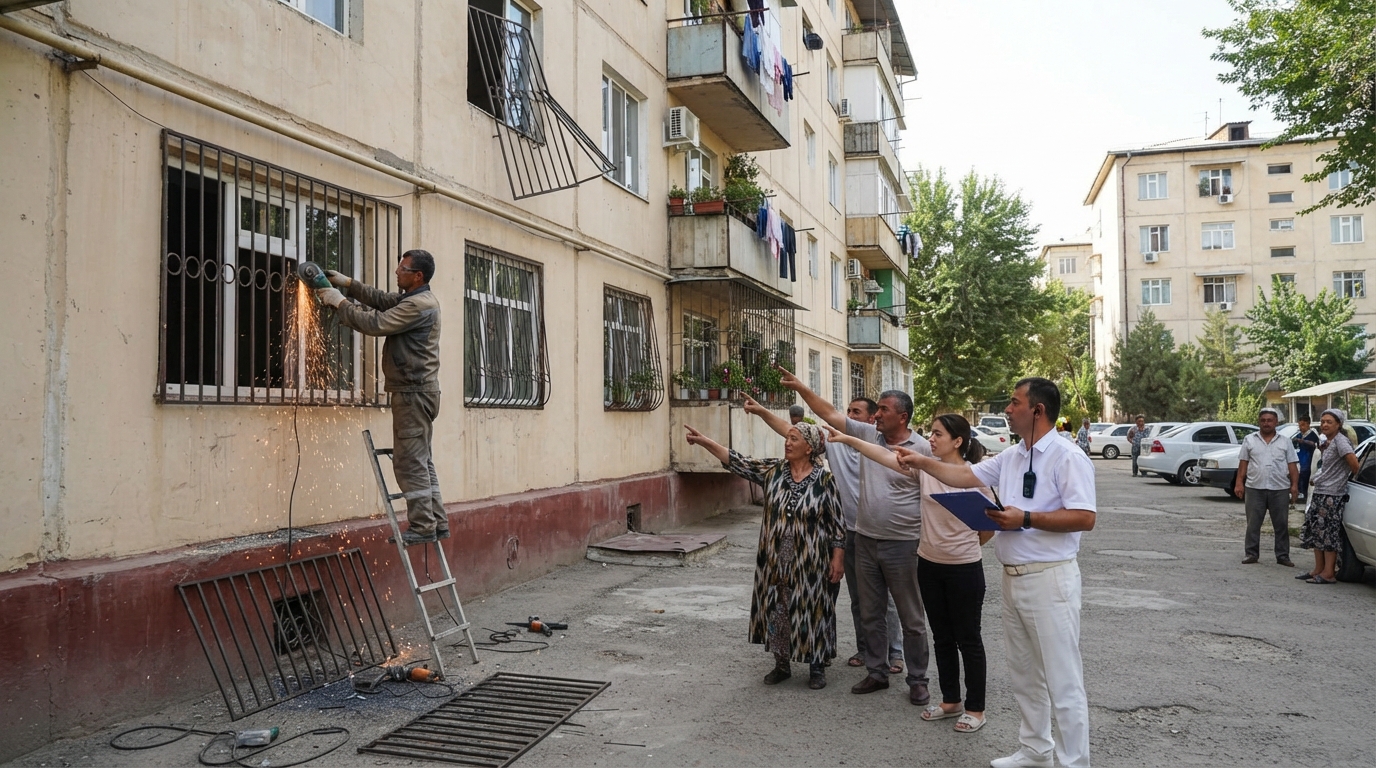
Demolition of window grilles in Tashkent mahalla suspended after residents' dissatisfaction
The dismantling of window grilles on residential buildings in one of the mahallas of the Mirzo-Ulugbek district of Tashkent has been stopped. This was reported by the capital's khokimiyat following outrage from residents and criticism from experts.
"The situation is under the control of the capital's khokimiyat: the causes of the incident and the persons responsible for this decision are being identified, and an assessment of actions is being made for signs of abuse of authority and self-assumed power," the administration stated.
"Based on the results of the check by the Mirzo-Ulugbek khokimiyat, appropriate measures will be taken, and steps will be worked out to prevent similar situations from recurring," the khokimiyat assured.
"The comfort, safety, and rights of residents are a priority for the Tashkent City Khokimiyat. Decisions affecting people's safety and their property must be made with due regard to the interests of citizens.
The Tashkent Khokimiyat opposes actions of this kind and is not their initiator," the statement emphasizes.
On October 11, the Facebook community "Potrebitel.Uz" complained that in one of the mahallas, "at the instigation of the khokimiyat and citing new rules for the maintenance of apartment buildings," they began cutting off window grilles, including those on the first floor. Officials also claimed that the installation of grilles is not provided for by the cadastre.
"They managed to dismantle them on the fifth floor.
At this time, residents of the first floors rushed around the khokimiyat in search of the official who gave this order. They found him. They demanded that the dismantling be stopped. Since grilles are a matter of home security. And no one enters them into the cadastre. They managed to suspend it. But residents fear that after some time the khokimiyat will return to this issue," wrote community administrator Liliya Nikolenko.
Architect of the "Studio of Architecture and Design" ("SAD") Mariya Sultanova, commenting on the situation, asked several questions.
"1. Where was the oversight all this time?
Grilles on houses didn't grow overnight. If specific structures were installed with violations, when were these violations identified, where were they looking while the grilles were being put up? What requirements were presented to the owners before?" the expert noted.
She recalled that monitoring the technical operation of apartment buildings is among the tasks of the Inspection for Control in the Field of Construction and Housing and Communal Services. "Therefore, the question should not be addressed only to the residents. If violations remained without a reaction for years, we also need to look into the work of the controlling authorities."
"2. What exactly was violated?
'Not according to the cadastre' is an explanation of roughly the same legal precision as 'that's what we were told.' An ordinary grille in a window opening by itself does not add area to an apartment, unlike taking over a terrace, for example. Encroachment on territory and a protective structure on a window are different situations," Mariya Sultanova wrote.
"3. Where is the procedure?
A resident needs to understand who is making the demand, on what basis, and what exactly needs to be done. Even if the apartment owner is in violation, this does not give an official the right to act with an angle grinder. If the structure really needs to be removed, people should be given the legally provided opportunity to dismantle the grilles themselves and select acceptable window protection. In the absence of an emergency, suddenness is completely unnecessary here."
"4. What problem are we solving?
People install grilles to protect against break-ins and to prevent a child from falling out of a window. These needs do not disappear after dismantling. Yes, a solid, non-opening grille can hinder rescue during a fire. This means we need to evaluate the specific solution: whether the grille opens, whether it hinders rescue, whether the mountings are safe, whether it is suitable for saving children," the architect noted.
"An angle grinder is a useful construction tool. But it is no substitute for working with city residents," she emphasized in conclusion.
It should be noted that in various districts of Tashkent, sudden bursts of urban development and landscaping are regularly observed, about which residents are rarely warned, let alone consulted. Mirzo-Ulugbek district frequently makes media headlines.
For example, in the summer, the dismantling of a playground unexpectedly began in one of the courtyards in the "Turon" mahalla. They were planning to organize a barbecue area and build a fountain here.
The district khokimiyat assured that they had discussed the project with the residents, but the residents denied this.
After the dissatisfaction, the project was modified.
However, the builders paved over many areas of the courtyards that used to be green zones and widened the path leading into the mahalla, causing more cars to park here. The parking space promised in the courtyard of building No. 1 never appeared. A sidewalk near the building was not provided, despite requests.
Pedestrians, including children and parents with strollers, are forced to navigate around cars.
A speed bump that slowed down vehicle traffic was removed, causing many drivers to speed. Officials refuse to create a full-fledged intersection with traffic lights and pedestrian crossings at the entrance to the mahalla.
Despite the dissatisfaction, a shop was built next to a residential building. And on the end wall of a nine-story building, they attempted to "touch up" a mosaic by Nikolai Zharsky, assuring that permissions for this had been obtained (they had not). The fountain was ultimately built in another courtyard, while removing benches that were used by residents, passersby, and employees of nearby organizations.
Currently, the development of a walking zone along the Salar Canal has begun in the same district. When concreting the banks, workers left no space around the trees. After criticism on social networks, the tree trunks were freed. Why it is necessary to concrete the banks, excluding the possibility of future greening and increasing spaces that will heat up in the summer, and why nature-oriented landscaping methods cannot be used—Gazeta was unable to obtain answers to these questions.
It is impossible to list all such examples in one article. City residents have long dubbed such urban improvement "merciless," and the name "Obod Mahalla" ("Landscaped Mahalla") has come to be associated with the deterioration of the living environment. While declaring regard for people's interests and concern for their comfort, officials continue to "improve" mahallas in their own way, brushing off residents' questions and suggestions.
"City residents are not just users of the city. They are the owners of the city.
They live here, they pay taxes, and it is on these taxes that the state exists and all these reforms are carried out," urbanist Arkady Gershman said in an interview with Gazeta. Will officials, in their landscaping fervor, hear this truth?