

"Democracy is never a finished product." EU Ambassador to Uzbekistan on challenges to modern democracies
For the International Day of Democracy, Gazeta spoke with the Head of the EU Delegation to Uzbekistan, Toivo Klaar, about the challenges facing modern democracies. We also discussed reforms in Uzbekistan, media freedom, and the issue of trust in the courts.
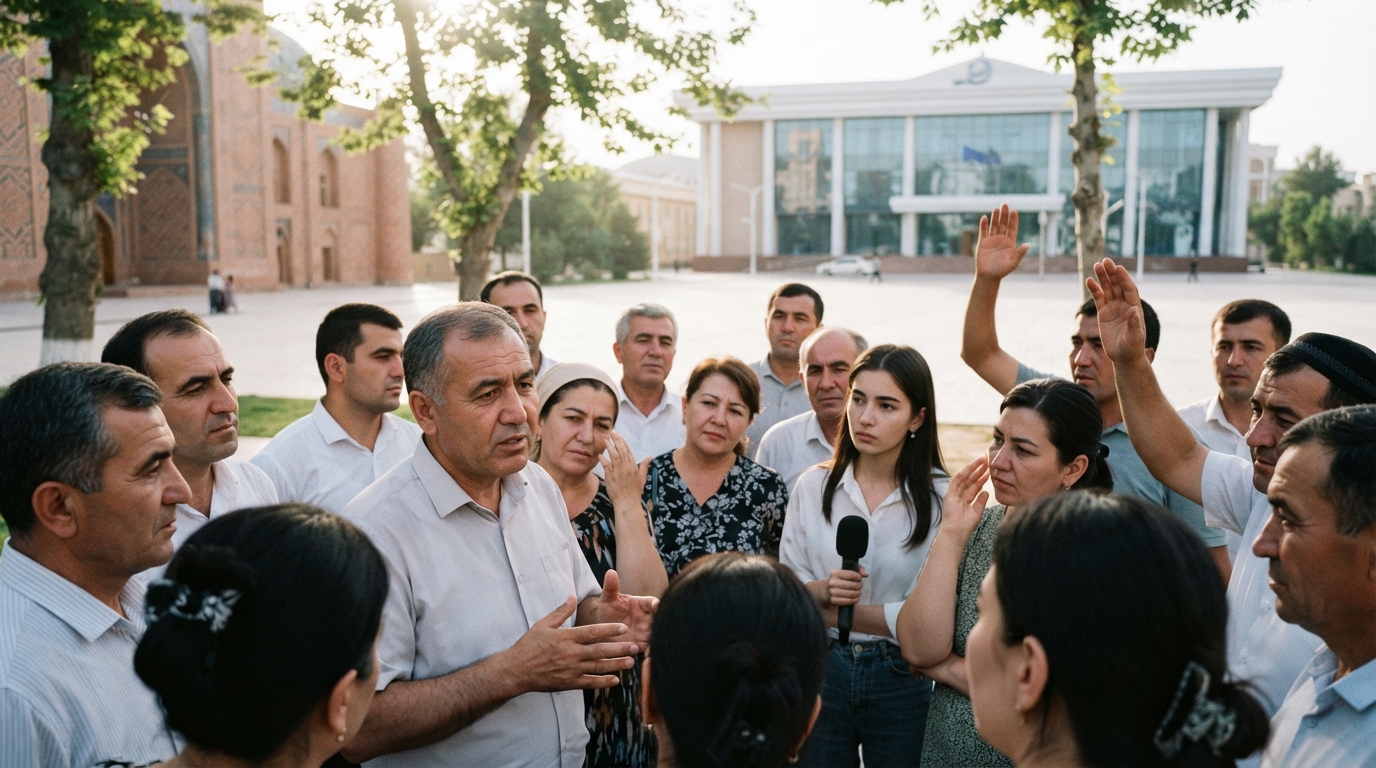
"Democracy is never a final, finished product." EU Ambassador to Uzbekistan on challenges to modern democracies
— Democracy is, first and foremost, the power of the people. For me, this means that people, the citizens of a country, can choose those who govern them—both at the national and local levels. That is, first and foremost, democracy is the opportunity to elect one's leaders, and after some time, to decide that other leaders are needed, and elect them.
— I think this is the result of many factors. Personally, I believe that democracy is ultimately our natural state, what we actually want. Because even those who say, "We need stronger leaders, we don't need so many different parties—there are too many of them," actually also want to be able to choose those strong leaders.
And after a while, they will want to choose other strong leaders. So, ultimately, they want democracy too.
It may seem that democracy is too chaotic and too complex. And I understand that. When modern democracy was forming in Europe and the United States, it was quite clear what each party stood for. Socialists and social democrats represented workers and fought for their rights. Conservatives expressed the interests of the wealthier classes, wanted perhaps a greater role for the church, and stood for more traditional values. Liberals were more in favor of free enterprise and perhaps represented small businesses to a greater extent.
In today's Europe, things are no longer so obvious. We have managed to agree on a great deal: conservatives agreed that workers' rights need to be protected, and socialists agreed that it is necessary to ensure good conditions for business. As a result, the parties have come so close to each other that people are starting to ask, "What is actually the difference between them?" And then they look for someone who really stands out, who says something truly radical and tough. This sounds much more attractive than positions that are essentially very close to each other.
But, as I said, even those who want to elect a strong leader or a radical party want to have the opportunity to make that choice, and after some time, to choose other people. So, as Winston Churchill once said, democracy is the worst of all possible systems, except for all the others.
— This is partly what I have already spoken about. In some countries, people feel that there is not much difference between traditional parties, and therefore they choose radical alternatives. And this is a challenge, because radical proposals sound good, but often turn out to be not so good when you start looking into how exactly these forces intend to implement their policies.
But the other thing is also true: the modern world is changing very fast, and some people feel left behind. They do not feel that traditional parties represent them, and they listen to radicals who say, "I will really change everything for you in a fundamental way."
On the one hand, I do not think that radical parties—whether right-wing or left-wing—are capable of fundamentally changing the situation. On the other hand, I believe it is important for traditional conservative, socialist, and liberal parties to find a way to talk to the people who vote for radical forces.
It is wrong to assume that if a fairly significant part of the population votes for an ultra-right or ultra-left party, all of these voters are necessarily ultra-right or ultra-left. This is not the case. They simply feel that traditional parties do not represent them. Therefore, traditional parties have a lot of work to do to find a way to talk to people who feel, "We have no one else to vote for."
In many European countries, this is one of the main challenges today: the connection between citizens and political parties is no longer as strong as it was a few decades ago. And we need to find ways to rebuild this sense of common purpose.
— First of all, I think that a lot of this kind of reasoning is promoted by people who do not actually understand or do not want to understand how the European Union works.
At its core, the EU is an association of 27 member states. Their heads of state and government meet regularly. And ultimately, it is the member states that defined the rules by which the European Union functions. It is they who can change these rules.
Of course, as you said, there is talk of a democratic deficit: that the European Commission is doing something on its own. But the European Commission was empowered by the same member states and the governments of those states, elected by their citizens. In other words, the powers of the European Commission are granted to it by the democratically elected governments of all 27 EU countries. This is not a democratic deficit.
If we talk about migration—which is, of course, a subject of serious debate—it actually has nothing to do with the European Commission. This issue is in the hands of the member states: it is they who agree on a common policy.
But there is a problem here. Politicians of member states often return home and say, "Brussels decided this" or "Brussels decided that." But there is no abstract "Brussels." Either it is the European Commission doing something because the member states have empowered it to do so, or it is a joint decision of the representatives of the member states—for example, ministers meeting in Brussels in one format or another.
And again: this is not some abstract Brussels. It is the member states that decided that something needed to be done. But some decisions may not be very popular. Therefore, it is easier to say, "Well, Brussels did it," rather than, "I, as a minister of my country, participated in making this decision and I take responsibility."
But, I repeat, there is no real democratic deficit here. And it is important for the politicians of the member states not to create the impression that there is one, because this feeds a popular but incorrect narrative.
— I think that after 70 years of Soviet dictatorship, and then 25 years that were not easy for independent Uzbekistan, reforms cannot happen overnight. The main thing is that indeed a lot has been done. And the main thing is that the reform process continues, moving in the direction of development.
As you already mentioned, I am Estonian. And I can say that I am very pleased with what happened in Estonia in the late 1980s and early 1990s. Back then, we had leaders who created a state system that ensured stability. This system was based not on any particular personality, but on the understanding that the country needed a state structure that would outlive any individual and ensure long-term stability.
I think this was a very important and very wise step by the Estonian leaders—the institutions created back then are still functioning today.
In Uzbekistan, too, they talk about the need to build systems. Ultimately, the most important thing for any state in the long term is to have a resilient state structure, a state system that does not depend on one person, but provides the country and its people with stability, security, and prosperity.
— I think, first of all, I would address this question to the citizens of Uzbekistan. After all, if we return to the original idea that democracy is a system created by the people and for the people, then it is important to hear the opinion of the citizens of Uzbekistan: how, in their view, the situation is developing and how it should develop.
Of course, as an observer, I may have my own views and opinions. And I do believe that it is very important to move forward, to continue the reforms started in 2017.
But ultimately, evaluating how well and fully everything has been done and how much more remains to be done should, to a large extent, be up to the citizens of Uzbekistan themselves. And they should have the opportunity to engage in dialogue with the country's leadership, so that the citizens and the political leadership are on the same page.
— First of all, we on the part of the European Union would very much like to have the opportunity to read the report on the events in Karakalpakstan. It has never been published in full, and I think that would be very important.
Those were traumatic events. And on the part of the European Union, we have always said that in this, as in all other cases, it is important that justice is not only done, but that people see and believe that it is done.
Therefore, the question of how the sentences were handed down and whether the court decisions should be reviewed is a fair question. I think it is important that an opportunity arises to heal, at the national level, the wounds inflicted by these events. And I very much hope that this will be on the agenda.
We continue to raise these issues because we believe that not everything has been answered. And first of all, of course, as I said, the report on the events was not published. I think it would be good if it were made public.
— Just a few days ago, I met with a group of female journalists. And in my conversation with them, I also raised an important point: journalists must be able to do their work freely—without intimidation, without fear of consequences.
Of course, any person—more or less influential—has the right to protect their honor. This is absolutely true and fair for any country. The question is how exactly this happens.
Journalists, of course, must approach their work responsibly and ensure that they report facts. But it is equally important that journalists can report these facts without fear that someone will intimidate them—whether an influential person or not, whoever they may be.
And here, it seems to me, Uzbekistan still has a lot to do. As far as I know about the media situation in the country, unfortunately, sometimes journalists prefer not to take on a particular story because they think it might have negative consequences for them. Or, after publishing a piece, they are subjected to unfair pressure.
I think it is important to understand: a free and vibrant press is very beneficial for building a stronger society. Free and open media expose problems that may not be obvious to decision-makers. They can discover what someone wants to hide. They can draw attention to issues that have not received enough attention before.
Free media are a very important partner in building a strong, prosperous, and free country. This is something to be valued and supported. And in this sense, I think Uzbekistan still has work to do.
— I think, first of all, this question should be addressed to the members of the parliament of Uzbekistan who voted for this law and passed it.
A state can be built and organized in different ways. There are countries with strong parliaments, there are countries with strong presidents, there are states with hybrid systems. Therefore, in this sense, it is up to the decision-makers here in Tashkent to determine what system of government they prefer and what mechanisms they support.
— We support Uzbekistan in many different areas. An important part of the cooperation was agriculture. We have provided support in the field of social services, environmental protection and, of course, good governance in a broad sense—whether it is the fight against corruption or, for example, spatial planning, which we are talking about now.
In the field of spatial planning, we are trying to help decision-makers in Uzbekistan make better decisions: to understand what should be located where—or, rather, what infrastructure is already located where—how to build more efficiently and how to design cities more efficiently.
In short, we have worked to help Uzbekistan become a more resilient and stronger state. In doing so, we help both state structures and civil society. We also pay attention to the environment and agriculture, so that the management of natural resources—both in the agricultural sector and beyond—becomes more efficient and these resources are used better.
Now, of course, we are very interested in both expanding and improving connections between Uzbekistan and the European Union. This means strengthening connectivity within the Global Gateway program—whether it is the Trans-Caspian Transport Corridor or the development of better satellite infrastructure and satellite communications.
— First of all, by signing the Enhanced Partnership and Cooperation Agreement, we, as partners, declared that both sides value democracy, human rights, and the rule of law, and that these are important principles for both sides.
Within the framework of existing cooperation, we regularly hold a dialogue on human rights and the rule of law. In addition, we have the GSP+ program, under which the European Union grants Uzbek goods preferential access to the European market. In return, we expect Uzbekistan to implement a number of UN conventions related to human rights, labor rights, environmental rights, and other issues.
Regular monitoring is conducted under GSP+. Its results are published and are publicly available. That is, anyone in Uzbekistan can read them, study them, and see how the EU assessed the development of the situation in the country over the past period. And, of course, the results of this review become the basis for our dialogue between Uzbekistan and the European Union.
— Yes, I think you have raised a very important point. European investors, as well as investors from other G7 countries and other Western democracies—such as Australia or New Zealand—look at the state of the rule of law in a particular country when deciding whether to invest there.
And it is not just about whether the company's management wants to invest in a certain country. It is also important whether the company's shareholders believe that this is indeed the country where they want to put their money. Therefore, the rule of law—and how people perceive its state—is an incredibly important factor in the decision-making of Western investors.
There are not many European companies operating in Uzbekistan—at least, nowhere near as many as I would like. And I think this is an indicator that many companies still do not feel confident enough to come to Uzbekistan. There is still work to be done to convince them.
As I said in my response to one of the previous questions, in the area of the rule of law, it is not only important to do things right—it is important that people see that things are being done right. And that means transparency. It means access to court proceedings. It means that appeal procedures must also be transparent.
In many ways, this is a matter of perception. We can have the best laws one could wish for. But if people still have the feeling that something is not quite right, that is a problem—and it needs to be addressed.
As the saying goes, the customer is always right. The same applies to the citizen. Ultimately, it is the citizen who must decide whether they feel confident, whether they consider the decisions of the government or the court to be fair and lawful.
It is the citizen who must make the final assessment. And if a person feels that things are not quite as they should be, then there is a problem that needs to be solved.
— I will give an example from a slightly different angle—Afghanistan, a country located next to Uzbekistan, but in a completely different situation.
In the case of Afghanistan, the European Union and its member states decided at a certain point: we will not engage with the Taliban until they meet certain conditions. And, of course, we do not want to deal with the Taliban as long as they continue to discriminate against women and girls.
This is one approach. Another approach is to say, "We need to engage with the Taliban to encourage them to change. Then they will have something to lose and there will be an opportunity to influence them." This is a very specific example related to Afghanistan, but the same logic applies to international relations in many other situations.
I think the vast majority of people believe that the decision of the US and the West to enter into dialogue with the Soviet Union in the early 1970s to achieve the signing of the Helsinki Final Act was correct. It guaranteed people certain rights and eventually led to the emergence of Helsinki committees, including in the Soviet Union. These committees demanded compliance with the rights enshrined in the act. And that was the right decision—as opposed to refusing to engage with the Soviet Union.
I think the engagement of democratic states with countries that still have some way to go towards full democracy has, in various circumstances, contributed to the further opening of these countries and the spread of values.
Personally, I believe it is important for the European Union to work with all countries of the world. But I also believe it is important for us to emphasize our values, to insist on attention to those areas that are important to us—whether it is the media, civil society, labor rights, or other issues.
I do not see these approaches as mutually exclusive. On the contrary, they complement each other. It is important to engage, it is important to have a dialogue in order to have leverage and the opportunity to make a difference.
And ultimately, as I said at the beginning, despite all the difficulties that different societies and countries may face, democracy is the best system. This means that we share a common path with all the peoples of the world. And we just have to keep working together to reach a common understanding of how democracy benefits us all.
— I think there is no such thing as democracy as a final, finished product. If you look at Europe, you could say that in the 1970s and 1980s, Western European democracy was perhaps as good as it could possibly be. Well, now we have certain difficulties.
This means that there is no such thing as stability achieved once and for all. We must constantly work, constantly solve emerging problems.
The essence of democracy is precisely that we must constantly ensure that the people who make and must make decisions feel part of the system. So that they want to continue building this imperfect, but still good system together.