

Current Agenda (July-August 2026)
At meetings chaired by the President of Uzbekistan, the most acute issues of the ongoing reforms are resolved in a working manner. On the most important decisions made during the meetings dedicated to the development of the socio-economic sphere.
**Current Agenda (July-August 2026)**
On July 16, under the chairmanship of President Shavkat Mirziyoyev, a videoconference meeting was held dedicated to creating a new environment in mahallas and a new procedure for organizing the activities of the "mahalla seven."
It was noted that this year, an average of 250 billion soums was allocated to districts, and 5.5 billion soums to mahallas, to improve infrastructure and create conditions for the population. Due to the expansion of powers, the volume of revenues remaining locally increased almost twofold. On average, an additional 22 billion soums remained in the districts, and an average of 150-200 million soums was received by mahalla budgets. At the same time, the low involvement of low-income families in projects in certain districts was criticized, as well as the fact that in 32 mahallas, not a single person in need was employed in a permanent job. In this regard, since the beginning of the year, 152 managers have been dismissed from office, and disciplinary measures have been applied to another 700.
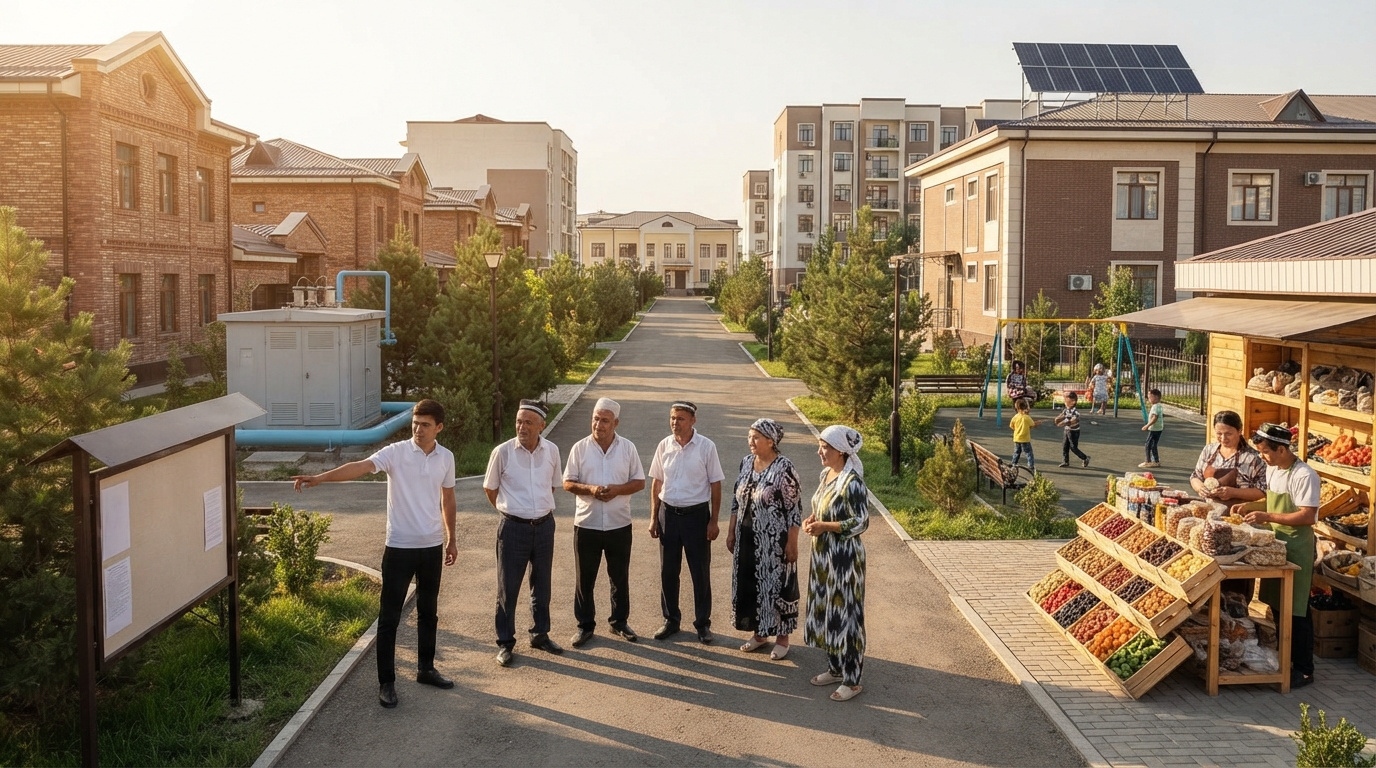
The Head of State emphasized that the mahalla must become a true center of trust, support, and opportunities for the people. Recently, a presidential decree was signed, according to which every mahalla chairman will now form the economic and social order of their territory. Mahalla chairmen will also be delegated the authority to auction land plots for the construction of private kindergartens, schools, clinics, and sports facilities.
The mahalla chairman must take the initiative in projects aimed at solving social problems, ensuring cleanliness, and increasing income. For such projects, "mahalla sevens" will be allocated grants of 10 million soums. For these purposes, a resource of 240 billion soums will be formed. The mahalla chairman will also approve the weekly and monthly plans of the "mahalla seven," set specific tasks for them, and hold them accountable for their execution. To provide methodological support for the activities of the "seven," the National Institute for Mahalla Development will be established.
The working style of mahalla bankers will be radically changed. Banks must identify the "growth points" of each mahalla, find enterprising people, and increase the number of profitable projects. No more than three mahallas will be assigned to one mahalla banker. Mahalla bankers will work with bank clients in their territory. To train the unemployed in these professions, they will send applications to the employment department and employ those who have completed training.
This year, an additional 2 trillion soums of preferential resources have been allocated for family entrepreneurship projects. State banks will work on the specialization of mahallas, as well as on creating, together with "Agro-star" companies, a "cultivation — processing — storage — packaging — sales" chain. The task has been set to start work in 1,000 mahallas within a month.
New initiatives have also been put forward to strengthen mahalla budgets. Now, 5% of the land tax and property tax received from non-residential objects in the mahalla will also be directed to the mahalla itself. Thanks to this, another 400 billion soums will remain at the disposal of mahallas annually. During the year, 200 mahallas that showed the best results will receive 2 billion soums in rewards. In general, due to new initiatives, receipts to mahalla budgets this year will reach 1 trillion 600 billion soums, and from next year — 2 trillion soums.
To organize improvement works in mahallas, a republican headquarters headed by the Prime Minister will be created, and regional headquarters will be headed by khokims. To encourage labor, at the end of the year, nominations will be established for "Most Well-Kept Apartment" in apartment buildings, "Most Well-Kept Yard" in the mahalla, "Most Well-Kept Street" in the territory, and "Most Exemplary Mahalla" in the district and region.
Currently, about 100 services are provided through the "seven." Now, all public services will be phased in at the mahalla level. Cases of unjustified refusal of inclusion in the social register or artificial exclusion from it were criticized. As a result, families in need cannot use guaranteed services such as receiving social assistance and placing children in kindergarten. The Prosecutor General's Office has been instructed to strictly control the correct maintenance of the social register.
Within three months, day and home care, as well as "Madad" homes for persons with dementia and intellectual disabilities, will be organized in 250 mahallas; the "Faol khayot" program for elderly people in need of care will be launched in 75 mahallas; and support centers for children left unattended and affected by violence will be created.
On July 21, under the chairmanship of President Shavkat Mirziyoyev, a videoconference meeting was held to discuss the results achieved in the first half of this year in ensuring growth rates in regions and sectors, as well as priority tasks for the period until the end of the year.
Since the beginning of the year, the economy has grown by 8.5%. Growth of 8% was ensured in industry, 16.9% in services, 13.8% in construction, and 4.7% in agriculture. The volume of investments reached 28 billion dollars, and exports reached 14.4 billion dollars. International rating agencies Fitch and Moody's upgraded Uzbekistan's sovereign credit rating. At the same time, the President emphasized that to improve the quality of life of the country's 40-million population, it is necessary to ensure 9-10% economic growth. At the meeting, the execution of the six-month plans of the heads of regions and sectors was critically analyzed.
Special attention was paid to organizing the activities of the "mahalla seven" on a new basis. Employment agencies will conduct targeted work in each region to train citizens in need, employ them, and increase their incomes. A decision was made to review the activities of banks and departments of the Mahalla Association.
Issues of supporting entrepreneurship and improving the business environment were also discussed. It was noted that in the context of intensifying competition in foreign markets, it is necessary to reduce the number of payments, fees, and excess costs for exporters. All ministries and departments were instructed to submit proposals to reduce bureaucratic procedures, fines, payments, and fees, as well as to further improve the business environment.
Important tasks for the restoration and privatization of production facilities were also defined. Within the framework of the new privatization program, it is planned to put up for auction real estate objects, land plots, and state shares with a total value of 100 trillion soums, as well as to ease payment terms for entrepreneurs acquiring state assets.
Despite the fact that over the past three years, 509 export-oriented production facilities with a total value of 11 billion dollars have been put into operation, 208 of them have not yet entered foreign markets. If at least 30-40% of the products of these enterprises are directed for export, additional foreign exchange earnings in the amount of 1.5-2 billion dollars can be ensured. In addition, since the beginning of the year, not a single export operation has been performed in 29 of the 47 special economic zones. Responsible officials were instructed to form "operational teams" and quickly resolve issues related to certification, provision of working capital, search for sales markets, and logistics at enterprises and in economic zones that have not exported. A program will also be developed to promote national brands in foreign markets and protect them from dumping and counterfeit products.
Due to a shortage of freight cars and high congestion on individual railway lines, logistical difficulties arise. Responsible officials were instructed to attract additional rolling stock, as well as to reach an agreement with the World Bank to attract 200 million dollars for the development of railway infrastructure.
The progress of the implementation of agreements reached within the framework of high-level visits was also reviewed. In recent years, during 52 such visits, agreements were reached on the implementation of 1,617 investment projects with a total value of 213 billion dollars. From now on, the implementation of these "roadmaps" will be under the strict control of the Chamber of Accounts and the Ministry of Foreign Affairs. The Presidential Administration has been tasked with reviewing the activities of diplomatic missions in the field of economic diplomacy, attracting investment, and developing exports.
The meeting also considered issues of ensuring food security. It was reported that due to rising meat prices, 300 billion soums were allocated to cover the costs of air transportation of imported meat. Until the end of the year, the task was set to import 100,000 head of cattle and 150,000 head of sheep and goats. Specific measures were also defined for forming stocks of fruit and vegetable products and potatoes, constructing cold storage warehouses, and replenishing food reserves. Until the end of the year, the task was set to put into operation 340 cold storage warehouses with a total storage capacity of 87,000 tons.
The Head of State emphasized that no one can predict in advance how long the uncertainty in the global economy will persist. In this regard, it was noted that all leaders must be ready to mobilize available reserves, taking into account any possible risks. Macroeconomic parameters, the budget, as well as investment and export programs for 2027 will be developed based on a new approach — the "mobilization scenario."
On July 27, under the chairmanship of President Shavkat Mirziyoyev, a videoconference meeting was held dedicated to the priority tasks of the fuel and energy sector.
Over the past ten years, 23 billion dollars of foreign investment have been attracted to the energy sector, and power plants with a total capacity of 9.5 gigawatts have been put into operation locally. 30 trillion soums were directed to the modernization of electricity and gas networks, substations, transformers, as well as gas distribution equipment. At the same time, it was pointed out that serious shortcomings remain in the effective use of the created opportunities.
In June-July of this year, about 4,000 accidents occurred in electrical networks. As a result, in certain regions, the population and business entities remained without electricity supply for up to 8-10 hours. Moreover, in many regions, the growth of electricity consumption and the increase in load on infrastructure were not taken into account in advance. Electricity losses in networks amount to 17.2%. Over the past six months, the volume of losses reached 4.8 billion kilowatt-hours of electricity. Despite the introduction of ASKUE and ASKUG systems, hundreds of thousands of electricity and gas metering devices do not transmit data to the centralized system.
At the meeting, a new system for organizing electricity and gas supply at the level of each district and each mahalla was defined. An energy balance of each territory will be formed, taking into account the needs of the population, business entities, and social sphere objects. It is planned to develop targeted programs to reduce the number of accidents, connect metering devices to a single system, as well as significantly reduce energy losses and accounts receivable. The task has been set to create an exemplary model in this direction in the Yangiyul district. In the future, this experience will be extended to all districts and cities of the republic.
Special attention was paid to the wide introduction of digital technologies and artificial intelligence into the energy sector. The Center for Digitalization of the Fuel and Energy Complex and the Implementation of Artificial Intelligence Technologies will be created within the structure of the Ministry of Energy. The Center will conduct a comprehensive analysis of the entire "production — transmission — distribution — supply" chain and develop optimal scenarios for the development of the sector. Data from ASKUE and ASKUG systems will be analyzed using AI, and a platform will be launched that will automatically detect cases of suspicious consumption, losses, and debts.
The meeting also discussed preparations for the autumn-winter period. Today, in 1,916 mahallas, there are difficulties with natural gas supplies. Precise calculations will be prepared to increase the stability of the heating system of residential buildings, strengthen the electricity infrastructure, and cover the additional demand for electricity in these territories. A separate program will be developed for mahallas in need of priority funding.
Today, 3.7 million households use liquefied gas. The task has been set to increase the volume of liquefied gas production from the planned 520,000 tons to 606,000 tons by the end of the year, as well as to widely involve the private sector in the field of liquefied gas supply. The new practice will be introduced first in the Andijan region. Entrepreneurs will be given the opportunity to supply liquefied gas, imported independently or purchased at exchange trades, to the population and businesses. And families included in the Unified Register of Social Protection will be provided with subsidies for the purchase of liquefied gas.
The Head of State also dwelt separately on the issues of training personnel for the energy sector. Today, about 5.5 thousand specialists are trained in energy specialties in 25 technical universities. At the same time, due to the insufficient link between the educational process and practice, graduates require up to 2-3 years to fully adapt to professional activities. In this regard, it was instructed to completely update the educational programs in the areas of the fuel and energy complex in universities. From the new academic year, half of the third-year students and all fourth-year students will be covered by the dual form of education. Priority attention will be paid to training specialists in solar and wind generators, charging stations for electric vehicles, as well as other modern technologies.
On August 13, President Shavkat Mirziyoyev was briefed on the work carried out in the regions based on the "Yangiyul experience" to stably provide consumers with fuel and energy resources, increase energy efficiency, and sharply reduce network losses and accounts receivable.
Earlier, the task was set to create an exemplary system in 14 districts, selected one in each region. The work carried out covered 916 mahallas, 832,000 households, 49,000 business entities, and over 2.2 thousand social sphere objects. For each mahalla, an energy passport and a balance of energy resource needs have been formed.
As a result, for the first time in the context of mahallas, the gap between the existing demand and available opportunities was accurately calculated. In particular, in 265 mahallas, a deficit of electrical capacity in the volume of 60 megawatts was identified, and in another 42 mahallas — of natural gas in the volume of 47 million cubic meters per year. At the same time, in 207 mahallas, there is a capacity reserve. This approach allows for calculating future energy resource needs in advance and preparing the necessary infrastructure in a timely manner.
On this basis, the renewal of electricity and gas networks has been accelerated. It was established that in 14 districts, 5,695 transformers, 6.9 thousand kilometers of electrical and 242 kilometers of gas networks, as well as 404 gas distribution devices, need repair. Work has begun to improve their technical condition and transfer them to the "green" category. To date, 441 transformers, 1,134 kilometers of electrical and 88 kilometers of gas networks, as well as 92 gas distribution devices, have been repaired.
In the next five years, the demand for energy resources in these districts will increase by 49%. In this regard, a five-year program has been developed aimed at reliably and stably providing the population and entrepreneurs with energy resources. Within the framework of the program, it is planned to renew 2,261 transformers and 7,449 kilometers of electrical networks in 721 mahallas, as well as 313 gas distribution devices and 327 kilometers of gas networks in 200 mahallas. The implementation of these measures will allow for creating additional transmission capacities in the regions in the volume of 1,300 megawatts.
Energy consumption at social sphere objects was also studied. The consumption of energy resources at 1,938 objects was analyzed, and 226 of them with low efficiency indicators were classified in the "red" category. A program has been developed to transfer them to energy-efficient systems. The implementation of the planned measures will allow for saving 4.3 million kilowatt-hours of electricity and 2.1 million cubic meters of natural gas annually. The Head of State pointed out the need not to limit themselves to the approach applied in 14 districts, but to extend it to all districts of the republic. The goal is to transition in the energy sector from the practice of "eliminating a problem after it arises" to a system that provides for the early identification of problems and their prevention.