

Crew searching for Amelia Earhart arrives at crab-infested island
Researchers will sleep on their ship to avoid giant crabs that can lift heavy weights, split open coconuts, and may have played a role in Earhart's demise.
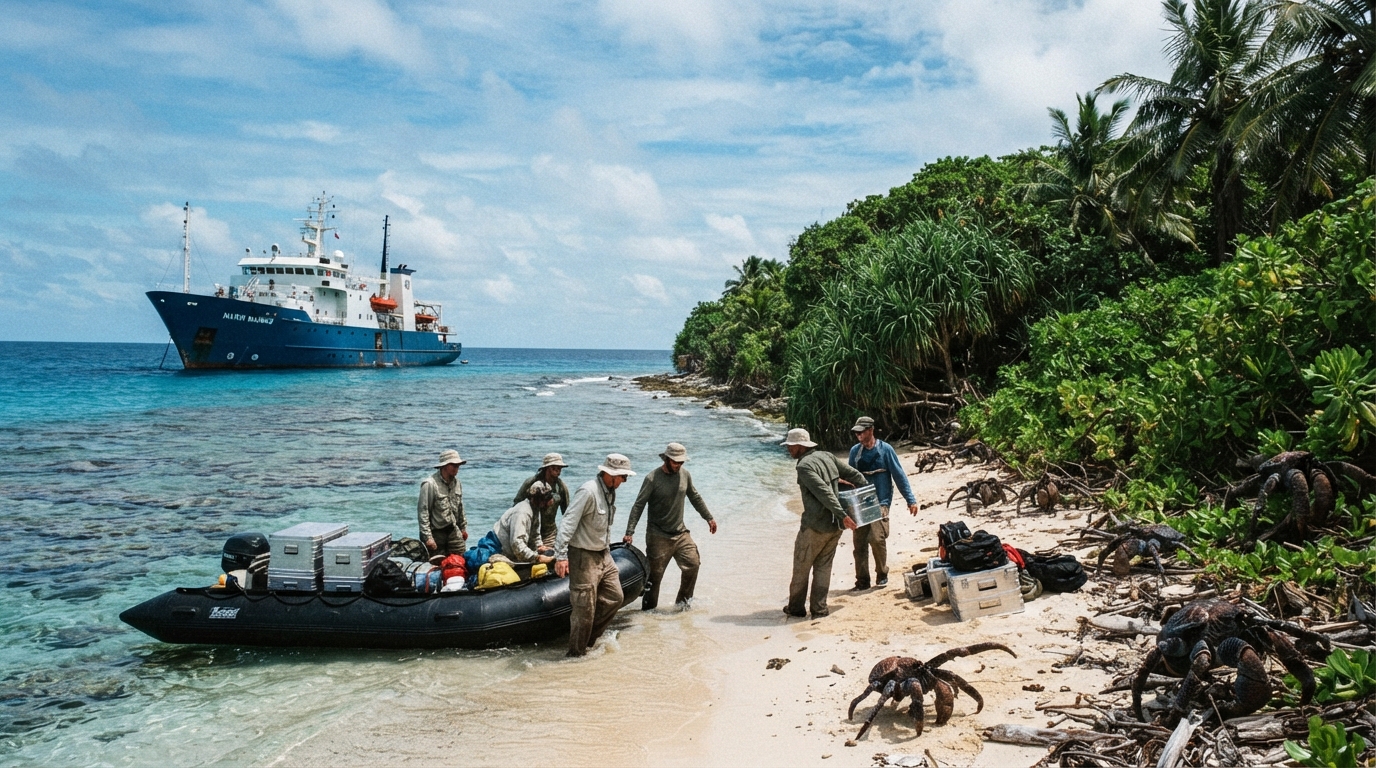
Crew searching for Amelia Earhart arrives at crab-infested island
A team of researchers has reached a remote island to examine possible wreckage from the plane of famed aviator Amelia Earhart, who disappeared in 1937 while flying around the world.
The group from the Archaeological Legacy Institute (ALI) and Purdue University arrived on Nikumaroro Island in the Pacific Ocean on Monday.
Their work, which is expected to last five days, could be disrupted by giant land-dwelling crabs, as well as the El Niño climate phenomenon, which is now the strongest ever recorded.
Coconut crabs, also called Robber crabs, come out at night to hunt small mammals and seabirds, and will require the search crew to spend nights on their ship for safety.
Earhart’s disappearance, while the American aviation pioneer was trying to circumnavigate the globe with navigator Fred Noonan, has fueled decades of speculation.
Researchers will try to locate what has been dubbed the Taraia Object, first seen in satellite imagery in 2020 sitting on the edge of a lagoon off Nikumaroro.
Some think it may be the wreckage of her plane, while others doubt it is an aircraft at all, with one theory saying it is a fallen tree.
According to Purdue, this is the first authorized trip to Nikumaroro Island in seven years, and the first visit to the Taraia Peninsula in more than 15.
The ship Marin Mainiku arrived Monday on the western side of the island, part of Kiribati, after a five-day journey covering 830 nautical miles across the South Pacific.
"It is incredibly rewarding to be this close to completing our inspection of the Taraia Object and potentially solving, at long last, the outstanding mystery of the disappearance of Amelia Earhart and Fred Noonan more than 89 years ago," expedition leader Rick Pettigrew said in a blog post on Monday.
On Tuesday, the crew plans to pass through a narrow gap "blasted" in the atoll’s reef by the British in 1963 — the last time the island was inhabited — in preparation for landing.
The first day on the island will be devoted to "transporting equipment, clearing vegetation, and establishing staging operations," according to the post. One team of researchers will cut a path through the jungle.
Work will then move on Wednesday to searching the Taraia Peninsula for evidence, including magnetic metals.
Finally, the researchers will use dredging equipment to shift sediment for a visual inspection of the mystery object, which is believed to be only 10 feet from shore in as little as five feet of water, depending on the tides.
Researchers say weather and ocean conditions "will continue to be a factor," and El Niño could restrict daily access to shore. Michael Krivor, a marine archaeologist on the trip, said he is currently worried about a weather pattern moving from east to west that could interfere with "safe transit in and out of the blasted channels".
Another issue is the crabs, the largest land-dwelling invertebrates on the planet.
"The crew will sleep nightly aboard the Marin Mainiku for a number of reasons, one of which is the presence of coconut crabs, whose size and overnight activity make staying on the island impractical," the blog post says.
The crabs, which live on atolls and desert islands across the South Pacific, can lift up to 28kg (62lbs) and are among the few species able to crack open a coconut, though they also hunt live prey such as rats and birds.
With a leg span of up to one metre and a body weight of more than 4kg, they are also the world’s largest land-dwelling crustacean and can climb trees.
In 2018, the International Group of Historical Aircraft Recovery used pig carcasses to show how the crabs could drag bodies to their burrows and strip the flesh from bones in less than two weeks.
Earhart had already flown successfully from California across South America, Africa and Asia in her Electra twin-engine plane when she arrived in Lae, Papua New Guinea, on 2 July 1937.
From there, she and Noonan intended to head toward Hawaii, but the plane vanished without a trace as they tried to reach uninhabited Howland Island, near Nikumaroro, to refuel.
Although many theories have been proposed about the disappearance, the official explanation is that the plane had communication problems and, as she and Noonan struggled to locate the island, ran out of fuel and crashed into the ocean.