

Expedition hopes to find aviator Amelia Earhart's plane on remote island
The team en route to the suspected crash site aim finally to solve the mystery of her 1937 disappearance.
**Expedition hopes to find aviator Amelia Earhart's plane on remote island**
**The research team departed Kiribati's capital on Wednesday and hope to arrive at the suspected wreck site by Monday**
A group of researchers is traveling to a remote island to examine what they believe may be the wreckage of famed aviator Amelia Earhart's plane.
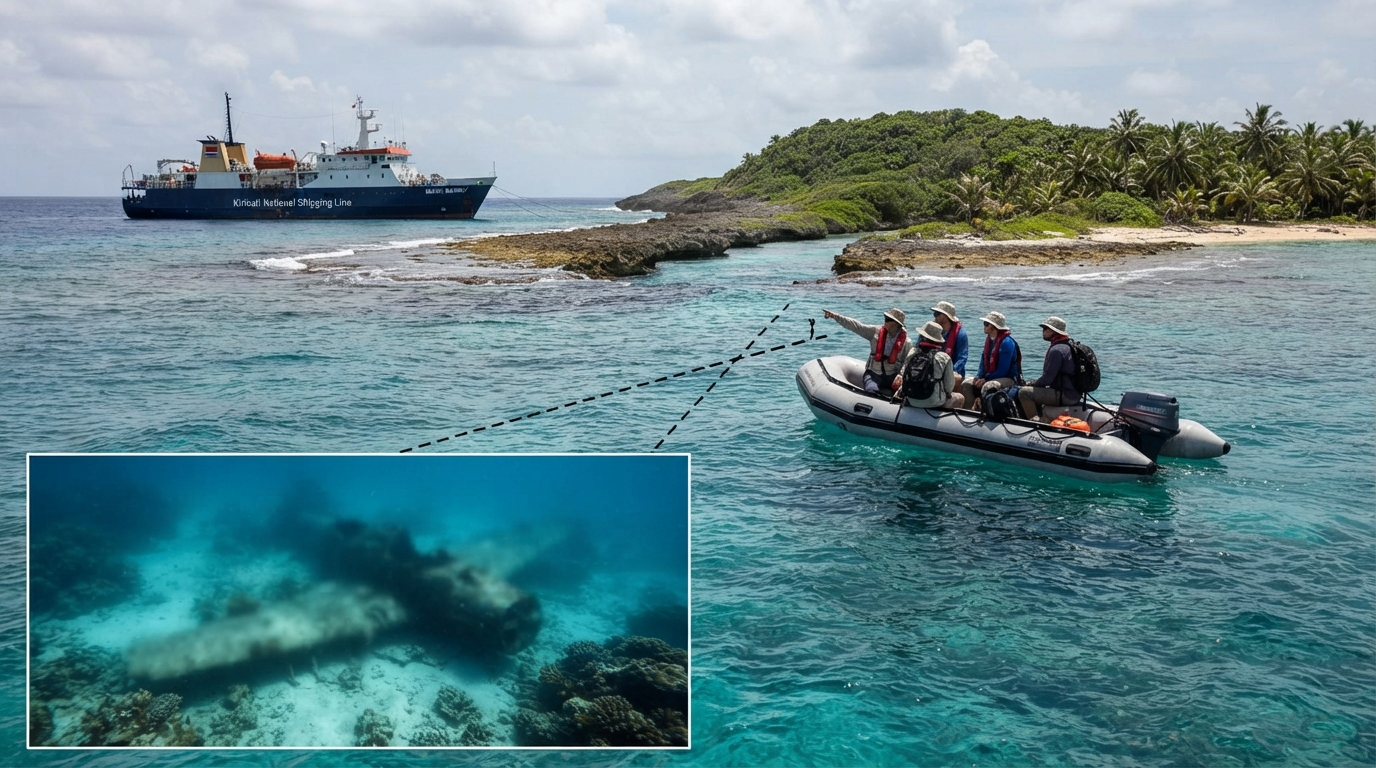
The team, from the US-based Archaeological Legacy Institute (ALI) and Purdue University, is expected to reach Nikumaroro Island in the Pacific Ocean by Monday in hopes of finally resolving the mystery of her disappearance.
The American pioneer disappeared while trying to circle the globe in 1937, prompting decades of speculation about what happened to her.
The researchers are hoping to locate what has been dubbed the Taraia Object, first seen on the edge of a lagoon off Nikumaroro in satellite images in 2020.
Purdue University said the object was later confirmed to have appeared in aerial photographs of the area dating back to 1938.
The team is now about halfway through the trip to the remote atoll aboard the Marin Mainiku, a vessel operated by the Kiribati National Shipping Line.
They left Kiribati's capital on Wednesday to start the 830-mile journey to Nikumaroro, which is also part of the island nation.
Once they arrive, they will need to pass through a narrow opening in the atoll's reef, created by the British in 1963, the last time the island was inhabited.
"Finding Amelia Earhart's Electra aircraft would be the discovery of a lifetime," Richard Pettigrew, head of the ALI and leader of the expedition, said.
Earhart had already flown successfully in her Electra twin-engine plane from California across South America, Africa and Asia when she reached Lae, Papua New Guinea, on 2 July 1937.
From there, she and her navigator Fred Noonan intended to head to Hawaii and then return to California.
But her plane disappeared without a trace while attempting to reach Howland Island, a remote, uninhabited coral island near Nikumaroro, to refuel.
Earhart's disappearance led to many theories, ranging from a straightforward crash caused by fuel exhaustion to more elaborate claims of interference.
The official account is that the plane experienced communication problems as the pair struggled to locate the island, and Earheart ultimately crashed into the ocean after running out of fuel.
Although this version of events is widely accepted, no physical evidence has ever been found.
One theory is that Earhart accidentally reached Nikumaroro, where she landed her plane in the water and died as a castaway.
Images of the so-called Taraia Object show what may be the remains of a small aircraft in shallow water.
But some people, including rival explorers, have voiced doubt that it is a plane, much less Earhart's.
Ric Gillespie, who specialises in recovering historic aircraft wrecks, told news agency Reuters that the object looked like a tree that had fallen from the atoll into the nearby water.
The researchers heading to the island credit Gillespie with previously uncovering evidence of human presence on the atoll in the 1930s, and forensic analysis of skeletal remains found there in the 1940s that they say supports their theory.
But Gillespie believes Earhart's plane likely broke apart and its pieces were carried into the depths of the Pacific long ago.
Earlier efforts to locate her Electra have also failed.
In 2024, a group of researchers said they may have found it resting about 4,877m (16,000ft) below the surface near Howland Island through sonar imaging - but this was later confirmed to be a rock formation.
Likewise, an expedition in 2019, led by the marine archaeologist who discovered the Titanic wreck, to examine a photograph of what might have been a landing gear sticking out of the water near Nikumaroro also found nothing.