

Construction work in Uzbekistan increased by 12.9%.
The National Statistics Committee reported that the volume of construction work in Uzbekistan for January-July 2026 reached 227.4 trillion soums, an increase of 12.9% compared to the previous year.
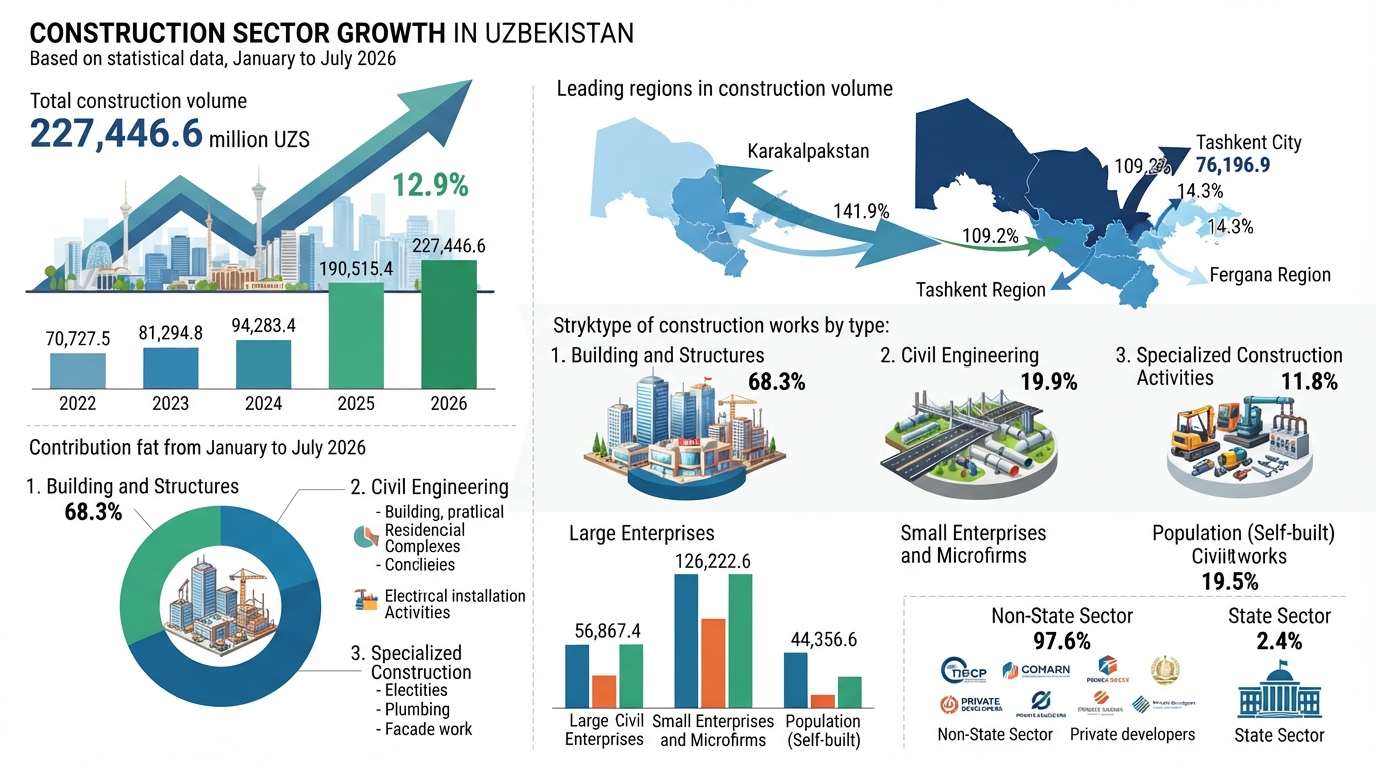
The volume of construction work in Uzbekistan demonstrated significant growth, increasing by 12.9% from January to July 2026. The total value of completed work reached 227,446.6 billion soums, according to the National Statistics Committee of the Republic of Uzbekistan.
The agency notes a steady upward trend in the country's construction sector over the past five years. For example, in the same period of 2022, the volume of work amounted to 70,727.5 billion soums, in 2023 – 81,294.8 billion soums, in 2024 – 94,283.4 billion soums, and in 2025 – 190,515.4 billion soums.
Among the regions, Tashkent leads in terms of construction work volume, with 76,196.9 billion soums and a growth rate of 109.2%. It is followed by Tashkent Region (21,080.7 billion soums, an increase of 14.3%) and Fergana Region (13,770.4 billion soums, an increase of 19.5%). Significant volumes were also recorded in Bukhara Region (12,674.6 billion soums), Samarkand Region (11,219.3 billion soums), and Kashkadarya Region (11,066.4 billion soums). The highest growth rates were recorded in the Republic of Karakalpakstan (141.9%) and Samarkand Region (138%), while Tashkent City demonstrated the lowest growth (109.2%).
In the structure of construction work by type of economic activity, the construction of buildings and structures accounts for the largest share – 68.3% of the total volume, equivalent to 155,287.7 billion soums, with a growth rate of 106.8%. Civil construction accounted for 19.9% (45,181.6 billion soums), an increase of 22.3%, while specialized construction work accounted for 11.8% (26,977.3 billion soums), an increase of 41.2%.
Analysis by business type shows that large construction organizations completed 36,358.8 billion soums worth of buildings and structures (an increase of 108.9%), 14,787.8 billion soums worth of civil construction (an increase of 31.3%), and 5,720.8 billion soums worth of specialized construction (an increase of 34.9%). Small businesses and micro-firms constructed buildings and structures worth 74,584.1 billion soums (a 6.1% increase), civil engineering projects worth 30,382 billion soums (an 18.4% increase), and specialized work worth 21,256.5 billion soums (a 42.9% increase). Residential enterprises constructed buildings and structures worth 44,344.8 billion soums (a 6.3% increase) and civil engineering projects worth 11.8 billion soums (a 4.8-fold increase).
Overall, small businesses and micro-firms contributed the largest share of the total construction volume, accounting for 55.5% (126,222.6 billion soums at current prices), with a growth rate of 113.9%. Large construction organizations completed 25% of the work, amounting to 56,867.4 billion soums, a 16.3% increase. The share of construction work performed by the population amounted to 19.5% of the total volume—44,356.6 billion soums, an increase of 6.3%.
The largest volume of work performed by large construction organizations was recorded in the city of Tashkent (17.2 trillion soums), Tashkent region (4.1 trillion soums), and Navoi region (3 trillion soums). Among small businesses and microfirms, the leaders were the city of Tashkent (53,195.7 billion soums), Fergana region (8,101.8 billion soums), and Samarkand region (7,496.3 billion soums). In terms of the volume of construction work performed by the population, high figures were recorded in Tashkent region (5,854.2 billion soums), Bukhara region (4,512.4 billion soums), and Khorezm region (4,136.9 billion soums).
By type of ownership, the non-state sector completed 97.6% of the construction work, while the state sector accounted for 2.4%.