

"Clean Air": if air quality reaches the "red" level, the activities of enterprises may be suspended
If air pollution reaches the "orange," "red," or "purple" level and the situation is forecast to persist for a day, special laboratories will be dispatched to the area to identify the sources of pollution. If necessary, the operations of enterprises polluting the air will be temporarily suspended. This was announced at a press conference dedicated to the "Clean Air" nationwide project.
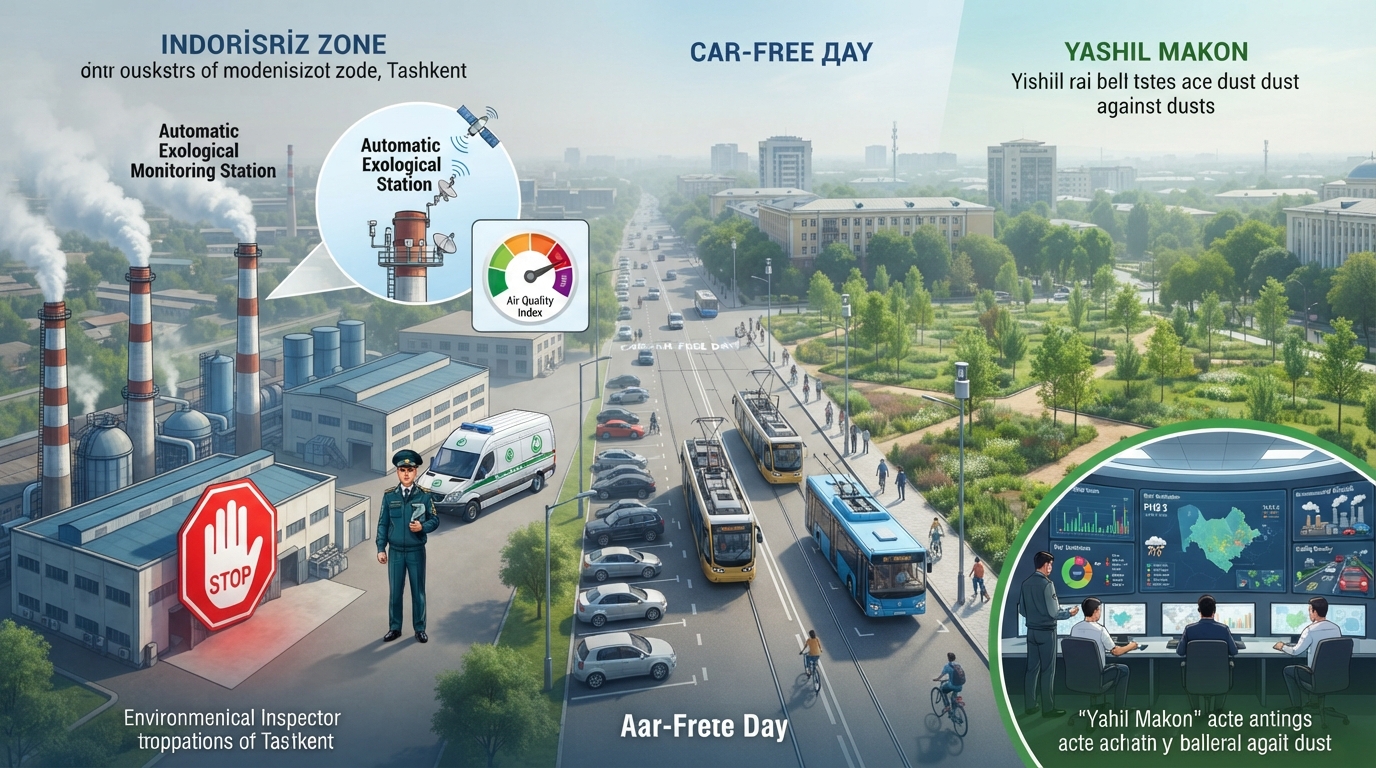
"Clean Air": if air reaches "red" level, enterprise activities may be temporarily suspended
On October 2, a press conference dedicated to the protection of atmospheric air, improving its quality, and the implementation of the "Clean Air" nationwide project was held in Uzbekistan. Officials from the ecology and environmental protection sector participated in the event.
At the conference, questions were raised regarding what measures would be taken based on online monitoring data in areas where air quality sharply deteriorates, as well as why special attention is being paid to vehicles within the framework of "Clean Air" despite the indicators in World Bank studies, and what practical work is being done regarding dust and heating systems.
According to Doniyor Turgunov, Director of the Hydrometeorology Research Institute, along with observing the current state of air quality through the online platform, forecasts for the next 1–3 days are also prepared. If air pollution reaches "orange", "red", or "purple" levels and this situation is expected to last for at least one day, urgent measures will be taken.
"Our online platform allows us to see the real-time situation and provide air pollution forecasts. Based on the real situation and forecasts, we have our plans and urgent measures for the next 1–3 days. If air pollution is forecast to reach orange, red, or purple levels and last for a day, appropriate measures will be taken in cooperation," Doniyor Turgunov said.
According to him, in such a situation, first of all, special laboratories, mobile laboratories of "Uzhydromet", and laboratories of the National Ecology Committee will be dispatched to the area. They will conduct inspections to identify and study the sources of pollution.
If the sources causing high levels of air pollution are identified, urgent measures will be taken by ecological control officers. If necessary, measures up to the temporary suspension of the activity causing the pollution may be applied.
The press conference also discussed the requirement to install automatic ecological monitoring stations at large enterprises and integrate them into the National Monitoring Center.
According to Nodirbek Jamburboyev, Head of the Eco-police Department of the Committee for Ecology and Climate Change, a Presidential decree stipulates the integration of Category I and II facilities into the automatic monitoring system. Financial measures are also envisaged for enterprises that do not comply with these requirements.
"To give an example, even if they install that very automatic monitoring station but do not integrate it, we have our own program called EcoFund. That is, compensation payments are paid for polluting the environment. This thing is automatically calculated at five times the amount in our system, and a financial leverage measure is applied against them.
At the same time, the legislation has been amended again; we have financial sanctions established against legal entities for violating the requirement to use these automatic monitoring stations.
Now, if you want to know how the fine amounts are formed automatically, we have recently submitted a draft resolution to the Cabinet of Ministers, we will have the 'Econazorat' (Ecocontrol) information system. And in the 'Econazorat' information system, with all the data of legal and physical entities entered, those fine sanction amounts will also be digitized," said Nodirbek Jamburboyev, Head of the Eco-police Department.
The World Bank stated the transport share is 16 percent. Why is there a strong focus on cars?
Doniyor Turgunov emphasized that "Clean Air" is not a project focused only on vehicles. It also covers other sources of pollution such as industrial enterprises, greenhouses, heating systems, boiler houses, and thermal power plants.
"'Clean Air' is not focused only on transport. Within the project, work is also carried out on all types of pollution sources, including industrial enterprises, greenhouses, heating systems, boiler houses, and thermal power plants," he said.
The official explained that the share of transport is assessed based on the annual average indicator. However, the share of sources affecting air pollution may change during different periods of the year.
According to climatologist Erkin Abdulahatov, the World Bank's 2023 study indicated the share of transport in PM2.5 pollution as 16 percent annually. However, this indicator changes depending on the season: while the impact of natural dust is high in the summer months, anthropogenic factors intensify in the winter months.
"Our automotive sector is stable: about 1 million cars move regularly every day, 365 days a year in Tashkent and constantly emit pollutants. Therefore, one of the main objects of struggle is still the automotive sector," he said.
The specialist noted that during the autumn-winter season, when inversion, windless weather, and drought are observed, dust does not leave the air. Under such conditions, car traffic becomes one of the factors influencing the re-suspension of dust.
"Therefore, the 'Day Without Cars' campaign has been introduced. Specialists believe that we should adhere to this campaign more in the autumn-winter months than in the summer months. Because 16–20 percent is not a small value either. In addition, not only PM2.5 particles but also other harmful particles affecting public health are emitted from cars," Erkin Abdulahatov said.
What measures will be taken regarding dust and heating systems?
According to Doniyor Turgunov, within the framework of "Clean Air", it is planned to identify large sources of pollution, install automatic monitoring stations on them, and integrate the data into a single platform.
"According to World Bank studies, more than 60 percent of Central Asia is affected by natural dust. We are located in the 'dust belt'. Therefore, within the framework of 'Yashil Makon' (Green Space), work is being carried out not only to plant trees but also to establish green areas and green belts aimed at retaining dust.
In addition, scientific analysis is being conducted on the impact of the activities of greenhouses in southern Kazakhstan on the air of Tashkent. The amount of pollutants being emitted, under which meteorological conditions they reach Tashkent, and the level of impact are being studied," he said.
Therefore, measures are also being taken to reduce the penetration of dust into residential areas by establishing green zones and protective forest plantations.