

China is everywhere and forever
China is strengthening its economic influence in Tajikistan. Large investments are accelerating the republic's development, but are increasing the price of dependence on a single partner
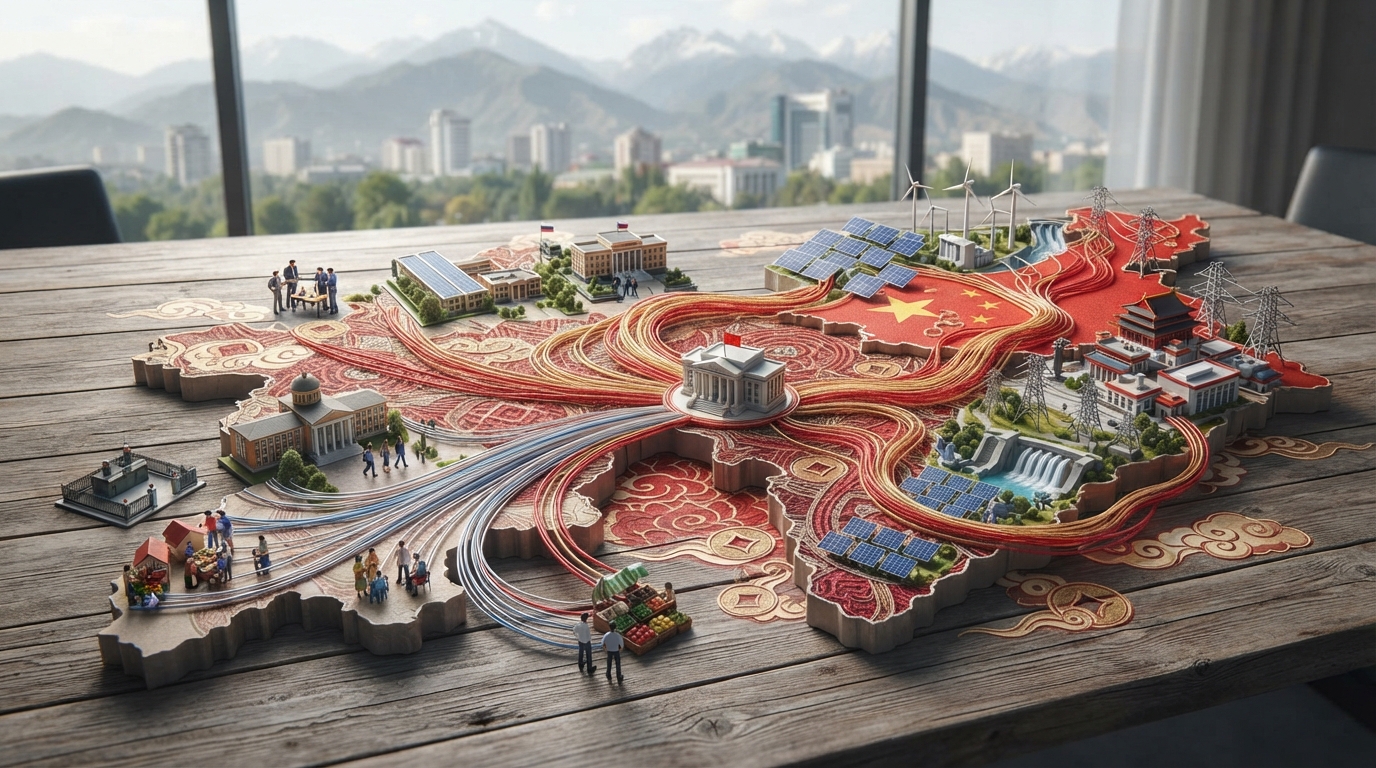
**China Everywhere and Forever**
China is increasingly turning into a partner for Tajikistan on whom trade and investment opportunities are becoming ever more dependent. However, the scale of economic presence in itself does not yet mean political control. For Dushanbe, the key question is on what terms Chinese capital enters the economy and whether it helps the country form its own sources of growth.
In September, Dushanbe became the venue for a whole series of Tajik-Chinese meetings. At the center of the discussions were the visit of a PRC delegation led by Professor Xin Guangcheng and an event dedicated to the 77th anniversary of the founding of the republic. Participants spoke about strategic partnership, joint projects, and the role of the "Belt and Road" initiative in the development of Tajikistan.
However, the scale of the Chinese presence speaks for itself more convincingly than diplomatic formulations. As follows from information from NIAT "Khovar" published following the results of President Emomali Rahmon's May visit to the PRC, Chinese investments in the economy of Tajikistan for 2007–2024 reached almost $6 billion. In the same publication, the volume of direct investments was estimated at approximately $3.5 billion. More than 700 companies with Chinese capital operated on the territory of the republic.
China's influence is also manifested through the sphere of education: in May 2026, approximately 6,000 Tajik students were reported to be in Chinese educational institutions. For the republic, this is a chance to train specialists, and for China, it is a way to expand professional ties in the long term. Studying abroad in itself does not mean political loyalty, but it creates a foundation for further cooperation.
According to a national report published by the CIS Executive Committee, in 2025 China accounted for 26.4% of Tajikistan's foreign trade turnover, while Russia accounted for 22.9%. Thus, in the trade of goods, Chinese leadership has already become a fact. But this is only one of the indicators of influence.
The concentration in the raw materials sector is particularly noticeable. In 2025, China provided 74.9% of the export value of Tajik ores, compared to 53.1% a year earlier. Antimony accounted for 20.1% of the republic's total commodity exports. These figures show how important mineral resources are for Dushanbe's foreign economic policy.
A large buyer provides mining enterprises with a sales market, but at the same time increases their dependence on its own purchasing terms. If there are few alternative buyers and routes, the exporter's negotiating positions narrow.
Debt obligations also require attention, although in themselves they do not prove a loss of sovereignty. According to a joint analysis by the IMF and the World Bank, at the end of 2025, Tajikistan's public and publicly guaranteed debt to China stood at about $3.5 billion. At the same time, as noted by the Minister of Finance of Tajikistan, Fayziddin Kahhorzoda, statistics show positive dynamics: the debt burden on Tajikistan's economy has decreased significantly — from 25.2% to 19.2%.
With China's help, Tajikistan is increasing its GDP and strengthening its army. The republic finds funds for high-rise construction and humanitarian aid to Afghanistan — 3,000 tons, or 150 trucks of 20 tons each. Against the backdrop of gasoline difficulties in Russia, promises of Chinese supplies reduce Dushanbe's concerns about securing the country's fuel and lubricants.
China's peaceful expansion is intensifying: in a number of economic indicators, leadership is shifting from Russia to the PRC. But Russia's significance remains. According to the World Bank's estimate, remittances in 2025 were equivalent to approximately 46% of Tajikistan's GDP, supporting consumption and payment for imports. This refers to the ratio of cash flows to the size of the economy, rather than their share in GDP production. More than a quarter of the country's workforce works abroad, mainly in Russia.
In 2025, imports amounted to $8.31 billion, and exports to $2.49 billion. Imports exceeded exports by 3.34 times, and the deficit reached $5.82 billion. Calculations from the national report show how important external inflows are for paying for purchases. Chinese capital does not eliminate families' dependence on earnings abroad: investments support production, while migration supports a significant part of demand.
The military-political reliance on Russia also remains. Tajikistan is a member of the Collective Security Treaty Organization, and the 201st Russian military base is stationed in the republic. In Tajikistan, several major Russian investments are still remembered — in the construction of the Sangtuda HPP, and in five Russian-language schools built in 2022. Russia continues to fund the Russian-Tajik Slavonic University (RTSU). Among several notable ongoing projects is the start of construction in 2026 of an industrial park joint with Tajikistan.
Therefore, it is too early to speak of Russia being completely displaced by China: trade, financing, employment, and security form different ties that cannot be assessed by a single indicator.
Against this background, the question of Tajikistan's accession to the Eurasian Economic Union (EAEU) acquires special significance. However, in February 2026, Minister of Foreign Affairs Sirojiddin Muhriddin stated that Tajikistan is not currently considering joining the EAEU and BRICS (an association of 10 states: Brazil, Russia, India, China, South Africa, and the joined Iran, Egypt, Ethiopia, and Indonesia), continuing bilateral cooperation with their members. However, this formulation describes the current position, rather than a final refusal of integration.
Speculation has been voiced in the media that it is Beijing that is preventing Dushanbe from joining the EAEU. But this version remains a hypothesis. For the conversation to become substantive, calculations on specific commodity groups and possible terms of accession are needed. Then it would be possible to compare the interests of importers, producers, the budget, and citizens working abroad.
Tajikistan needs large investments, and cooperation with China opens up serious opportunities for this. The main risk is that dependence on the capital provider may combine with dependence on the buyer of raw materials. The more difficult it is to replace such a partner, the more costly disagreement with their terms becomes. Preserving the freedom of economic choice will require transparent contracts and a competitive environment from Dushanbe. It is by these results that one should judge whether Chinese participation strengthens Tajikistan's independence or gradually narrows it.