

China has entered the decisive phase of constructing its "artificial sun"
In China, the installation of the main systems of the BEST experimental thermonuclear fusion device has begun. More than half of the planned work on the project has been completed. The construction is scheduled to be completed by 2027, and the demonstration of energy generation from deuterium and tritium fusion is expected around 2030.
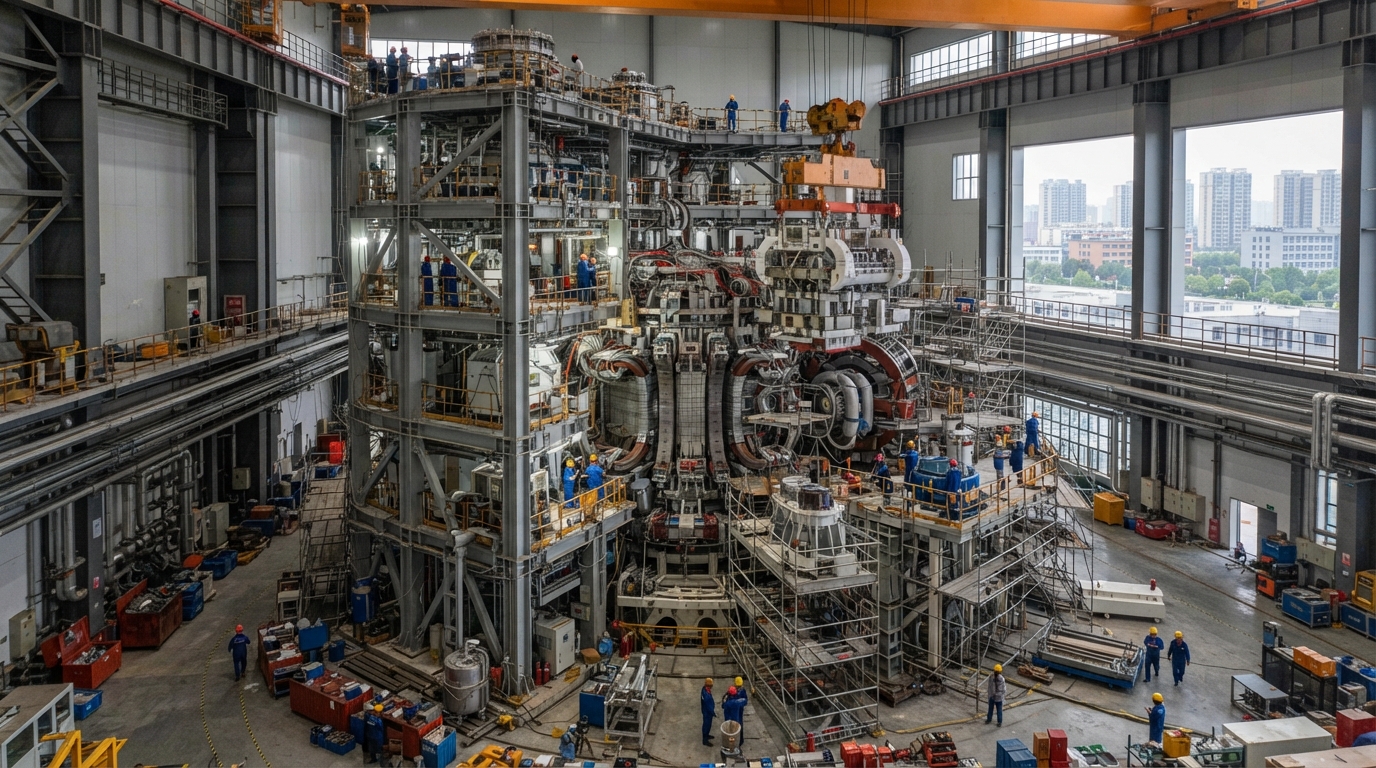
China has reached a decisive stage in the construction of its "artificial sun"
BEST - Burning Plasma Experimental Superconducting Tokamak - is an experimental superconducting tokamak being built in Hefei, the administrative center of Anhui Province in eastern China.
This project, called the "artificial sun," is aimed at researching controlled thermonuclear fusion. Its task is to test the feasibility of using the principle of nuclear fusion, which is the basis of solar energy, to generate energy on Earth.
According to the report, the complex designed for the device has been officially put into operation. However, the assembly of the main systems in the thermonuclear device itself is still ongoing.
Since July, several key components have been delivered to the construction site. Their installation is being carried out step-by-step.
Currently, the vacuum chamber, cryogenic shield, toroidal magnetic systems, and other high-precision internal parts are being assembled. With this, the main part of the device has entered the most critical stage of construction.
The vacuum chamber serves as the working environment where the thermonuclear fusion process takes place.
The cryogenic shield serves to protect the cooled parts by limiting heat transfer.
The toroidal magnetic systems generate a strong magnetic field. This field confines the high-temperature plasma, preventing it from touching the reactor walls.
The construction of BEST is planned to be completed by 2027. The next goal is to demonstrate energy generation from deuterium and tritium fusion around 2030.
The project is aimed at verifying the fundamental possibility of generating electricity on an industrial scale using controlled nuclear fusion.
This is currently an experimental device, and the completion of construction does not mean the immediate start of commercial power supply.