

"Changes should help the familiar environment evolve." Architect Maria Sultanova on the organization of urban space
Empty parks, overheating buildings, streets inconvenient for pedestrians — many urban problems can be foreseen as early as the design stage. At Tashkent Design Week 2026, Maria Sultanova, director of the SAD studio, spoke about how architects can influence the quality of the urban environment.
"Changes should help the familiar environment develop." Architect Maria Sultanova on the organization of urban space
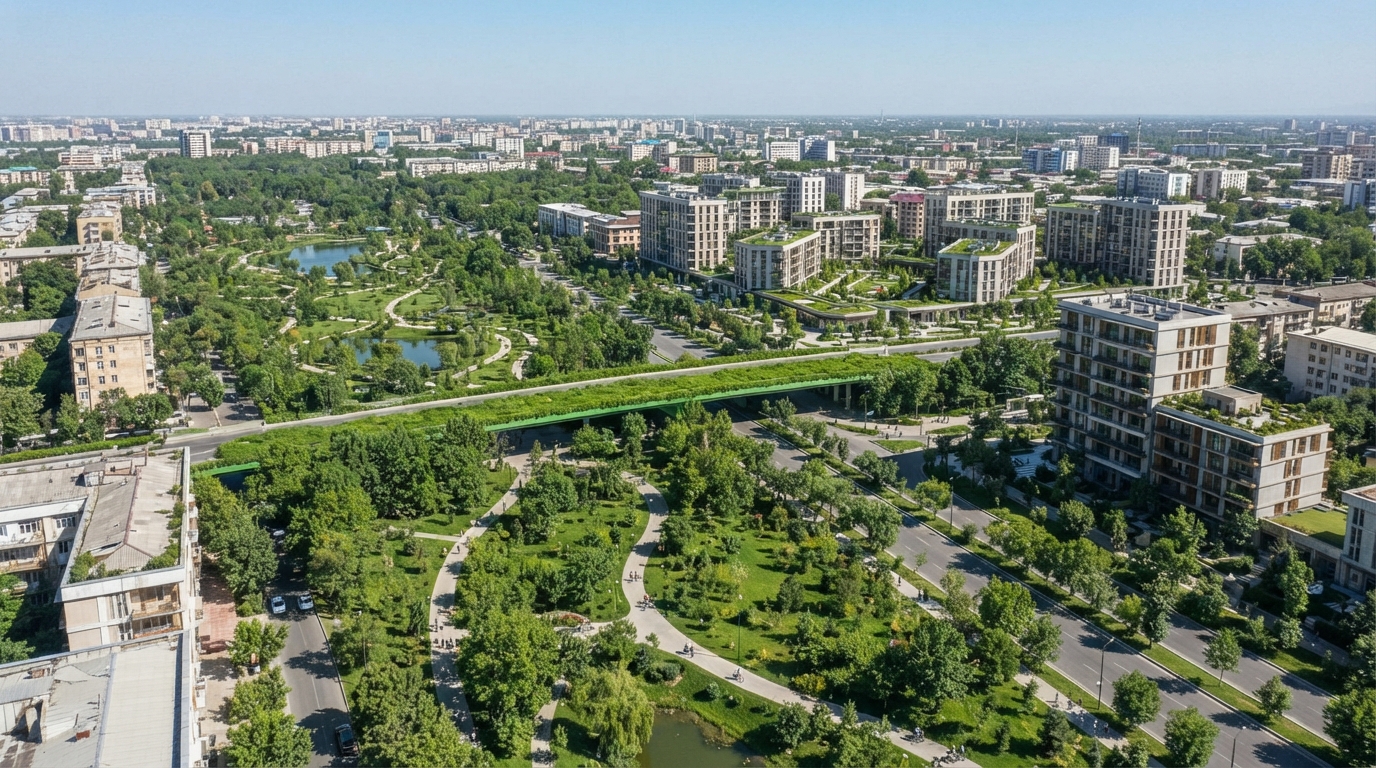
This summer, news emerged about two urban space optimization projects in Tashkent. One involved the transformation of the area around the Oksaroy residence, while the other proposed merging the Ecopark and the Central Park named after Mirzo Ulugbek (formerly Telman Park) into a single green zone.
Maria Sultanova, director of the SAD architecture studio, participated in both initiatives. At Tashkent Design Week 2026, she explained why, in certain cases, traditional approaches to urban space organization require revision.
On the map, Central Park (formerly Telman Park) and Ecopark appear as a single green area; however, in practice, moving from one park to the other is not so simple. Roads fragment the space into several parts, forcing pedestrians to look for convenient crossings. There are other nuances as well.
"One of the roads, which functions as a bypass, is actually underutilized by cars. That is, there are three hectares of asphalt in the city that offer no benefit, but merely overheat the area and take up space. If we connect both territories, we will get a large, beautiful green belt. There are currently no such examples in the city," Maria Sultanova noted.
According to her, this example shows that in some cases, approaches to urban space organization require revision. Transport infrastructure should not remain unchanged if the needs of the city change—and this happens constantly, since a city is a living environment. "It is important to keep up with these changes," the architect emphasized.
Maria Sultanova also drew attention to the fact that Tashkent has public spaces that are not popular, even though the city lacks places for recreation. The reasons vary. For instance, a park might be difficult to reach, or the territory itself is not integrated into the daily routes of residents. One such place is Furkat Park.
The project proposes creating a new residential area near the park while simultaneously updating its territory. The calculation is based on the expectation that an increased number of nearby residents will help attract visitors and bring life back to the park.
"The case demonstrates how increasing population density in areas where it is needed can contribute to the revitalization of public spaces that already exist in the city," the architect explained.
According to her, when designing, it is important to maintain a balance in building density. High-rise buildings and landmark architectural objects are not appropriate everywhere—their placement must take into account the characteristics of the territory.
As an example of working with low-density sites, the architect cited the renovation of the Shuraryk mahalla in the Namangan region.
When working with such territories, she explained, it is not enough to simply update the buildings or landscape the streets. The task is to ensure that the changes do not destroy the familiar environment, but rather help it develop. This is especially important for areas where local identity is closely tied to the organization of daily life.
During the discussion, meeting participants touched upon another important topic for Tashkent: the impact of architecture on the microclimate.
Maria Sultanova explained that when designing, it is necessary to consider air movement, the orientation of buildings relative to the sun, and window placement. People's comfort depends on these decisions.
If windows face south or west and are not protected from direct sunlight, rooms can overheat. Residents are forced to enclose balconies and loggias, install additional shading devices, and seek ways to make their apartments cooler.
At the same time, many problems can be prevented as early as the concept development stage if buildings are positioned correctly.
A separate question concerned sun-shading structures characteristic of some Modernist-era buildings. In response, the architect explained that such elements protect indoor spaces from direct sun, but when designing, one must also consider how a building affects the space around it.
For example, a large amount of glass without adequate sun protection can create an additional thermal load on the surrounding area. Even if energy-efficient double-glazed windows are installed inside the building, this does not mean the adjacent street or trees will be protected from overheating.
In conclusion, Maria Sultanova noted that urban planning decisions always have long-term consequences.
Uzbekistan's population is growing, the economy is developing, and construction volumes are increasing. All of this already raises the question of what the city will look like decades from now.
"We need to understand that we will only see the results of our work—as architects and planners—in 10 to 20 years. We very much hope that they will come to fruition. We firmly believe that this will be done well and [will become] a high-quality environment," the speaker concluded.