

Central Bank approved fintech strategy until 2030: Open Banking, digital currency and $1 billion in investments
The Central Bank has approved the fintech development strategy until 2030. The plans include launching Open Banking, developing digital identification, cross-border payments, a regulatory sandbox, as well as pilots with AI and digital assets. By 2030, Uzbekistan aims to become the main fintech hub of Central Asia.
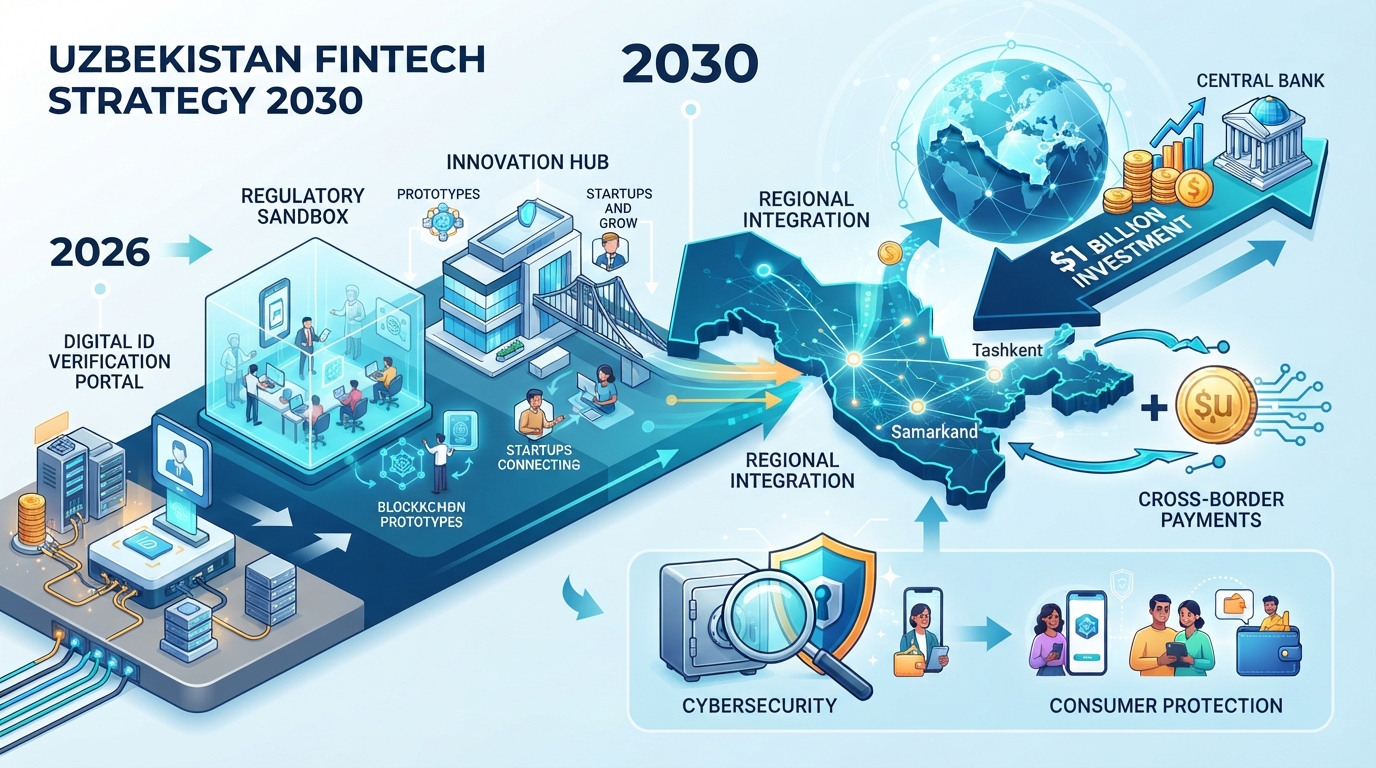
The Central Bank of Uzbekistan has approved the National Fintech Development Strategy for 2026–2030. Its main objective is to make the country the most attractive jurisdiction in Central Asia for fintech companies by the end of 2030, while simultaneously expanding access for citizens and businesses to secure digital financial services.
The implementation of the strategy is divided into three stages. In 2026–2027, it is planned to create the basic infrastructure of the fintech market; in 2028–2029, to launch Open Banking, expand digital identification, and integrate payment systems; and by 2030, to establish Uzbekistan as a regional fintech hub.
One of the strategy's directions involves forming an ecosystem that will support fintech companies from the inception of an idea to business scaling.
This system will include an Innovation Hub, a "regulatory sandbox" (a special legal regime within which financial technology market participants can test new products and services under controlled conditions), a talent training system, financing mechanisms, and cooperation between banks and fintech companies. It is envisaged that startups will be able to go through the stages of incubation, testing in a regulated environment, licensing, and subsequent expansion of activities.
The presentation also cites plans previously announced by the President to establish a Fintech Office and an Innovation Hub under the Central Bank, involving specialists from Singapore.
It is planned to prepare 20–30 fintech startups annually for entry into foreign markets and to create conditions to attract up to $1 billion in investment to the sector by 2030.
A separate block of the strategy is dedicated to the development of digital finance infrastructure.
It is planned to develop Open Banking and open APIs (application programming interfaces), which will allow financial institutions and other market participants to securely share data with customer consent. This is expected to foster the emergence of new business models, increase competition, and develop financial services.
"When we announced open banking, we wanted these fintech companies to literally be able to enter the traditional banking market, perhaps providing only one of the products that banks usually provide. But they can do this so efficiently that they will ultimately stimulate competition and innovation," stated the head of the Central Bank, Timur Ishmetov.
In addition, the strategy provides for improving the digital identification system for remote customer verification, fraud prevention, and simplifying access to financial services.
During the 2026–2027 stage, it is planned to launch pilot projects using digital ID, and in 2028–2029, to extend this infrastructure to the entire financial sector.
The strategy allows for conducting experiments in a controlled environment on the tokenization of real-world assets, including securities, as well as testing interaction mechanisms between various financial services.
The Central Bank also intends to identify priority areas for the use of artificial intelligence in the financial sector and launch corresponding pilot projects.
AI is also expected to be applied in supervisory activities — in particular, to detect financial crimes. The strategy provides for the development of SupTech ("supervisory technology"), automated data collection via APIs, monitoring of operational incidents, and strengthening cybersecurity control over financial institutions.
One of the proposals concerns regional financial integration. Among the initiatives in the presentation is a wholesale Central Bank Digital Currency — wholesale CBDC (wCBDC).
It is being considered alongside the development of interconnected regional payment systems, simplifying cross-border transactions, and reducing the cost of money transfers.
There are also plans to increase the transparency of fees and exchange rates in international transfers and to develop digital trade finance tools.
In 2028–2029, it is planned to launch initiatives to integrate regional payment systems and cross-border pilot projects.
Another direction of the strategy is attracting foreign fintech companies and investments.
To achieve this, it is planned to utilize the Innovation Hub, the Enterprise Uzbekistan project, the Tashkent International Financial Centre, as well as to host the Silk Road Finance & Technology Forum and develop cooperation with foreign fintech hubs.
By 2030, the authorities expect to turn Uzbekistan into a regional hub for investment and innovation in the field of financial technologies, expand the presence of international companies, and deepen the financial integration of Central Asia.
The strategy provides not only for the development of new financial services but also for strengthening customer protection.
It is planned to create a coordinated system to counter fraud across the entire financial sector, increase the transparency of credit products, improve the credit information system, and develop the financial literacy of the population.
Regulation is expected to become risk-oriented: requirements for market participants will vary depending on the scale and risk level of their activities. At the same time, it is planned to strengthen control over the protection of consumer rights and how clearly financial institutions disclose service terms to customers.
In the presentation, the Central Bank points out several problems that the strategy is designed to solve. These include the limited coverage of international money transfers, insufficient access of small and medium-sized enterprises to financing, the gap in the availability of financial services among different population groups, growing risks for consumers of digital services, and the need for long-term financing.
According to the presentation, 94% of the population in Uzbekistan uses the internet, the level of digital payment usage is about 72%, and the number of users of remote banking services has grown by almost 70%.
The Central Bank lists the growth in the number of fintech companies and foreign investments, the expansion of financing for small and medium-sized enterprises, the increased accessibility and security of digital finance, the development of cross-border payment infrastructure, and the strengthening of regional integration among the key expected results of the strategy.