

Uzbekistan is developing its role as a financial hub in Central Asia.
In Tashkent, more than 6,000 participants from dozens of countries discussed the development of fintech, Islamic finance, and cross-border infrastructure.
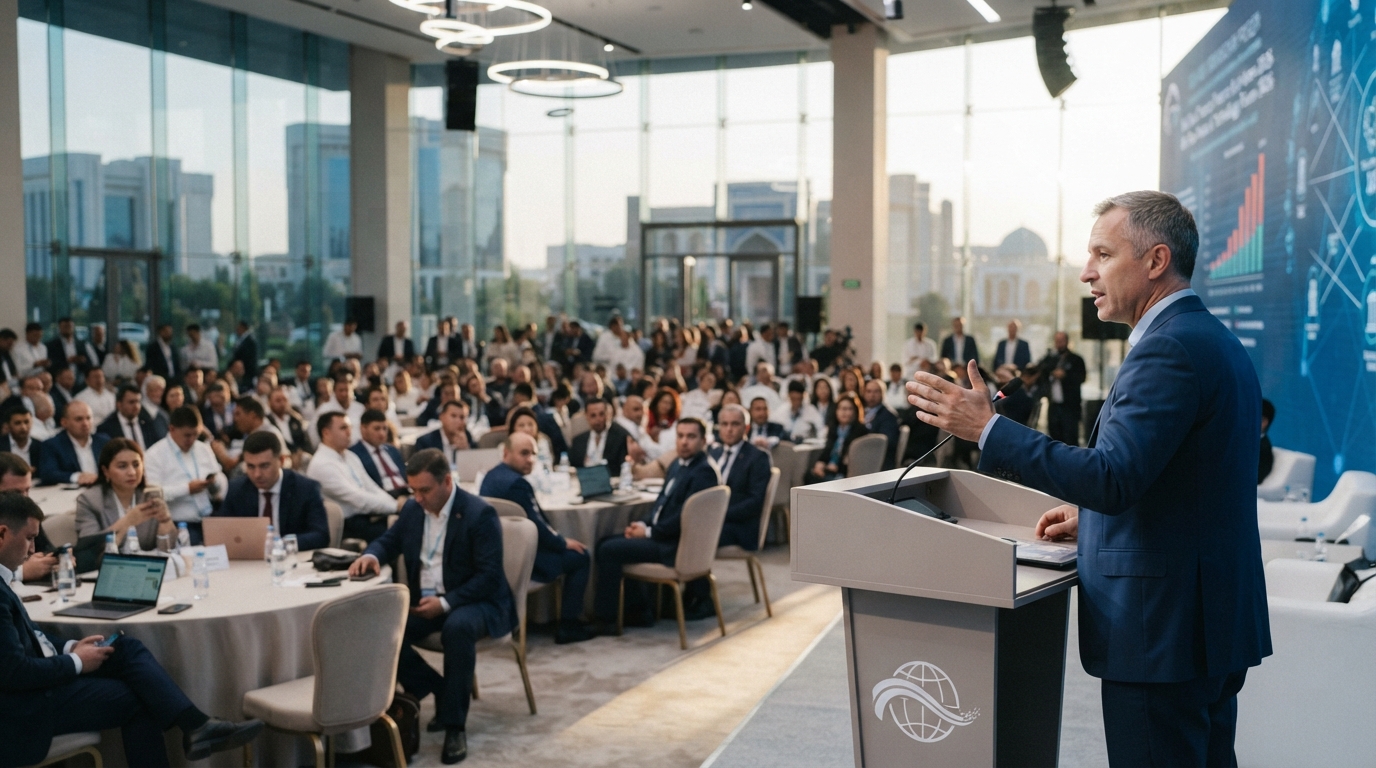
Uzbekistan is strengthening its position as a financial hub in Central Asia.
The Silk Road Finance & Technology Forum 2026 opened in Tashkent on August 24, bringing together over 6,000 participants from 74 countries. The forum focused on discussing the development of financial technologies, attracting investment, and strengthening cross-border financial ties in Central Asia. The event was organized by the Central Bank of Uzbekistan and Singapore's Global Finance & Technology Network (GFTN), with Ant International serving as a co-organizer.
The forum is featuring approximately 200 speakers and over 25 investors, managing $4 billion in assets. The main program is taking place on August 24–25 at the CAEx Exhibition Center. The forum will continue on August 26 at the Center for Islamic Civilization as part of a special initiative, The Azimuth, dedicated to Islamic finance and entrepreneurship.
Forum participants are focused on creating a new financial corridor for Central Asia, covering five key areas: digital payments and infrastructure, Islamic finance and new corridors, artificial intelligence and advanced technologies, tokenization and digital assets, and cross-border finance and regulation.
At the opening of the forum, Deputy Prime Minister and Minister of Economy and Finance of Uzbekistan Jamshid Kuchkarov and Chairman of the Central Bank Timur Ishmetov outlined the next stage of the country's financial transformation. Priorities included transforming reforms into investment-attractive markets, attracting long-term capital, expanding access to Islamic finance, and creating an interoperable cross-border financial infrastructure.
In his speech, Timur Ishmetov encouraged international investors and technology companies to develop projects in Uzbekistan, emphasizing the country's openness to investment, technology, expertise, and long-term partnerships.
According to the organizers, Uzbekistan is approaching the forum amid growing economic indicators and ongoing financial reforms. In the first half of 2026, the country's GDP increased by 8.5%, and foreign investment in the first quarter reached $8.3 billion. In June, the international rating agency Moody's upgraded Uzbekistan's sovereign rating from Ba3 to Ba2.
As part of the reforms, open banking, digital payments, and licensing of innovative solutions are being actively developed.
The National Fintech Development Strategy aims to attract $1 billion in investment in the fintech sector by 2030, increase the number of licensed market participants to more than 200, incubate 100 startups, and train 5,000 specialists.
The penetration rate of digital payments in the country has increased from 39% in 2021 to 71% in 2025, according to the forum materials.
The program places special emphasis on Islamic finance. The new Islamic banking law, which came into force in June 2026, created a legal framework for Sharia-compliant banking. Organizers estimate that this could open a new channel for Uzbekistan to attract Islamic capital, whose global assets are approaching $6 trillion.
The Azimuth program on August 26 will focus on Islamic finance standards, Sharia governance, liquidity, digital infrastructure, and cross-border capital.
Cross-border payments and settlements were another key focus of the forum. Participants are discussing the possibility of connecting the national payment systems of Central Asian countries, which should help reduce the cost of money transfers and speed up settlements.
The forum materials also emphasize the need to develop corporate governance, cybersecurity, financial market liquidity, and predictable regulation. These factors are seen as prerequisites for scaling solutions in the fields of artificial intelligence, tokenization, and digital assets.
Sopnandu Mohanty, CEO of the Global Finance & Technology Network, noted that Uzbekistan is actively creating institutions and infrastructure to develop digital finance and strengthen Central Asia's ties with international markets.
The forum also explores opportunities for developing industrial and financial cooperation in the region, creating infrastructure for the flow of capital and data between markets, and expanding the participation of institutional investors.