

Can well-being be designed? Experts on the concept of wellness in architecture
Modern architecture increasingly takes into account how space affects human health and well-being. This principle lies at the core of wellness—an approach that combines care for physical, psychological, and social well-being. How to put it into practice was discussed at Tashkent Design Week.
Can well-being be designed? Experts on the wellness concept in architecture
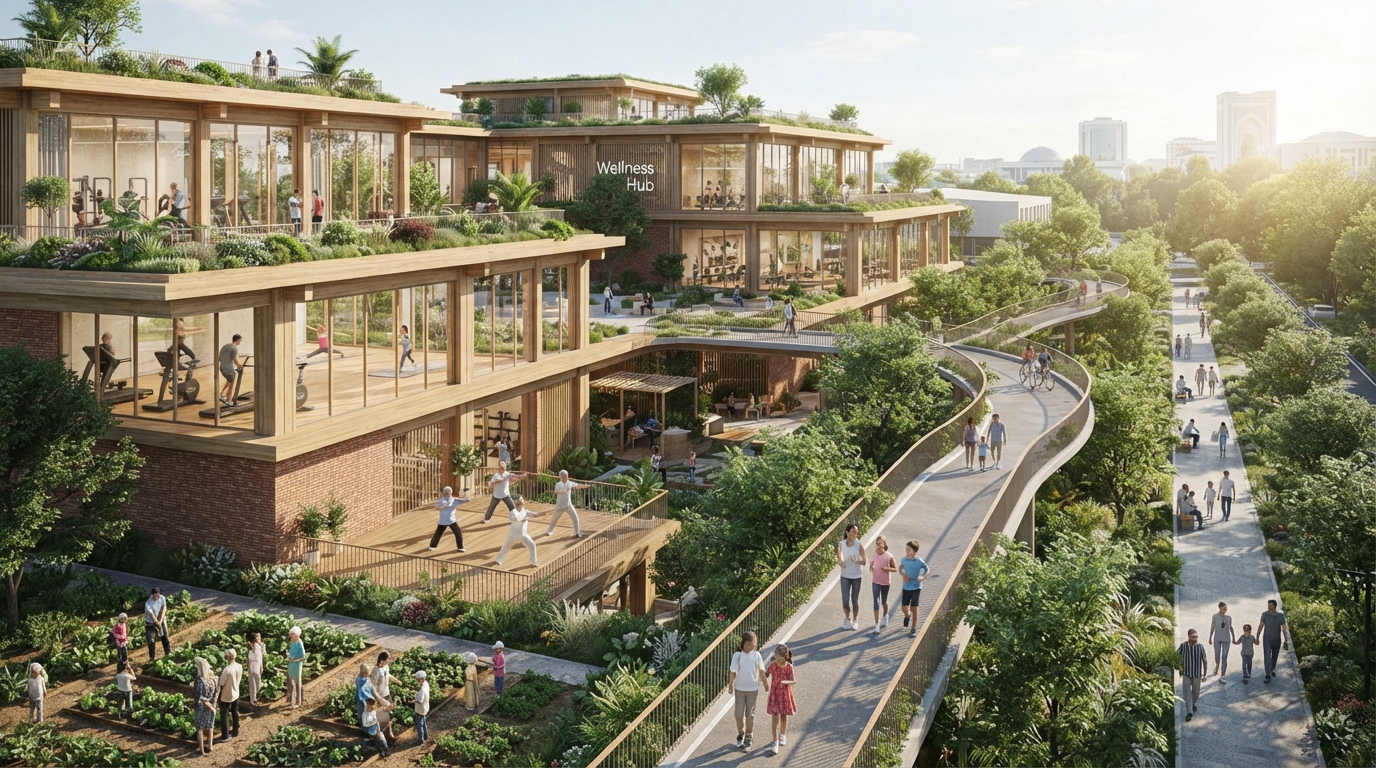
Architecture and design can influence not only how a space is perceived visually, but also people's health and well-being. This is the domain of Wellness Design, which uses a conscious approach to designing buildings, interiors, and the urban environment.
During Tashkent Design Week, Technogym Uzbekistan founder Farrukh Zakirov, SAD studio founder Maksim Oltyan, and Marie Wellness and Matcha Club curator Tamara Samadova discussed why it is important to consider a person's physical, mental, and social well-being when designing.
According to Technogym Uzbekistan founder Farrukh Zakirov, the perception of a healthy lifestyle has changed noticeably over recent decades.
"About 60 years ago was the era of bodybuilding. People tried to bulk up and look big. Then came the era of fitness, when attention was focused on how a person looked in the mirror, their shape, and waist size. Since 2000, fitness has gradually shifted on a global scale toward wellness. Exercise equipment began to be moved out of basements and placed on upper floors, and equipment manufacturers started working with designers," he said.
The next stage of the industry's development, according to the speaker, is connected with the concept of longevity, which implies maintaining health, physical activity, and quality of life in old age.
SAD studio founder Maksim Oltyan suggested viewing architecture and design as tools that shape a person's everyday experience.
"We need to understand that today everything around us is made by architects and designers. Clothes, premises, the city — all of this is created by people. There is an important fact: the environment determines consciousness and state of mind. It gives us a state from which we then act and which we bring into our lives. We, as architects and designers, influence how people will experience these moments," Maksim Oltyan said.
He stressed that a designer's task is not limited to creating an aesthetically attractive object.
It is important to think through in advance how people will use new spaces in their daily lives.
"We are not building monuments to ourselves, but an environment in which people will earn money, express themselves, fall in love, and play sports. How inspiring and active this environment will be depends on how well we have thought it through," the architect noted.
The impact of architecture on human well-being is not determined solely by the layout and appearance of buildings. According to Maksim Oltyan, lighting, ventilation, and acoustic comfort can affect concentration, performance, and the quality of decisions made. As an example, he cited office spaces where insufficient ventilation can lead to an increase in carbon dioxide concentration, while unsuitable lighting and noise create an additional load on the nervous system.
"If you control the environment correctly and create it with high quality, you can increase employee efficiency and reduce the number of sick days they take," he explained.
According to the architect, such solutions must be incorporated as early as the project concept development stage. If the need for them arises after construction is completed, modifications are more expensive.
In Maksim Oltyan's opinion, modern cities need to create conditions under which walking, playing sports, and spending time in nature are more convenient than constantly using a car.
As an example, he cited the project to combine Central Park and Ecopark in Tashkent. This involves not only expanding green areas, but also creating a pedestrian route between them.
"If we create parks as linear spaces where people can not only ride attractions, but also spend time under the trees, do yoga, or walk the dog, this makes the city healthier. Improving the urban environment affects mental health and quality of life, and can also contribute to an increased life expectancy," the architect believes.
He identified the development of communities united by common interests as another important direction. According to him, such a model already exists in the traditional culture of Uzbekistan in the form of the mahalla, but its potential can be expanded.
"If we can make it interesting for people to gather together not only for palov, but also for runs, walks, and other activities, it will change the quality of life. We will get a healthier and happier society, and our cities will become more attractive to active and creative people," Oltyan noted.
The panel discussion participants also addressed why even a well-thought-out concept of a wellness space does not always lead to a successful outcome.
According to Tamara Samadova, not only the interior and architectural solutions matter, but also how well the space corresponds to the offered product, service quality, and original concept of the project. When designing, it is necessary to consider natural light, the amount of materials and colors used, as well as how comfortable it is for a person to stay in the room for an extended period.
Farrukh Zakirov, in turn, drew attention to the need to account for the specific features of fitness and wellness zones at the building concept development stage. For example, when placing fitness clubs, it is important to take into account soundproofing, acoustics, and other technical parameters. Noise from dropping sports equipment can disturb people working or resting on the lower floors of a building.
If such spaces are added to a project last, they are often allocated inconvenient spots not intended for full-fledged physical activity, the speaker noted.
According to Zakirov, the modern approach to health is gradually shifting from treating diseases to preventing them. Spaces that help a person maintain physical activity, eat right, rest, and interact with others are becoming increasingly important. He cited the Italian project Wellness Valley in the Emilia-Romagna region as an example. Its concept involves developing the territory through infrastructure for physical activity, including bicycle and pedestrian routes, parks, and public sports spaces.
Maksim Oltyan shared that SAD studio is studying the possibility of implementing wellness village projects in Uzbekistan, following the example of existing ones in Indonesia. These are residential and public spaces where infrastructure is initially built around a healthy lifestyle and interest-based communities.
According to him, this approach could become one of the directions for developing urban and suburban real estate, as people's demands and their ideas of a comfortable life are changing.