

Britain's posh schools are heading to India for students and profits
Half a dozen elite British schools are chasing growth in India amid a boom in its wealthy population.
Britain’s elite schools are heading to India in search of pupils and profit
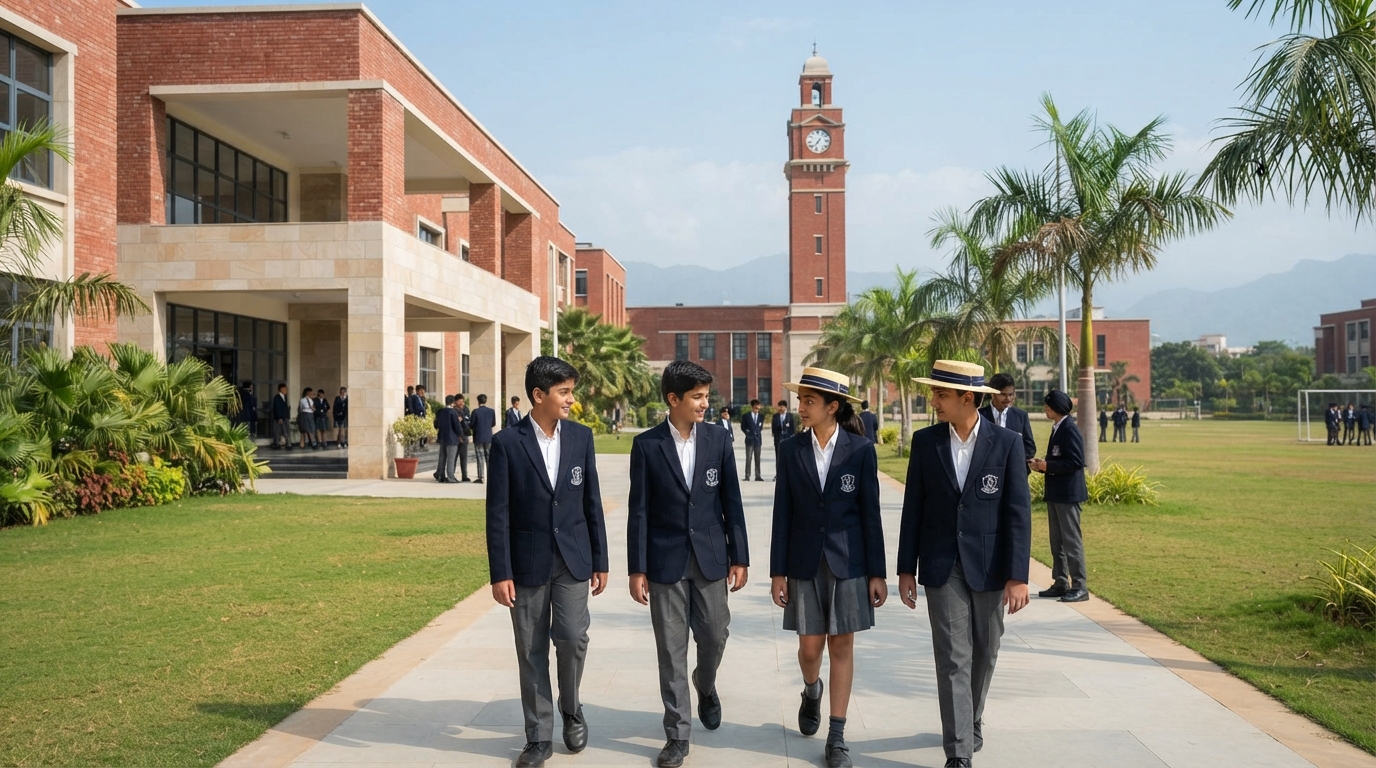
At Harrow’s Bengaluru campus, students wear the school’s traditional hats and uniforms.
On the edge of Chandigarh in north-west India’s Punjab state, a 473-year-old British public school opened its first all-girls international campus earlier this year.
Unlike the striking Gothic central building at the school’s grounds in Bedfordshire, England, the Indian site is more contemporary, with purpose-built academic blocks. Even so, a prominent red-brick clock tower clearly reflects the school’s British roots.
Bedford School, Mohali, is the latest of at least half a dozen British public schools — elite, fee-paying private schools with long histories — including three of the oldest in the country, to establish campuses across India. Their move comes as conditions tighten in China and Britain introduces VAT on private school fees from 1 January 2025.
Since 2023, Bengaluru — India’s Silicon Valley and a centre for software and start-up firms — has hosted the prestigious Harrow School, the alma mater of India’s first prime minister, Jawaharlal Nehru. Shrewsbury School has opened a campus in Bhopal in central India, while Wellington College has chosen Pune, a western city that brands itself the “Oxford of the East” because of its respected universities and colleges.
Millfield, Queen Elizabeth’s School and several others are also said to be planning satellite campuses in the years ahead.
For decades, India has had established local boarding schools based on the colonial British public-school model, serving elite and aristocratic families. But the market has expanded quickly as newly wealthy Indian families increasingly want their children to gain more international exposure.
“Our international curriculum is quite a driver for many of them,” Caroline Pascoe, head of school at Harrow in Bengaluru, told the BBC.
Harrow and Bedford are among the few schools in India offering an all-through Cambridge curriculum — a global education framework used by 10,000 schools worldwide — from primary level through to A-levels.
Bedford School is the newest of at least half a dozen British public schools to enter India
Harsimran Singh Kocchar, whose extended family runs a chain of schools across India, says he chose to send his five-year-old daughter Parineet to Bedford Mohali because of the school’s “holistic focus on character development, confidence and not merely academics”.
He also said he was attracted by the fact that the school does not have a “VIP culture”, unlike many Indian equivalents.
“All kids are treated the same. Children of ministers and bureaucrats don’t get greater privileges,” Singh said.
Pascoe says that beyond affluent local families, non-resident Indians are also an important market for these schools — including those who have returned home after long periods abroad, as well as those still in the UK or Middle East who want their children to connect with their roots.
Sixty per cent of Harrow’s staff in Bengaluru are international and, like the others, the school has brought its distinctive traditions to the campus: teachers are called Beaks, students wear the traditional Harrow hats and uniform, and they take part in The Long Ducker — a cross-country race held across its schools worldwide. There is also a house system, a classic feature of traditional British education.
These distinctly old-school customs are combined with local traditions such as singing the Indian national anthem each morning or marking Ganesh Chaturthi, a major Hindu festival.
Schools such as Harrow in Bengaluru also encourage extracurricular activities including music and drama.
While India’s rising economic standing and growing population of newly minted millionaires naturally support expansion, part of this growth is being fuelled by a slowdown in China.
Much of the overseas expansion of British public schools over the past decade was driven by China and Hong Kong — half of the 151 satellite campuses run by 50 UK schools are in those two places.
But that growth has slowed after regulatory changes and “increased scrutiny, and even resistance, from national governments”, according to a 2025 study by the UK-based Private Education Policy Forum (PEPF, external) think tank.
A new Chinese law in 2024 requiring schools to weave patriotic education into all subjects further complicated expansion and even caused some planned campuses to be cancelled, pushing these schools to look at other destinations such as India and Vietnam, according to PEPF.
In addition, Britain introduced a 20% VAT on private school fees in the 2024 Autumn Budget. Naomi Atkins, founding principal at Bedford School Mohali, says this has compelled many private schools to seek opportunities overseas.
“They are in a desperate situation. Even those that hadn’t previously looked for international expansion are now suddenly active in India,” she told the BBC.
Well-off local families and non-resident Indians are a key target market for British schools in India
But India has not been an easy market, she admits.
Most of these schools operate in partnership with local investors or operators.
Where schools in other countries may once have been able to strike deals at 10% of revenue — the fee charged to the local partner-investor — margins in India may have fallen to as little as 1% in some cases, Atkins says.
She also says the size of the market has sometimes been overestimated.
Although India has nearly 250 million children in school, English-language education is deeply embedded in the country, and competition from local providers is far stronger than in other non-English-speaking countries such as China, Korea or Vietnam.
India’s per capita income is also much lower, and the high fees charged by British schools — which can reach £15,000 or more for full boarding — can restrict growth.
“I’ve worked in Indonesia, Malaysia and China but Indians are much more price-sensitive — they like a bargain,” Atkins says.
That is why Bedford Mohali has set its fees at about half those charged by other British schools.
Between 2011-12 and 2022-23, satellite campuses of British schools produced £152.4m in profit, according to PEPF, and that profit has risen sharply over the years.
But in India, growth is likely to be gradual rather than dramatic.
The country’s colonial legacy and new wealth create a major business opportunity for these long-established institutions, but it is unlikely to be large enough to make up for the loss of the Chinese market, at least for now.