

Broken toilets, leaking roofs: Why India's 'cockroach' party wants to fix schools
The poor state of government schools is the focus of a new campaign by India's Cockroach Janta Party (CJP).
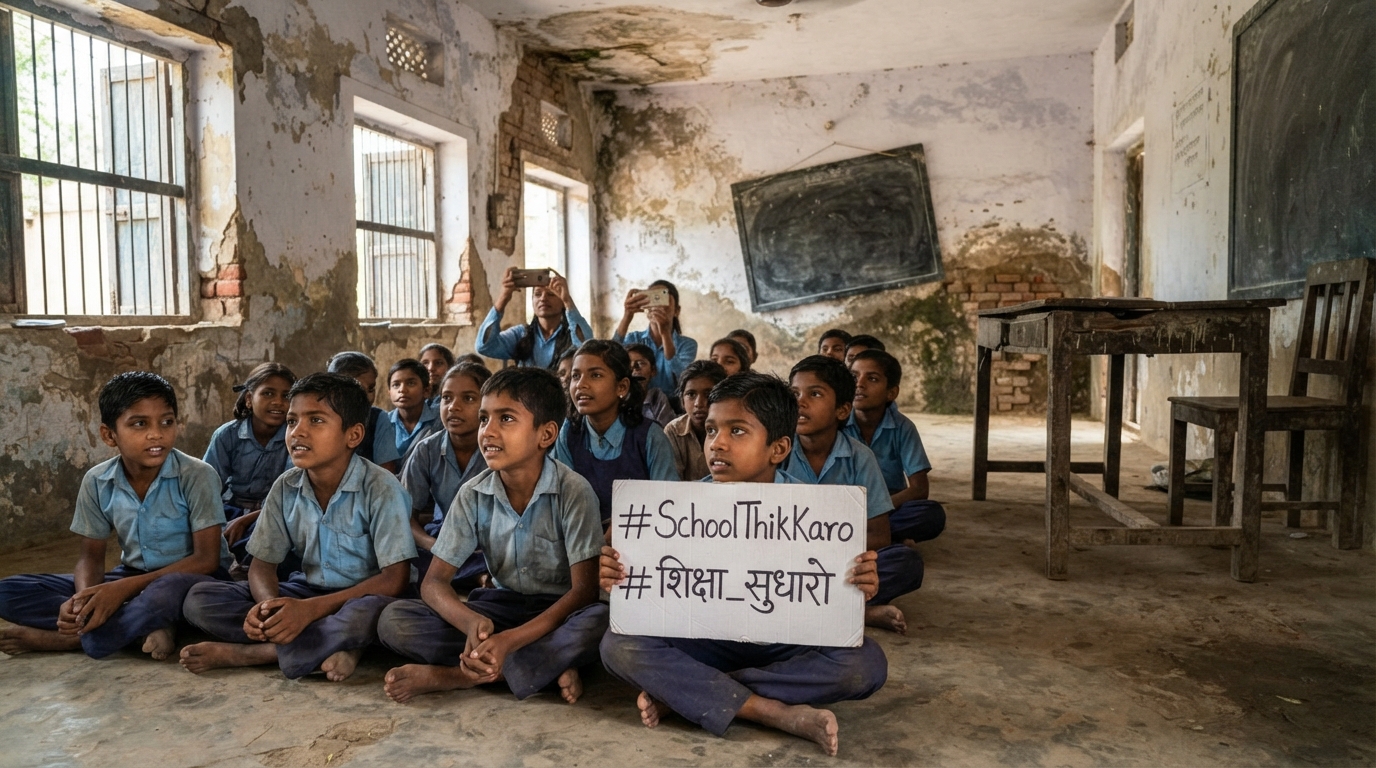
**India's "Cockroach" Party Aims to Revitalize Neglected Schools Amidst Widespread Disrepair**
India's educational infrastructure, particularly in rural areas, is facing a severe crisis of underfunding and dilapidation, prompting a new campaign by the satirical online movement, the Cockroach Janta Party (CJP), to demand urgent reforms.
A prime example of this widespread neglect is a government-run primary school for girls in Faridabad, a district bordering Delhi. Despite a recent exterior paint job, the single-story building in Khedi Kalan village is plagued by numerous internal issues. Local social worker Satpal Narwat highlights the crumbling plaster, four unusable toilets filled with refuse, and four abandoned classrooms deemed unsafe for students. He notes that during the monsoon season, classrooms flood, leaving children without adequate seating.
This situation is not unique. Many schools across rural India are in a state of disrepair due to insufficient funding. India allocates only 4.1% of its GDP to education, meeting UNESCO's lower minimum threshold but falling short of the over 5% spent by countries like France, Germany, Australia, Brazil, and the US, and even more by Belgium and Sweden. Experts and the Indian government's own National Education Policy (NEP) recommend a 6% allocation. Official data reveals that 94,000 government schools have closed between 2014-15 and 2024-25.
The dire condition of government schools is the central focus of the CJP's new #SchoolThikKaro (#FixTheSchool) campaign. This initiative follows the CJP's weeks-long protest in Delhi, which garnered international attention and culminated in the resignation of Education Minister Dharmendra Pradhan last month. Those protests, sparked in May by the cancellation of India's largest medical entrance exam, NEET, due to a question paper leak, led to nearly two million students having to retake the test and tragically, over 20 student suicides.
CJP founder Abhijeet Dipke emphasizes that the campaign aims to highlight the deteriorating infrastructure in government schools and pressure authorities to address it. "Government schools, especially in rural India, have been neglected for many many decades now," Dipke told the BBC, explaining that this neglect deprives rural children of equal opportunities, often relegating them to agricultural, daily wage, or construction labor. He asserts that the CJP seeks to rectify this disparity by improving school conditions.
Dipke recently visited over 20 rural schools and reported finding "not even a single good school," citing a complete lack of benches, bathrooms, drinking water, and other basic facilities. He described the experience as "heartbreaking," noting that conditions have remained unchanged for two decades since his own childhood visits to his village.
Through their Instagram account, with 26 million followers, Dipke and other CJP leaders have shared numerous videos showcasing leaking roofs, unsanitary toilets, children sitting on floors, and frustrated students. Dipke states, "We want to ensure that children get benches to sit on, good washrooms and clean drinking water. They should have smart classrooms with digital boards. That is when they will also feel that they are getting the same quality of education as those living in big cities in the country."
Neither Prime Minister Narendra Modi's government nor his Bharatiya Janata Party has commented on the campaign. The BBC has also sought a response from India's education ministry.
The CJP's Delhi protest and the #FixTheSchool campaign appear to have galvanized students nationwide, leading to a surge of complaints and localized protests against what many perceive as an apathetic administration. Students, armed with mobile phones, are recording and sharing videos on social media, some of which have gone viral and prompted official action.
At Delhi's Jantar Mantar, the site of the CJP's earlier protest, the group demanded not only Pradhan's resignation but also a comprehensive overhaul of India's education system with greater accountability. Journalist and author Nilanjan Mukhopadhyay observes that by the end of the initial protest, "it was clear that it wasn't just about one exam or one minister's resignation," but rather the broader state of schools. Mukhopadhyay views the #FixTheSchool campaign as a logical progression, noting that the public's contribution of videos highlighting infrastructure flaws indicates the movement's growing momentum. He anticipates a "slower and a long-lasting movement" that will garner significant support due to the widespread issues in schools.
Chatar Singh, treasurer of the Primary Teachers' Association in Haryana state and head teacher of a primary school in Atmadpur village, identifies a critical problem: a severe shortage of teachers and staff. While his school, funded by a private company's corporate social responsibility program, is relatively well-equipped, the toilets are often uncleaned due to a sick part-time cleaner. However, Singh's primary concern is the lack of teachers.
Out of 40 teachers for 910 children, only six were present on a recent BBC visit, as 30 were deployed for voters' list revision and four were sick. Singh explains that teachers are frequently assigned non-teaching duties, such as election work and census collection, which significantly impacts the quality of education. He attributes the neglect of government schools to the fact that children of bureaucrats, MPs, and politicians attend private schools, leaving government schools to serve primarily the children of migrant factory laborers and underprivileged communities.
This trend is evident across India, with private schools proliferating in smaller towns and villages. Satpal Narwat, who attended the crumbling girls' primary school in Khedi Kalan from 1968 to 1973, expresses his dismay at its current state. He recalls a relatively new building with eight full classrooms. Flooding became a problem after the road outside was raised about 15 years ago, leaving the school below road level. Narwat, a retired electricity officer, eventually moved his own children to a private school for better facilities.
At the village's second primary school for boys, classes are held in two rooms and a veranda, as a second building with three classrooms was demolished five years ago due to safety concerns, with promises of a replacement that never materialized. The site is now a bicycle parking area. Narwat's repeated petitions to officials and the National Human Rights Commission have yielded little change. He now sends his grandchildren to a private school, despite the expense, due to the superior facilities and consistent teaching staff.
Narwat expresses hope that the CJP campaign will finally bring attention to these neglected schools. "I think the CJP can be a force for good. They've taught people to fight, to not be afraid. The government has all the power and resources. And now they have to perform."