

“Bring someone sighted!”: How an internal notary regulation outweighed the law in Uzbekistan
People with visual impairments face systematic discrimination when accessing notary services in Uzbekistan. Notaries refuse to accept legally recognised facsimile signatures. Dilmurad Yusupov and Abdullo Abdukhalilov call for the system to be changed in an op-ed for Gazeta.
## "Bring Someone Sighted!": How Internal Notary Rules Trump the Law in Uzbekistan
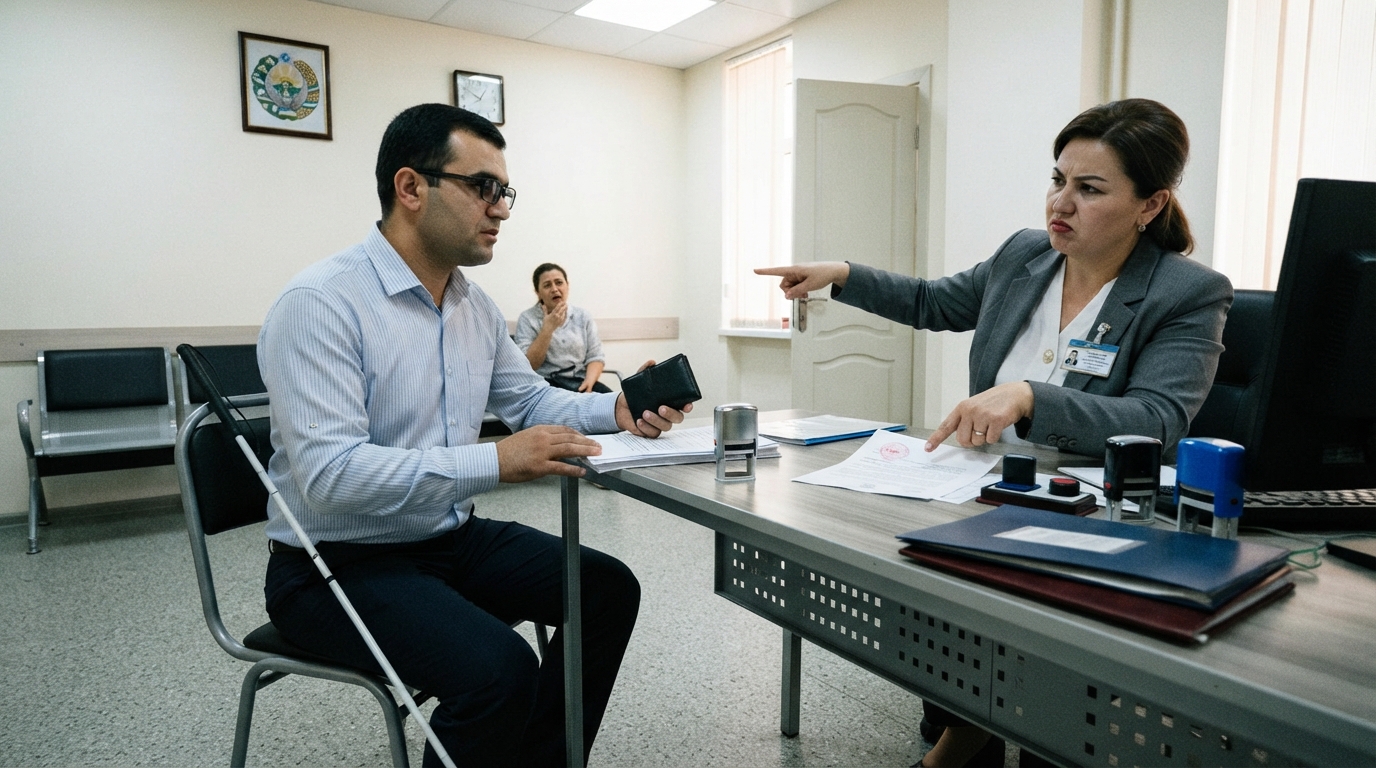
On July 24, Abdullo, a Group I visually impaired individual since birth, encountered significant bureaucratic hurdles and blatant disability-based discrimination when attempting to obtain a simple power of attorney at a notary office in Tashkent's Yashnabad district. He sought to authorize another person to collect a bank card, but instead of receiving the public service, he was met with a categorical refusal.
The notary insisted that a representative from the Society of the Blind of Uzbekistan was required to process the documents. An attempt to resolve the issue by contacting the Notary Chamber only led to further absurdity. An employee there posed an unethical question: "Have you been blind since birth, or did you acquire the disability?" Upon learning Abdullo's lifelong blindness, she reiterated the demand for a mediator from the Society of the Blind.
This illogical regulation dictates that if visual impairment is acquired, a representative from the Society of the Blind is not necessary. This highlights a systemic issue, not merely an isolated error by one notary. Current state regulations effectively relegate legally capable, independent citizens with visual impairments to a secondary status, denying them the right to manage their own affairs.
Individuals with visual impairments are fully legally competent citizens, bearing full responsibility for their actions. Globally, a facsimile – a specially crafted stamp that replicates a handwritten signature – is used to enable them to sign documents independently.
In Uzbekistan, Article 29 of the Law "On the Rights of Persons with Disabilities" explicitly establishes this right, recognizing a disabled person's facsimile signature as official and legally binding. However, notaries routinely disregard this law, citing an internal departmental regulation (paragraph 9 of the 2019 Ministry of Justice regulation on the procedure for performing notarial acts) that strictly prohibits accepting documents with a facsimile signature.
This creates a severe legal conflict, where a subordinate act from a single ministry is prioritized over the law and the Constitution of the Republic of Uzbekistan. According to the Law "On Normative Legal Acts," departmental regulations are subordinate and cannot, under any circumstances, contradict laws.
The Ministry of Justice's internal regulation, as a subordinate departmental act, lacks the authority to nullify or restrict the Law "On the Rights of Persons with Disabilities," which permits facsimile use. By applying the regulation instead of the law, notaries directly violate Article 15 of the Constitution, which upholds the unconditional supremacy of laws.
To circumvent its own facsimile ban, the notarial regulation (paragraph 8) offers a demeaning alternative: a "proxy" must sign the document on behalf of the visually impaired person in the notary's presence, under video recording. Curiously, notaries consistently demand that blind individuals specifically bring representatives from the Society of the Blind.
This requirement is entirely illogical. Firstly, most employees of the Society of the Blind are themselves blind; how can they serve as sighted proxies? If a visually impaired representative acts as a proxy, will their rights also be infringed? Secondly, not all visually impaired individuals are members of this organization. Access to a state service should not hinge on membership in any NGO, as this artificially creates dependency on third parties.
The rationale behind the Society of the Blind being the sole intermediary between notaries and blind citizens is unclear. No normative legal documents enshrine such a role. Why can only a representative from this specific organization act as a proxy? Visually impaired individuals should have the freedom to choose their trusted representative, whether a legal entity or a natural person, or ideally, to receive notarial services without any intermediaries. These questions remain unanswered.
Furthermore, by imposing the proxy services of a specific organization, notaries directly violate the Law "On Non-Governmental Non-Profit Organisations." Part 3 of Article 18 of this law explicitly states: "The requirement to indicate in official documents membership or participation in the activities of a particular non-governmental non-profit organisation is not permitted. The affiliation or non-affiliation of citizens with an NGO cannot serve as a basis for restricting their rights and freedoms." Thus, by refusing service without a Society of the Blind representative, the notary system unlawfully restricts the rights of visually impaired citizens.
In response to Abdullo's appeal to the President’s virtual reception regarding this incident, the Tashkent City Department of Justice sent an official reply. Signed by Deputy Head J. Khudoyorov, the letter fully endorsed the notary's actions.
The department's response cited the Administrative Regulation (Cabinet of Ministers Resolution No. 726 of 2020), which mandates the presence of a "typhlo-interpreter" when a blind person applies. The interpreter's credentials, according to the document, must be confirmed by a power of attorney and an official identity card issued exclusively by the Society of the Blind of Uzbekistan. The response concluded that the notary was merely explaining the regulation, and the citizen "incorrectly understood this as discrimination."
This response raises more questions than it answers and exposes the system's striking incompetence. Firstly, the profession of "typhlo-interpreter" does not officially exist in Uzbekistan, though audio describers (specialists who describe visual sequences for the blind) do. Where is a blind citizen expected to find a specialist in a non-existent profession? Secondly, the Society of the Blind lacks the legal authority, mechanisms, or educational facilities to train, certify, or issue identity cards to any "typhlo-interpreters."
Thirdly, the regulation itself (No. 726), referenced by officials, contains egregious logical errors and demonstrates a profound lack of understanding of disability specifics. The document states that a "typhlo-interpreter" is unnecessary if the notary knows how to operate a certain "device intended for a blind citizen." The specific device is not identified. Is it a Braille display? A screen reader program (JAWS, NVDA)? A dictaphone? The phrasing "if the notary knows how to work with the device" (moslama bilan ishlay olsa) renders the norm unworkable from the outset, as no notary in the country receives training in using special typhlotechnical aids.
Moreover, the regulation absurdly links this mythical device to the possibility of "communication," despite blind individuals having no issues with verbal communication. This legal "black hole" provides notaries with a loophole: since the device and its operation are unknown, notaries simply turn away all blind individuals, instructing them to find non-existent "typhlo-interpreters."
The most cynical aspect of this response is the assertion that the blind person "incorrectly understood" the situation as discrimination. This begs the question: how can one "correctly" or "incorrectly" perceive the infringement of one's own rights? Why does a justice department official presume to judge the validity of a disabled person's feelings when facing a barrier?
The answer lies in a conflict of interest. A complaint against discriminatory regulations, developed and issued by the Ministry of Justice, is reviewed by an employee of that very same justice department. Instead of an objective analysis of the problem and the protection of human rights, the system merely defended its institutional reputation and its own unworkable regulations.
The most dangerous consequence of this bureaucracy is the gross violation of fundamental civil and property rights. Consider a blind citizen wishing to draft a will to bequeath their house or savings to their children. According to Articles 1127 and 1128 of the Civil Code of Uzbekistan, every citizen has an unconditional right to the "secrecy of a will," meaning its contents should remain confidential until a specified time.
However, the notarial regulation strips blind people of this right. Since they cannot simply affix their facsimile stamp, the system compels them to involve a third party – a stranger who will sign on their behalf. This stranger will inevitably learn all the details and secrets of the will, completely destroying the confidentiality guaranteed by law. A blind person is thus deprived of the basic right to freely, independently, and secretly dispose of their own property.
The ban on facsimiles is often justified by "security considerations" and fraud prevention. However, this argument collapses when examining the financial sector. Banks deal with real money, loans, and substantial risks. Yet, the Central Bank of Uzbekistan resolved this problem long ago. According to official CB instructions (specifically, paragraph 30 of Resolution No. 3420), if a disabled person cannot sign by hand, banks officially permit the use of a facsimile signature when opening accounts and executing documents. Furthermore, priority service has been introduced for persons with disabilities in banks, and conditions have been created for the remote signing of contracts. If a strict and conservative financial system could adapt, recognize facsimiles, and ensure equal rights for clients with disabilities, why does the notary system persist in adhering to discriminatory rules?
Blind and visually impaired individuals are considered fully legally capable citizens with equal rights and can bear full responsibility for their actions. Nevertheless, the actions of notaries and the internal rules developed for them effectively render blind citizens legally incapacitated. A person can only be declared legally incapacitated by a court order.
The blind citizens of Uzbekistan do not require condescension or externally imposed "proxies" to exercise their constitutional rights. They simply need compliance with the law. Uzbekistan ratified the UN Convention on the Rights of Persons with Disabilities (CRPD) in 2021, and its norms take precedence and are binding upon state bodies, including the Ministry of Justice and the Notary Chamber. The Convention prohibits any discrimination based on disability and, to ensure equality, mandates the provision of "reasonable accommodation" for people with disabilities.
The use of a facsimile signature is precisely that "reasonable accommodation" for a blind person, enabling them to access services on an equal footing with everyone else. The Convention considers the denial of this accommodation an act of discrimination based on disability.
To promptly rectify this situation, the Ministry of Justice and the Notary Chamber must urgently review the norms for providing notarial services to persons with disabilities, taking into account their interests and rights.
Our main recommendations include the following measures:
It is time to cease categorizing citizens into those who can manage their lives independently and those who must solicit favors from others to do so. The right to human dignity must be equal for all.
Dilmurad Yusupov — Postdoctoral Fellow at the University of Tokyo, PhD in Development Studies from the Institute of Development Studies, University of Sussex.
Abdullo Abdukhalilov — Acting Professor at the Department of Social Work, National University of Uzbekistan named after Mirzo Ulugbek, Doctor of Sociological Sciences, Deputy Chairperson for Strategic Planning at the Association of Disabled People of Uzbekistan, international expert in the field of inclusion and disability.