

Book recommendations from the 12 guests of the "If only I had your youth..." project
September 8 is International Literacy Day. On the occasion of this date, Gazeta presents stories from the guests of the "If Only I Had Your Youth..." project about the books that changed their worldview in their youth and played an important role in determining their life path.
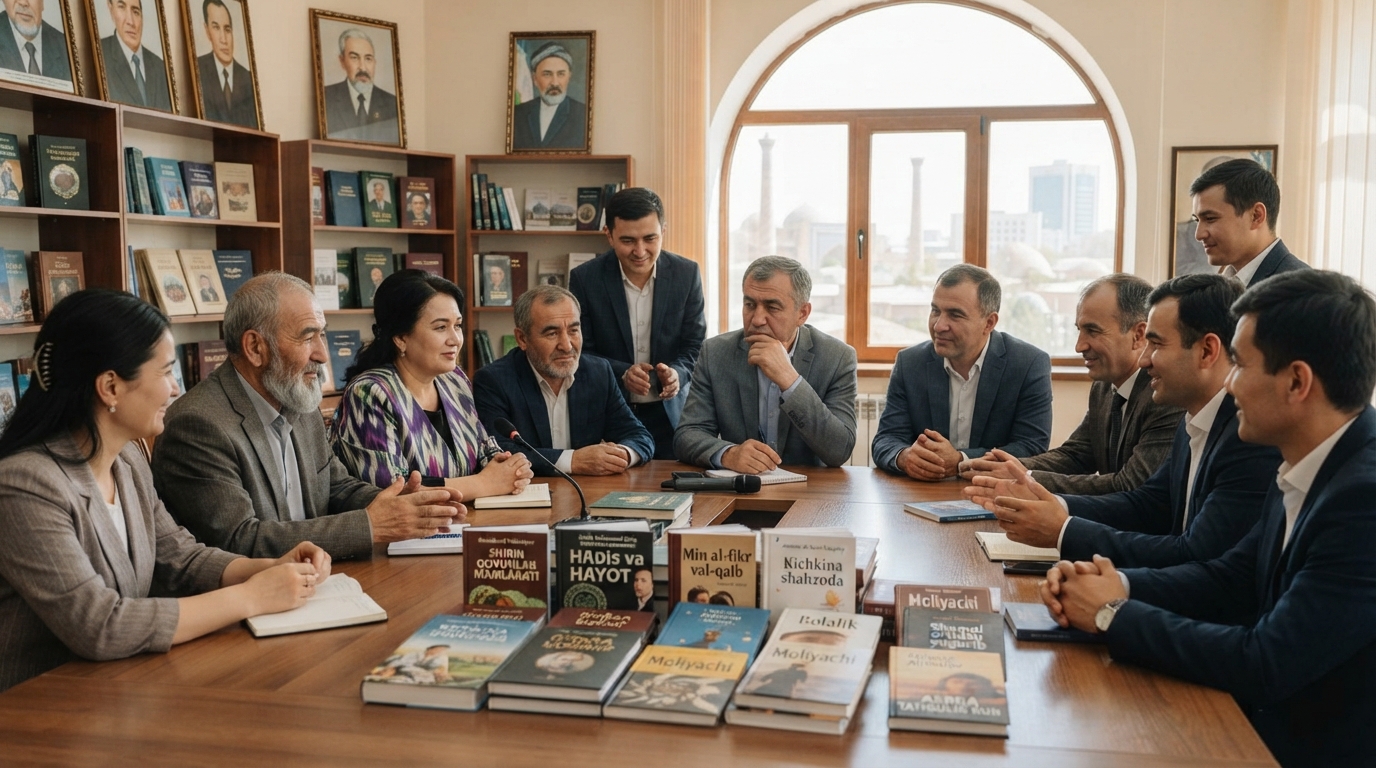
Book recommendations from 12 guests of the project “If only I had your youth…”
For a year now, Gazeta has been presenting the project “If only I had your youth…”, which offers advice to young people. Recently, its 12th episode was recorded. In the project, people respected by the nation — educators, scientists, political scientists, entrepreneurs, publishers, and financiers — recalled their youth and gave advice to today's youth from the perspective of modern times.
On the occasion of September 8 — “International Literacy Day”, we decided to gather the guests' answers to the project's question “Three books that influenced your life in your youth” on one page.
It is said that a person who wants to form a habit of reading should first start with a topic they like or a book that interests them. The first book is Khudoyberdi Tukhtaboyev's work “The Land of Sweet Melons or the Battle of the Wizards”. Although I read it in my childhood, I found it necessary to mention it because it was the work that awakened my love for reading.
The second is the collection “Hadith and Life” by Hazrat Sheikh Muhammad Sodiq Muhammad Yusuf. I read it even before it was published. When we were living in Libya, Hazrat was writing this book. I was on the verge of graduating from university, and he gave me the chapters “Janazah” (Funeral) and others, asking me to check them. I cried while reading the stories and conclusions about those who passed away with honor in the “Janazah” chapter.
Inside, there were examples from the lives of some companions of the Prophet. Their purpose in life, their honorable lives, and especially the beautiful end of their lives caught my attention. Every time I recall that emotional state, I keep thinking that a person should really pay great attention to how their life ends. That is why the most beautiful part of deeds is said to be the end. If it ends with goodness, it means your whole life was beautiful. If it is the opposite, God forbid, this is considered a very big loss for a person.
The third is the book “Min al-fikr wal-qalb” (“From the Mind and Heart”) by Imam Buti, may Allah have mercy on him. During his lifetime, Imam Buti was one of the great scholars who served as an example to many with his loyalty to the homeland. The books he wrote also gained great fame in the Islamic world. Some topics in the book “From the Mind and Heart” are intellectual, and some are emotional. From it, you will learn how to manage intellect and emotion, which are among the strongest aspects of a human being, the balance between them, and relevant topical issues.
I read this book on Hazrat's recommendation and was very impressed. I can say it is my most interesting and favorite among the books I have read so far. In particular, it would not be a mistake to say that the author's elegy titled “Amira”, written for his wife, serves as a great example of how much Islam, a Muslim, and a person of knowledge elevate and value a woman.
There are also books that played an important role in specific situations. During the independence period, I was in the 8th grade. My father brought home the book “A Thousand and One Hadiths” when it was published. Reading it, I understood for the first time that religion and our customs are different things.
According to custom in our society, there is a view that a girl must marry whoever her parents approve of. In that book, it was stated that the consent of the daughter is mandatory for marriage. Then the conclusion arose that “so, religion and custom are different things, and such a thing exists in religion,” and this can be called the book that caused me to know myself and choose my path.
The next is Abdul Qadir Jilani's book “Understanding Divinity and Attaining Merciful Grace”. Abdul Qadir Jilani was a sheikh, a man of very strong knowledge and faith. It turns out that his lectures during every Friday prayer were collected and written down by his students. Although it was published in 2010, I still read it over and over again. Every word of his can be made into an aphorism.
Furthermore, besides books, there are also people in a person's life who cause them to determine their path. I also had two teachers. May Allah have mercy on them, both have passed away. One of them was my academic supervisor, Aziz Jurayev. He made a great contribution to my choice of field; moreover, I learned how to be a researcher by looking at this person. He was an extremely honest person in terms of both science and money.
If I am not mistaken, in 2000–2004, he was the director of the Tashkent headquarters of Radio Liberty. At that time, the rector was against his leaving the university. When he said, “No, my salary is not enough,” the rector replied, “If you want, we will make money for you from the admissions process.” The teacher left, saying, “I am used to earning my bread honestly.” He was so honest that I couldn't even give him a gift from the bottom of my heart as I wished. His attitude towards science, students, and society played an important role in shaping my life principles.
The person who introduced me to my first specialty and profession was Abdumajid Pulatov. He hired me when I had just finished my master's degree. He stood out among the scientists I had seen until then for his simplicity and his closeness to students and the younger generation. He was an extremely optimistic person, always in high spirits and joking. Looking at him, I came to the conclusion that “yes, so the things my heart is inclined to are not so wrong.”
In my opinion, such personalities play a more important role than books in a person finding themselves.
If we take our youth, Dale Carnegie's book “How to Win Friends and Influence People” had an impact. Before that, I was an introvert and did not talk to people. I started talking after this book.
Oybek's work “Childhood” also had an impact. Reading about the severe hardships of the 40s, I became much more grateful for my own life.
After the 7th grade, I suddenly started reading a lot of books. From Uzbek classics like “Starry Nights” to “Days Gone By”, from “The Count of Monte Cristo” to “One Hundred Years of Solitude” and “Chronicle of a Death Foretold”. There was even a time when my father got angry and scolded me, saying, “Are you just going to lie around reading books, who is going to do the work?” I remember that. Therefore, there are no three specific books.
When you are young, society determines what kind of books you read. Most people read those books voluntarily or involuntarily following the direction mentioned and shown by the readers around them. For example, we all praise Uzbek classics, and they are read. Then, gradually, you become a personality and start choosing books yourself. And you begin to know which book is not yours and is not worth your time.
The period when you start choosing books yourself and enjoying them, rather than society doing it, is different. When you reach this point, you can be called a professional reader. Now people start listening to you, asking what books they should read. If we tell young people to look for this point, in my opinion, it would be right.
In my youth, during the formation period, I used to think a lot about how I should be, who I actually am, what I like, what I dislike, and how I should behave. And, unfortunately, there were no shows like yours. There was little information about people who had found themselves in life.
The book that influenced me the most in my youth was a book collecting Uzbek folk proverbs. If I am not mistaken, it was in two volumes, and I read it a lot. Through those proverbs, I tried to study the Uzbek mentality and worldview. In our proverbs lies our life experience gathered over centuries, and how morality should be was also expressed.
The second book is the work “Qabusnama”, consisting of Kaikaus's letters to his son. This book, which has educational value, helped me get answers to my question of how a person should be.
The third was the 19th volume of the “Hadith and Life” collection, titled “The Prophet, a Mercy to the Worlds”, written by Sheikh Muhammad Sodiq Muhammad Yusuf. In it, the biography and history of our Prophet are very well covered. Of course, it is impossible not to be moved by this and not to take lessons from their life.
Because during his life, there were no hardships that our Prophet did not experience. If each of us is experiencing some kind of hardship in our lives, all of them also passed through the head of our Prophet. How those around them, the companions, and the wives behaved and how they got out of these situations also serves as an example for all of us.
There is one book — “The Little Prince”. I read it every five years, and each time I understand it differently. The impact is always different. My becoming an entrepreneur was influenced by Theodore Dreiser's “The Financier” and Dostoevsky's books. Rumi's book “It Is What It Is” (Fihi Ma Fihi) was the reason I was able to find myself. In business, too, there are books for every level. If you read a lot, you can find them. There are books to be read by someone at 20, someone at 30, and someone at 40.
But there is no such thing as “if I read just one specific book, that's it, my life will change.” Let's say, when I was depressed and in debt, I read “Tarixi Muhammadiy” (History of Muhammad). This book makes a person so positive; you read it and say, “Wow, we are living, our stomachs are full, our parents are alive, no one wants to kill me, there are no obstacles for me from morning till night.” But if you read this book when you are not depressed, just for reading, it might seem like a simple story to you.
I must have read more than 500 books so far. Each one leaves some kind of trace. Even a single word can leave a trace. Since Dostoevsky, Nietzsche, and Kant were not translated into Uzbek in our time, we read them in Russian. We kept reading both Eastern and Western philosophy. In psychology, Milton Erickson, Virginia Satir, Freud, Adler, and others had an impact. They have not been translated for us yet. Many young people know English and can read them directly.
We have some psychologists now who blame someone else, saying, “Your problems are not your fault, they are your parents' fault.” Freud also pursues a similar philosophy. But Adler gives the philosophy that all your problems are yours, life is yours, everything is in your hands, and you can change them. A person can study themselves and change their life. And they must connect their soul with God. Everything is in His hands. Therefore, not just a book or a single book will influence your life.
Young people can just go onto Amazon, select the top 50 books, and read them. But many make one mistake: they start several books at the same time. If one takes one book and reads with small steps — saying, “I read five pages today, seven pages tomorrow, I am a 'good job', today I read 10 pages, I will go and eat a lavash, if I move to 20 pages, I will get my favorite sweet” — and reads by encouraging themselves, it will turn into a mountain of books. If you are better today than yesterday, you should get yourself a reward. If you repeat yesterday's life, you have no right to enjoy anything, even a little.
Khudoyberdi Tukhtaboyev's work “Riding the Yellow Giant” got me interested in reading books. Its language was so understandable and light that its expressions and phrases entered the conversations between me and my siblings. Later, I read all of the writer's works.
After my childhood period, which was thirsty for adventure, passed, “It is Difficult to Become a Human” had a strong impact on me in my adolescence. I started it and finished reading it without sleeping all night, unable to take my eyes off it.
There is actually such a period: you read continuously with interest, then for some reason, you drift away a little. I came to Tashkent to study. Our library remained in Kokand. In practice, even sitting in one place is difficult; we go to dance, we run, we do pantomime, we go to fencing — with all the hustle and bustle, I read a little less.
Even if we could finish the plays in the textbook, it was a big deal. We had to read 80–100 books for each subject, including Uzbek, Russian, and foreign literature, plus the history of these three literatures, with plays corresponding to their era. Therefore, I stopped choosing and striving for fiction books on my own.
I got married, and it turned out there was a library at home. I married into a family of writers and journalists, such as San'at Mahmudova and Bekmirza Mahmudov. They used to collect all the books they read. Here I discovered George Sand. She didn't have small books; they were all multi-volume, heavy, and thick. When I put them in my bag, those next to me would say, “Why is it so heavy?” I would read them in the metro, on the bus, wherever I had a little free time.
George Sand opened romantic literature to me. Then it connected to Hugo and Dumas. Since I had already read most of Uzbek and other sister literatures, Arabic, and Turkish literatures by then, I plunged into Western literature. I discovered many good works.
Then the Afghan writer Khaled Hosseini's “The Kite Runner” fell into my hands.
It was the first time I read a work about Afghanistan and its decline written by an Afghan person themselves.
No matter how hard a person writing from the outside tries, they interpret it to suit themselves. During the Soviet era, when the Afghan war was going on, we used to hear things like “Afghanistan is like this, Afghans are like that, they are bad.” Later, this thinking of mine changed by 180 degrees. I realized that they were defending their homeland, and the Soviets were invaders.
That is why I enjoyed reading what the Afghan writer himself wrote. Because I thought he wrote truthfully about his homeland and people. He acknowledged the good sides and did not hide the bad ones. My respect increased for his objectivity, and I read his other works as well. I remember my youth with these works.
In fact, one must always read to think. An intellectual person is not called an intellectual for nothing. There is light in their soul, thought, and eyes. Through that light, they illuminate society and its ills. They have a pain, a word to say to people, and their own civic position. Any creator must be able to lead people behind them. They must stand ten times higher than their society and those in other fields.
If you, as an actor, have not read more books than your audience, or if a teacher who is educating does not know more than their student, decline gradually begins. I say, thank goodness there are people who think about life, write books, write poetry, or enjoy music; they are the ones saving this life.
Why do some people read books with pleasure, while others fall asleep or get bored immediately? Reading books depends on imagination.
If you have an imagination, you see not a combination of letters in a book, but the event that arose through those words and sentences.
Everything the writer says passes before your eyes like a movie. If your imagination is poor, you only see letters.
In fact, one must read so that this imagination appears and becomes strong. You don't become great all of a sudden. You just keep reading, keep reading, and after reading ten books, you will be surprised yourself. For example, after you were born, walking was a necessity for you; because you couldn't sit without walking for a lifetime, you started walking. That's why this process didn't seem difficult. If reading books and gaining knowledge also becomes a necessity, performing it will not seem difficult; on the contrary, it will become an inseparable part of your life.
The books that influenced my life reached me not in my youth, but when I was a bit older. In my childhood, the book “History of the Homeland in Pictures” was the first to amaze me. I bought it from a store when I was in the second or third grade. Stories about Tomiris, Shiroq, Spitamen, and Muqanna are reflected in pictures. Shiroq's battle and Spitamen's struggles are shown in illustrations. This book got me interested in historical works. Thinking “so this is what our history was like,” I became interested in and read about the Ashtarkhanids, Sasanids, Samanids, Manghits, and, of course, the Timurids.
The second is Khudoyberdi Tukhtaboyev's work “Riding the Yellow Giant”. Until this book fell into my hands, I had only read fairy tale books. In the elementary grades, I thought children were not allowed to read big books. But there were many books in our house; I would take them, unable to go beyond one page, and switch back to fairy tales. One day, “Riding the Yellow Giant” fell into my hands, and I read it without stopping. Thus, this work opened the way to fiction books.
The third book that influenced me greatly in my youth was Chingiz Aitmatov's novel “The Day Lasts More Than a Hundred Years”. If I am not mistaken, I read it when I moved to the upper grades. Because it was difficult for me to understand, I would read each page three times. At that time, my amazement grew when I saw that he used words like “qazoyi qadar” (destiny), which are hardly even used in modern Uzbek jargon. For this, I must also give special thanks to the translator (translated from Russian by Asil Rashidov — Ed.).
I learned through Chingiz Aitmatov and Dostoevsky that a person's thoughts can be put into a book. Our great writers build their works on dialogue; the lifestyle, who the characters talked to, or situations like the times and circumstances are covered.
In “The Day Lasts More Than a Hundred Years”, however, putting aside the ideology and system of that time entirely, the human factor and the putting of human thought into a book completely amazed me. It is written about a small village. In the scenes of Kazangap being taken to the grave, the fact that a rocket site was to be built there, and other scenes, I saw that thoughts could be put into such an interesting work that people would read.
“The Day Lasts More Than a Hundred Years” is a work that taught me to choose books. Before that, I would read whatever book fell into my hands. After this novel, I started choosing old, worn-out works by foreign writers in the library. Later, as I grew older, I became even more precise in this matter.
I did not have such a limited number of books, and I have a strong suspicion that nothing changes completely after any single book. But after every single book, of course, there is a change. Just not to the extent of influencing your life. One book changes you a little, the next book a little more, the next one a bit more, and their combination influences your life, who you are, your personality, and the decisions you make.
There is also a view that “one work changes a person, but to find that one that changes you, you have to read hundreds of books.” My opinion is slightly different: one work does not change you; after reading 100 books, when you come to the 101st, the result of the experiences gathered one by one from the previous ones can be felt.
For a person to be able to feel someone else and to have a sense of justice inside, they still must have read many books. I do not believe in books that are not divine, but created by humans, that suddenly change someone. As books that influenced me for a long time during my school years, I can mention Franz Kafka's “In the Penal Colony”, “The Metamorphosis”, and Gabriel García Márquez's “Chronicle of a Death Foretold”.
In my childhood and youth, I just kept reading the books that fell into my hands one after another. The first big work I read was Parda Tursun's novel “The Teacher”. I read it for three days. Then a bigger work was Georgy Tushkan's novel about the Kyrgyz, “Jura”. Then I read Said Ahmad's “Horizon”.
I had started with big works on my own. Stories would end quickly, and then when a new story started, I didn't like entering a new character again. I wanted to live longer inside one novel. When two or three pages were left, not wanting to finish it, I would close it for a day or two, think about it, and then read it. And I took something small from every single book.
One of the books that influenced me the most and that I loved is “The Little Prince”. “The Little Prince” helped me better understand interpersonal relationships, find a friend, and realize how important it is to cherish a friend.
I actually have a top ten books that I teach my students: “Days Gone By”, “The Iron Woman”, the story “Poincaré”, “The Little Prince”, Aziz Nesin's stories “The Terrible Dream”, “A Thousand Thanks”, “If”, Shukur Kholmirzayev's story “The Teacher”, and Toghay Murod's novel “Fields Left by My Father”. That is, so that children can analyze who they are, which nation they represent, what to do as an Uzbek, and which values to preserve. True, there are also stereotypes that cannot be accepted as an Uzbek and need to be changed. But there are also traditions that must be preserved as a nation.
Another of my favorite books is the work “The Year of Otoyin's Birth” written by Erkin A'zam. My teacher Dilmurod Quronov gave it to me to read when I was studying for my bachelor's degree.
This is a story of outspokenness.
It is about a boy named Asqar, who says everything bluntly and gets into trouble and faces problems because of this.
My teacher, perhaps, gave it to me so that I would conclude that I would suffer like this Asqar. But it had a different effect on me. That is, no matter how bad his nature is, no matter how bluntly he says everything, without trying to compromise with people, struggling to impose his opinion, in the end, he finds a girl named Rakhshona who can accept him as he is.
I concluded that although I am being outspoken now, let's say, telling the truth to people's faces and making enemies for myself, even if many people dislike me, one day I will meet someone who will accept me as I am, with this nature of mine.
My late father used to say, “The point is not what you read, but what kind of conclusion you draw from it.” And whenever I have my students write about works, I always ask the question of what conclusion they drew from the work. They write up to three or five conclusions. A book should give you good conclusions, be able to answer the questions inside you, or, on the contrary, eliminate the questions you have.
When I was going through difficult times, I read Dale Carnegie's psychological books. They taught me to get out of depression, to stand tall, and to be patient. The second is the book “A Bouquet of Wisdom” that I took from my late father. It turns out my father carried this in his youth and left it to me as a legacy. It was always with me during my studies and work in Europe. The whole of life was inside it. I took a lot of things for myself, thinking, “so, such scholars and philosophers said this,” and I used each of them in my subsequent life.
The third is the book “My Life” by former US President Bill Clinton. In it, Clinton wrote down his entire life. I was in Finland then, and wanting to write a book too, I opened a page and started writing under the exact same title. In that book, I am describing everything from my youth, my entry into university, to my life today: stumbles and rises, good and bad, betrayal and loyalty.
Later, I started reading books on Islamic history. They are also changing my thinking. The thought arose that there were obstacles for prophets too, there were oppositions to them too, but I am an ordinary person, so I should look at these as ordinary things. This conclusion helps you get through all the obstacles in your life.
The interview will be published on our YouTube page on September 9.
Separating books is very complicated for me. In childhood, adolescence, and youth, both their types and genres differ. Speaking on the basis of these, the first is Shukrullo's work “Buried Without Shrouds”. The second is Aleksandr Solzhenitsyn's work “The Gulag Archipelago”. This is a very heavy book, all the events inside are real, nothing is made up. Perhaps, a person must be mentally very strong to read it.
There are such works: you read one or two pages, and closing it because you cannot find mental strength in yourself, you can find the strength to read that book only after two or three years, having been tempered in various aspects of life and having seen its ups and downs. Both of the above belong to the category of such works.
The third work is Abdulla Qodiriy's novel “Days Gone By”. But actually, there are many books that influenced us in our youth. I can also mention Leo Tolstoy's novels “War and Peace” and “Anna Karenina”, and all the works of Dostoevsky, Chekhov, and Abdulla Qahhor. Our Sheikh's “Hadith and Life” collection, as well as Ahmad Lutfi Kazanci's “Stories from the Age of Bliss”, are also among my favorite books.
I read Oybek's novel “Sacred Blood” when I was 12 years old; I was very deeply moved, and it still stands on the list of my favorite books. It is valuable because it beautifully describes Uzbek traditions and shows the negative effects of the wrong traditions of that time on the lives of young people; you perceive this differently the more you read it at any age.
I can also mention Antoine de Saint-Exupéry's work “The Little Prince”. If a person reads it every ten years or every five years, they perceive it differently. There is also a very big meaning in the part about putting one's planet in order. For a person to be able to understand someone else, they must first of all be able to understand and clean up their own mind and thoughts. Before there are negative criticisms towards others, one should think in the sense of “What do I actually want, maybe I misunderstood.”